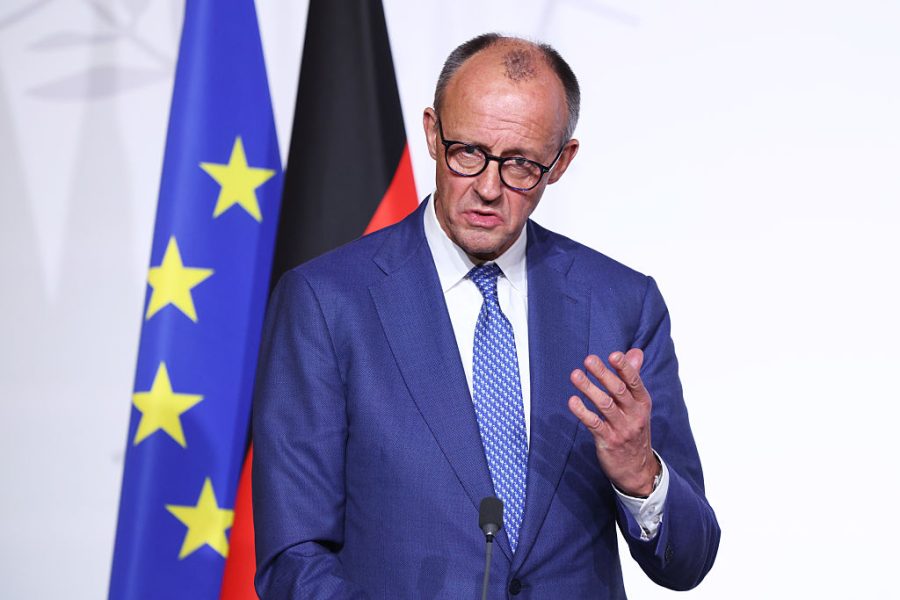
Nine months into the chancellorship of Friedrich Merz, the outlook for Germany looks grim. The country’s economy, the world’s third biggest, has been in recession or stagnation for the past three years as its leaders confront the worst economic crisis since the 1950s. Damningly, portions of the German press have accused Merz of presiding over an ‘economically lost year’.
Last year’s data makes for tough reading: industrial production was down 1.3 per cent and large corporate bankruptcies up 25 per cent. In the first six months of the year, 109,000 manufacturing jobs were lost. 48,000 of these were in the battered car industry which has a 24 per cent share of total industry revenue. The few rays of light were German arms producers like Rheinmetall and drone start-ups – but arms-making represents just 0.6 per cent of the country’s industry revenue.
Only two areas saw solid German ‘growth’ last year: electricity costs and government spending. Germany now has the highest domestic electricity prices in the developed world. Meanwhile, government spending rose to 50.4 per cent of GDP.
Yet you wouldn’t think there was an economic emergency demanding big answers thanks to the timid tinkering and social welfare and tax gifts Merz bestowed on the country last year. Merz’s Christian Democratic bloc and its Social Democrat (SPD) junior partner are a poor match for getting things done. Traditionally bitter rivals, former chancellor Angela Merkel normalized such coalitions between the parties. Merkel moved the Christian Democrats to the left while the SPD, once the party of workers, has shifted to being the advocate of welfare recipients and migrants.
The decay in the country is becoming increasingly visible
So far, there’s scant evidence that Merz has the stomach for an epochal battle with the SPD and parts of his own party who are resisting the root and branch changes needed to fix the German economy. Merz’s biggest defect is that he lacks a killer instinct to use his power to get things done. Past Christian Democratic chancellors including Merkel, Helmut Kohl and Konrad Adenauer, had this in spades.
Germany has been here before. At the start of the century, it was labelled the ‘sick man of Europe’ as it struggled to catch up following the reunification of the country in 1990. Unemployment hit nearly 12 per cent and there were two years of economic contraction. Then SPD chancellor Gerhard Schröder responded with radical reforms of social welfare and labor law, dubbed the ‘Agenda 2010’, which are widely credited with resurrecting the economy.
But this time, things are different. The country has fallen behind international standards, including in gene technology, AI and nuclear after the closure of all German nuclear power plants. Meanwhile, Germany’s old champion industries – automotive, mechanical engineering and chemicals – are struggling.
Full figures for last year aren’t yet available but in 2024 almost 200,000 companies in Germany went out of business – the highest figure since 2011. Even more striking was that 4,050 large companies partially closed German operations, often to relocate their production abroad.
Against a febrile international backdrop, Merz arguably faces the largest challenge of any German chancellor since 1949 in pulling the country out of the quagmire it is in. Foreign affairs will make that job much harder. The conflict in Ukraine and Russia’s acts of hybrid warfare across the continent have forced Berlin to rapidly inflate its military spending. Merz must get Germans to think the previously unthinkable and realise that in the era of Donald Trump, Berlin is damned to play a lead role in Europe’s defense. Further east, China has transformed from a bottomless pit for German exports into a brutal global competitor that can beat the prices and increasingly the quality of almost everything that Germany excels in. The country’s one-time partnership with China has soured quickly.
Back at home, sky-high electricity costs – more than double those in the US – mean that Germany has scant chance of enticing power-guzzling AI companies. The state-mandated closure of nuclear power plants is to be followed by shuttering coal-fired power plants. This sequencing is bizarre. The last three of Germany’s fleet of CO2-free nuclear power plants were shut in 2023. Nuclear once supplied 30 per cent of German electricity. But filthy brown coal plants, like Jänschwalde in southern Brandenburg, are still open. It has been running full blast all winter as night temperatures fall to -16 celsius.
Meanwhile, wind and solar get massive subsidies paid for by electricity consumers. Germans have forgotten that cheap energy is key to their economic success. The only fix would be a quick return to nuclear power. But it’s too late. Electricity is hardly more reliable: Berlin’s almost week-long power outage at the start of the month cut off 45,000 people, after a far-left group attacked the power grid in an act of protest. Energy needs to be cheap, clean and dependable. Germany is currently failing in all three areas.
If this weren’t bad enough for businesses, they are being smothered by high taxes and they respond with low investment rates. Germany’s effective corporate income tax is currently 28.3 per cent – far above the reported EU average of 19 per cent. One product of this is that net corporate investment in Germany measured as part of GDP has plunged just to 2 per cent per year, down from 15 per cent in the 1960s. Companies have been investing profit abroad, as opposed to ploughing it back into the German economy.
The economy is also suffering from a collapse in labour productivity. The last time productivity peaked was in the 1970s: by 2022 it had become stagnant, falling into negative figures by the following year.
Merz’s economic troubles don’t end there. Germany has a pay-as-you-go state pension under which the contributions of current workers are meant to directly fund pensioners. But with people working fewer years, pensioners living longer and a projected shrinking workforce, the system is kaput. The federal government will this year subsidize state pensions at a cost of €128 billion (£111 billion). In 2029 this subsidy is projected to use up €154 billion (£133 billion) of the expected €428 billion (£370 billion) collected in tax revenue that year. But after handing out yet more pension goodies since coming to power in May, Merz’s answer to the probelm seems to be that of politicians everywhere: set up a study commission.
The decay in the country is becoming increasingly visible. Bridges are collapsing: in Dresden, one broke in half and fell into the Elbe River the year before last. In Berlin, a key bridge at a downtown highway junction was torn down following an emergency closure, causing traffic chaos. The backlog is massive – some estimates say as much as €5 trillion (£4.3 trillion) will be needed by 2045 to update the country’s infrastructure (and make it net zero compliant) – but nobody knows where the money will come from.
Even if funding is found, glacial construction speeds remain commonplace. Rebuilding a busy crossing for cars and a tram in the city of Potsdam, for example, was finally completed last month after six years of work. There is also a problem with the misuse of funds. The city of Berlin, which is essentially bankrupt with €64 billion (£55 billion) of debt and subsidised by the rest of the country, is planning a tree-planting spree that will cost as much as €4 billion (£3.5 billion).
Then there is the issue of uncontrolled migration. Chancellor Merkel opened Germany’s borders to migrants from Syria, the Middle East and Africa in 2015, allowing over 1 million people into the country in the ensuing year. Given collapsing German birth-rates, the country needs migration. And yet a debate is raging as to what kind of migrants one of the most advanced industrial nations in the world requires? Crime committed by migrants has risen sharply, official figures show. This helped feed another of Merz’s problems: surging support for the extremist right.
All of this would suggest that it may be too late to reform Germany. And yet, and yet
The far-right Alternative for Germany (AfD) party was set up as an anti-euro party but never gained traction on this issue. After 2015, it pivoted to being anti-migrant and saw its popularity soar. It came in second place in last year’s Bundestag election to Merz’s Christian Democrats. Some polls now show it in first place ahead of Merz’s party at the national level. The party is polling so high in the east German state of Saxony-Anhalt that it may get an absolute majority when the state goes to the polls in the autumn.
The AfD is anti-Nato, anti-EU, anti-euro, anti-US, pro-Russia and pro-China. Some of its members have been convicted of using banned Nazi slogans. Where right-leaning parties in Italy, France and the UK have moderated, the AfD, by contrast, is radicalising.
All of this would suggest that it may be too late to reform Germany. And yet, and yet. There is a caveat to all this bad news. Betting against Germany is like betting against the US: there’s a good chance you will lose. After 38 years in Germany, the one truism I’ve found is that when things are at their very worst, Germans rise to their very best. There’s still hope for the country as a powerful recognition sweeps through it that things simply cannot go on as they are – not just in the economy but also in issues of society and defense.
Merz is vowing to make 2026 the year of economic transformation. ‘The situation of the German economy is very critical,’ he wrote in a New Year’s letter to members of his coalition in the Bundestag. The Chancellor followed this by sacking his chancellery office chief. The replacement, Philipp Birkenmaier, is not just a party Svengali but also an expert on the Mittelstand, the small- and medium-sized company economic backbone that employs 53 per cent of Germans working in private industry.
Even the Lutheran church is changing. In Potsdam’s Friedrichskirche, a church built by the Prussian king Frederick the Great, Pastor Corinna Hentschel concluded the last Sunday service of 2025 with the example of the all-powerful King Herod, who died an excruciating death. ‘Even rulers who think they are omnipotent discover in the end that they are not,’ she said.
Leaving the church, I asked if she had been thinking of Presidents Putin, Xi and Trump. ‘I was a pacifist all my life,’ Pastor Hentschel replied. ‘But one cannot be that anymore.’
So, is Germany unreformable? No, most assuredly it’s not. There’s still a sporting chance to turn Europe’s biggest economy around. But time is running out. Merz must take radical steps and move quickly or it will be too late. This year is pivotal. Actions in Berlin will determine the state of Germany for the coming decade – and, by extension, the fate of Europe.



Comments