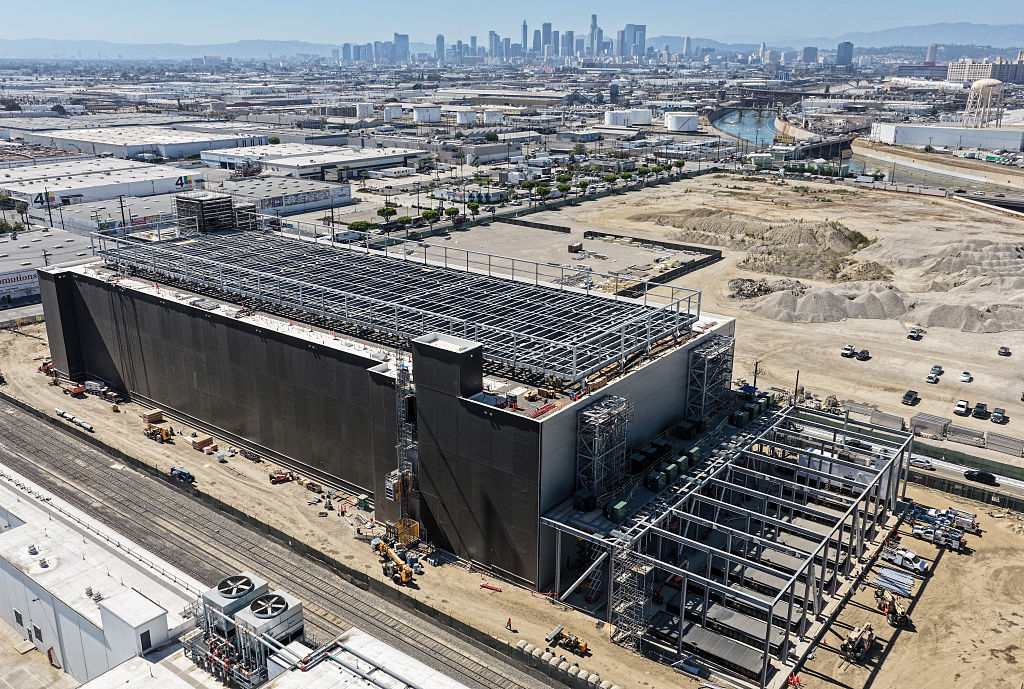
As June gave way to July, with a heat dome over the Eastern Seaboard, the US Department of Energy signed an order few people understood. It gave the region’s grid operator permission to do something that would have sounded simply deranged a decade ago. If the system came under enough strain, PJM – the body that keeps the lights on for 67 million Americans from Chicago to Washington – could order the great data centers of Virginia and Maryland to disconnect from the grid and run on diesel instead, so that everyone else could keep their A/C on. Any facility drawing 50 megawatts or more would have 15 minutes to comply. It was, said the order, a last resort before rolling blackouts. Secretary of Energy Chris Wright said keeping the power on was “non-negotiable.”
The blackout, mercifully, did not strike. Two days later, PJM forecast a peak of just over 166,000 megawatts, enough to break a record that had stood since 2006, and the grid held firm. But it is the near miss that is the story.
Something has changed – and quickly. For roughly 20 years, American electricity demand was flat: efficiency canceled out growth and utilities built very little. That era is over. Grid Strategies, a consultancy that watches these curves, now expects American peak demand to rise by around 166 gigawatts by 2030. A few years ago, the same five-year forecast was 24 gigawatts. It has risen sixfold and the single largest reason is the data center.
The artificial intelligence boom runs on electricity, drawn ceaselessly by vast halls of processors. In 2023, data centers consumed about 4.4 percent of American power; a federal laboratory expects that share to reach somewhere between 7 and 12 percent by 2028. On the more aggressive projections, data centers will account for roughly half of all growth in American demand between now and the end of the decade.

The real trouble sits upstream, in the electricity supply and in the wires meant to carry it. The line of new power plants waiting to join the American grid stands at over 2,000 gigawatts, more than the entire existing fleet, and only about one in seven of these projects is ever built, after a wait of some five years. New transmission lines take longer still, held up by permitting, litigation and the reliable objection of anyone who does not want a pylon near his house. Even the gas turbines you would build to burn on demand are back-ordered into the 2030s.
The data centers unsettle the grid by their behavior as much as their appetite. Built to protect their processors, they bolt onto their own generators the instant they sense trouble – one Virginia cluster shed 1,800 megawatts in moments last year. The June order only formalizes what the machines already do on their own, except that now the government decides when they unplug.
The other significant thing the state can do is to stop old plants closing. Since May of last year, the Energy Department has issued more than 40 emergency orders under a Depression-era statute, forcing coal and oil plants scheduled for retirement to keep running. The J.H. Campbell coal station in Michigan is the emblem of it. Due to close at the end of May last year, it has been kept alive by federal order ever since – though the regional grid operator never asked for it, and the state’s own regulator flatly declared that no energy emergency existed in Michigan at all.
But the trouble is that keeping half-century-old coal stations alive is not a real solution to the supply problem. The plants that can be built quickest, and that already fill the connection queue several times over, are overwhelmingly solar, wind and battery-powered – roughly 19 of every 20 projects in the line, and precisely the technologies this White House is least inclined to favor.
It’s an expensive business securing enough guaranteed capacity, and it is not the technology companies footing the bill. In the PJM region, the annual cost of securing capacity rose from $2.2 billion to $14.7 billion in a single year and the cost lands on the poor householder. Over all this hangs changing, more volatile weather patterns. The winter storms that struck Texas in 2021 and the eastern grid in 2022 killed more than 300 people between them – the fifth cold-weather grid crisis in 11 years. The man responsible for North American reliability, Jim Robb, CEO of the North American Electric Reliability Corporation, last fall characterized the mounting risks as “a five-alarm fire.”
None of this is uniquely American. In Ireland, data centers already consume around 22 percent of the nation’s electricity, the highest share in Europe, and Dublin was forced to freeze new grid connections for years.
This summer, as France endured its hottest weather since records began, EDF had to throttle back reactors because the rivers used to cool them had grown too warm. Everywhere the pattern holds: demand races ahead of the ability to generate and move power, and the physical world resists being hurried.
America is not short of power it might generate, it has simply lost the knack of delivering it
Britain has the same disease in a more advanced form, and without the compensating boom. It has the highest industrial electricity prices in the developed world, roughly four times what American industry pays – a fact that quietly strangles what remains of British manufacturing. Its line to connect to the grid has swollen past 700 gigawatts, four times what the country will actually need, with some projects paused until the 2040s.
The system operator has begun, sensibly, to tear the queue up and start again. But the position is stark: Britain is trying to attract the very data centers America cannot power, placing them on a grid that cannot clear its own backlog and racking up extremely expensive electricity costs.
The diagnosis, then, is not complicated, however uncomfortable to state. America is not short of power it might generate, but has simply lost the knack of building the things that deliver it. The queue, the pylon, the turbine and the permit are the binding constraints, and every one of them is self-inflicted. The remedy is correspondingly dull: reward firm power in the connection queue, build transmission across regions and stop retiring dependable plants until something dependable stands ready to replace them.




Comments