

It’s been more than a week since Sean Egan, a manager at Morrisons in Aldridge, announced that he’d been sacked just for doing his job – for stopping a thief nicking booze – and national outrage over the whole affair is still running high. Sean is on morning TV as I write, donations to pay for his appeal rising steadily. In part, the fuss is a measure of sympathy. Sean worked at Morrisons for 29 years and was liked by the people of Aldridge. He was sacked, the supermarket says, because it has a ‘deter, don’t detain’ policy – though what it thinks could possibly have deterred this thief, given his long list of previous convictions, is anyone’s guess.
But the feeling for Sean isn’t just a swell of support for one man; it’s also a symptom of wider frustration. Shoplifting across the nation is at the highest level since records began two decades ago. Do nothing, we’re told, leave it to the police – but they also do nothing. And this is really why Sean’s story has hit a national nerve. British people have watched the norms we grew up with unravel in just a generation – the old taboos lift like mist, against stealing, littering, yelling abuse. In February this year, half of all people polled admitted to dropping litter on the street. Yet we’re told, like Sean, not to act, to leave well enough alone.
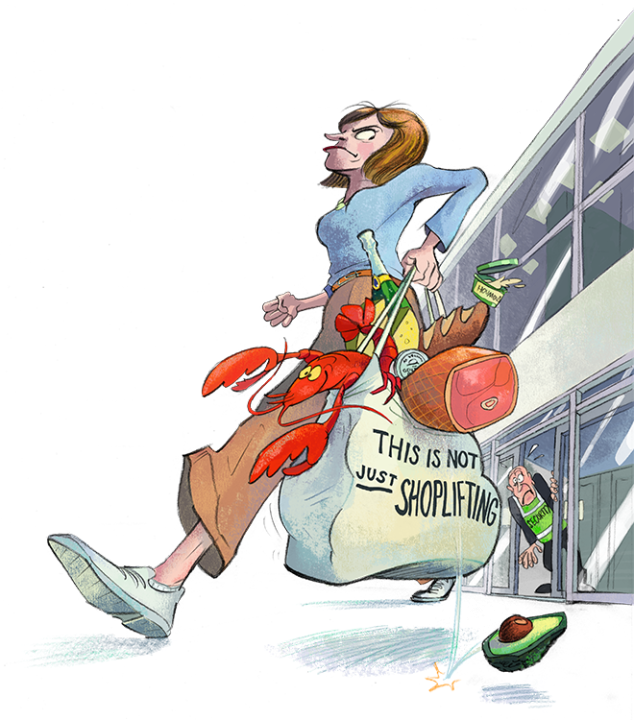
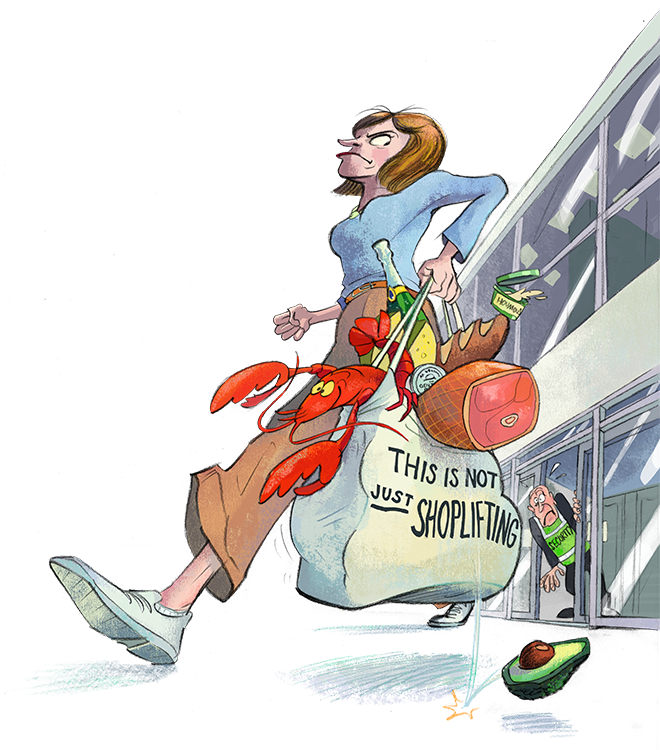
There are more violent crimes than shoplifting, but because we all shop and because we see it around us, it’s especially corrosive. Shoplifters are committing a record number of repeat offenses, the Center for Social Justice has revealed: an average of nine offenses per shoplifter. These people are escorted out nicely – ‘deterred’ – then in they come again, entirely shameless. And because the consequences are so negligible, all manner of different groups have got in on the game.
British people have watched the norms we grew up with unravel in just a generation
There are the petty crooks and addicts, like the Morrisons man. Keep an eye out and you’ll see them filling their rucksacks. Security sees them too but no longer makes much of a move to stop them. They also target middle-class stores like Marks & Spencer, whose retail director explained recently the daily battle faced by staff: ‘In the past week alone we have had gangs forcing open locked cabinets and stripping shelves, two men brazenly emptying the shelves of steak and walking out, a large group of young people ransacking a store before assaulting a security guard, a colleague headbutted trying to defuse a situation and another hospitalized after having ammonia thrown in their face.’
On a different part of the high street, there are the steal-to-order gangs, after trainers, electronic and designer goods. My ten-year-old was in the opticians recently when a man burst in, smashed the glass case beside his face and scooped the designer frames into his bag. The optician’s assistant didn’t flinch. ‘It happens twice a week,’ she said, ‘especially when there’s only one of us here. They’re always watching.’
Since the free-for-all days of Black Lives Matter, no protest in a British city is complete without a little looting. It’s thought of as a sort of going-home present, a thank-you for attending. Protests over Gaza now often include a spate of thievery, though should protestors ever find themselves governed by Hamas, they might soon not have hands to shoplift with.
The old shoplifting debate used to be about need. Was it wrong to steal food for a starving child? But food, as a proportion of income, is now far cheaper than it used to be and a sizable part of the shoplifting epidemic in both Britain and America is just for middle-class kicks. Some 15 years ago I wrote about what seemed to be an emerging trend for professionals pilfering, and about a friend of mine who regularly stole from Waitrose for reasons even he didn’t quite understand. Now there are TikTok accounts where young Brits challenge themselves to steal the most in a single visit.
The New Yorker’s star columnist Jia Tolentino said this week, in conversation with the internet personality Hasan Piker, that she felt just fine about shoplifting – or ‘micro-looting’ as she put it – from evil supermarket chains. For Piker and Tolentino, and for a considerable proportion of their fans both here and in America, shoplifting is now not only OK but admirable, a form of activism, a pushback against capitalism.
Online, the reaction of Gen Z to Sean Egan’s efforts to stop a thief was more often disgust than respect. ‘Oh, no!’ (This is a real comment.) ‘Someone is stealing petty merchandise from a multi-million-pound chain that pays me just slightly over minimum wage! I must stop them!’
The same twenty- and thirtysomethings, who without turning a hair pay £4 for an oat matcha latte, justify helping themselves on the grounds that they’re Robin Hood figures taking from the oppressor and giving to the oppressed – which is themselves, of course, because that’s how they identify. Tolentino would never steal from independent shops, she says, though she must know that it’s those evil low-cost supermarkets where the real poor shop and where prices rise as a result of all the thievery.
The steady drip-drip of shameless rule-breaking acts like acid on society – on our sense of a shared and fair public space. But spare a thought for the supermarkets too, which are themselves in a bind. The police have long since given up on shoplifting, since it costs far more to properly police a supermarket than they’d ever save by stopping stealing.
It’s the same dilemma faced by Transport for London or any company running transport in the UK. Twenty years ago, fare dodging was relatively rare. Remember the outrage over dodgers on London’s short-lived bendy buses? Free buses they were called. These days, all manner of Tubes and trains are considered ‘free’. Regular commuters have become used to the sight of quite ordinary people hopping barriers or pushing through saloon-style gates behind paying customers. The Docklands Light Railway (DLR) is known as the ‘Free LR’.
So why not more CCTV? Why fewer inspectors than in the days when there was less crime? The answer is that it costs far more to employ the inspectors than would ever be recovered in penalties. TfL already spends more than £20 million enforcing fare payment but recovers just over £1 million. It’s not worth it. Like the supermarkets, it can’t afford not to let people get away with it.
But here’s where the dilemma becomes a sort of paradox. The more freeloaders there are, the closer everyone else comes to doing the same. We’re like those 2p pieces in a classic coin-pusher arcade game: all of us just holding together on the top shelf – more likely to topple with every new round.
This year, London and the UK have been the subject of angry debate between liberal optimists and the prophets of societal collapse. Is it hellish here (Yookay) or still civilized, the envy of the world? The truth lies somewhere between the two. London hasn’t fallen – but it feels very much as if it’s hanging in the balance. True, violent crime and homicide are down, but a new sort of low-level violence seems to be rising – violence for the sake of it, Clockwork Orange-style.
Earlier this week, on Stamford Hill, a group of boys of about 15 were idly hurling stones at cars and passing cyclists. They wouldn’t appear in any stats. No one even paused to tell them not to. Who’d dare? Twice I’ve nearly come a cropper as the same kids yell at me as I bike by or they jump into the road in the hope that I’ll fall.
Hunting vulnerable schoolchildren also seems to be a new spring sport. The Nextdoor app, usually chock-full of lost cats, contains a spate of mothers reporting that their kids are being followed as they walk home, and beaten up, and that there’s no one to turn to for help. The schools shrug, the police shrug, and woe betide anyone who tries to hold an offender’s parents to account. If you returned from the encounter unhurt, you’d soon find yourself formally accused of harassment.
The more freeloaders there are, the closer everyone else comes to doing the same
The decline of the Marquess estate at the bottom of my road, where in 2015 the teenager Stefan Appleton was stabbed to death in the playground, is in many ways telling. A friend of mine in her seventies, who grew up on the estate and brought her children up there, explained it to me. The estate is arranged in three layers of flats all surrounding a central green. It used to be, said my friend, that the older generation, the grandmothers, lived on the top floors and they’d sit out on their balconies and keep their beady eyes on how everybody behaved. Any bullying or truancy and they’d have a word with the parents. Public shaming worked.
After right-to-buy and later, after migrant families were moved in, the self-policing fell apart. The cockneys, my friend among them, moved east, and in the absence of elders, the norms themselves began to change. Within each cultural bubble perhaps conventions held. But the shared ethic, learned by children in schools, was that their duty was not to their neighbor but to themselves and possibly the planet which their neighbor was likely polluting. They learned that all stigma must always be lifted and that the gravest sin was to judge. Then smartphones took over and the idea of a shared public space fragmented further into a frogspawn of private spaces.
If Britain is shameless, it’s because shaming – meaning expressing disapproval of any public behavior – has become not a virtue but the cardinal sin. Just a few years ago, it was quite normal to tut over flagrant violations of our unspoken code. If someone was having a loud one-sided phone call on train, or talking through a movie, or sitting scrolling on a bus while a frail octogenarian stood nearby, or dumping their chips by the bus stop, they’d be tutted at. Just imagine doing that now. You’d be thumped, derided as a ‘Karen’.
‘Loyalty, integrity, community’, read the banners in support of Sean Egan. The movement behind him is still growing and, sensing the way the wind blows, several MPs and the head of the Met and other big supermarket chains have now said they’re on Sean’s side, and that the thieving has to stop. Perhaps everyone’s beginning to understand that if Britain is to end its slide into shamelessness, we need all the Karens and all the Seans we can find.



Comments