Cecily Brown, like pop art, moved from Britain to America and found an audience. Picture Making, her new show at Serpentine South Gallery, is a return to the country of her birth – her first solo exhibition here since 2005.
Brown has steered clear of art movements. But she has a reverential attitude toward art history that keeps her work from identifying with recent genres of painting that have tried to escape either subject or materiality, or that have tried to collapse the space between painting and life. The subjects she recycles from art history are, as a rule, more interesting than what she drags up when she mines her personal life – though these two species of source material overlap in the worst way when the ghost of Francis Bacon, by whom she decides to be haunted occasionally, rears its head.
This art-historical strong suit, however, is often leaned on merely to facilitate dull realism. Contemporary British life is the subject – or rather a midle-aged bohemian vision of it. Sex and death are her big themes – and, less overtly, work. Sex is good albeit frightening; death is frightening and to be dwelt upon; and hard work is its own reward. As can be seen from the works painted after Bacon – ‘Couple’ (2003-2004) and ‘Untitled (Boating)’ (2021-25) – Brown is more sex-positive than transgressive. Bacon’s effect on Brown is that of a wilfully certain person on an ambivalent one; he makes her fawn, and in so doing she forgets to represent her own deep ambivalence, the lack of which one feels constantly in Bacon’s work, and the presence of which accounts for her best.
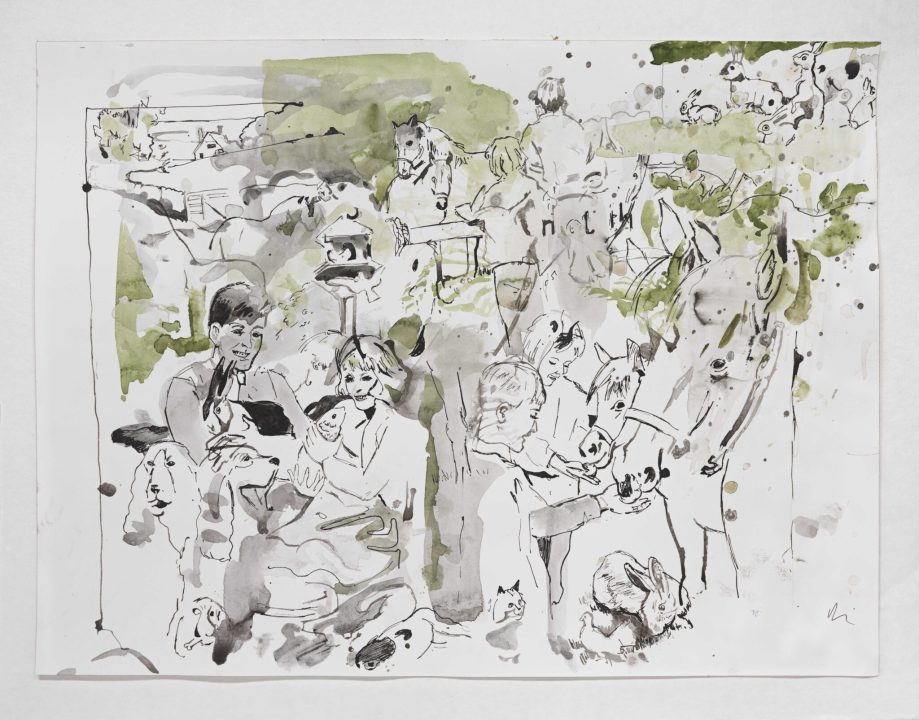
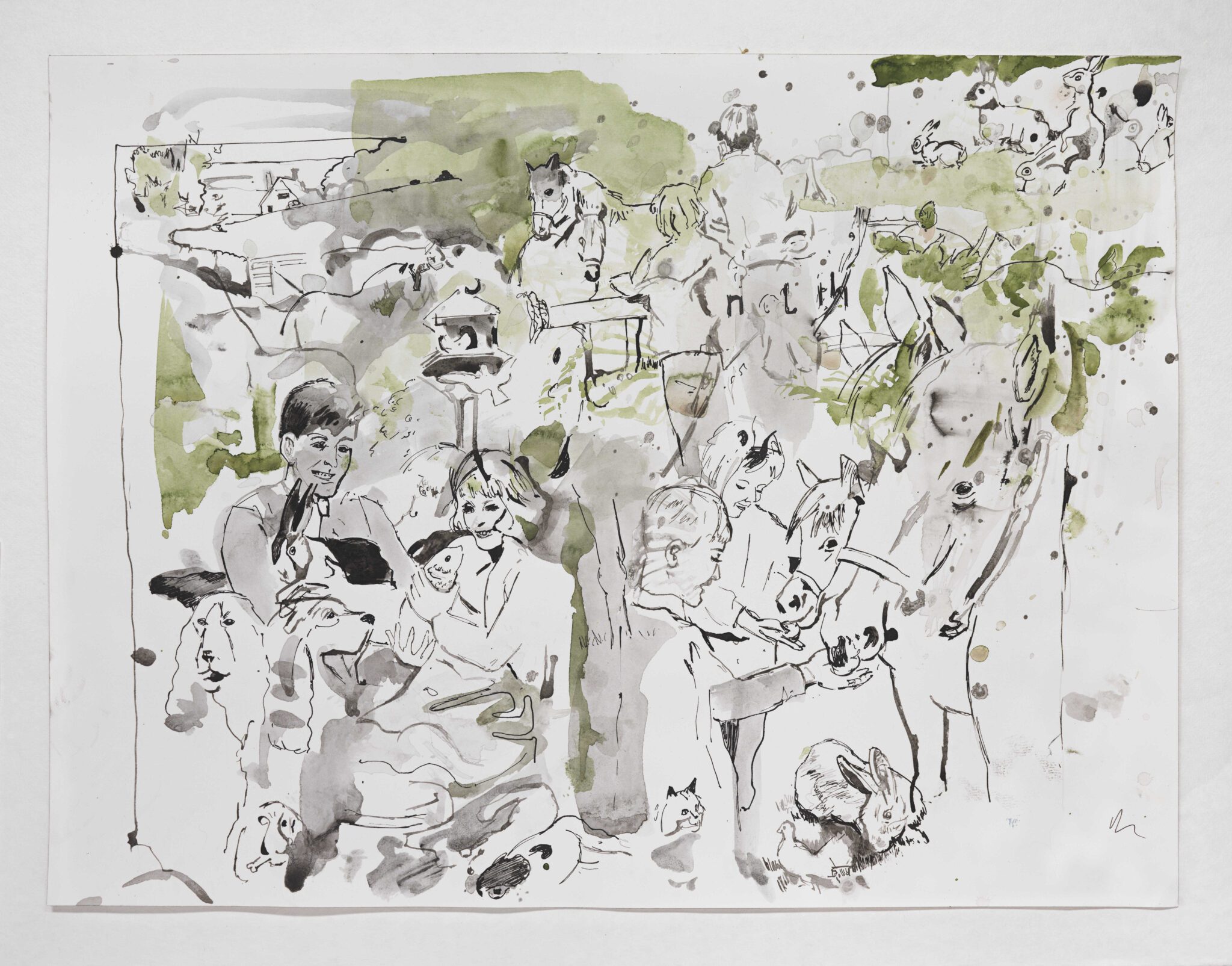
The better works fall into the micro-genre of park life. Take ‘Untitled (from Ladybird)’ (2024). The work comes together slowly when you first encounter it. What you see is something like a collage of torn pages. Subtle differences in scale give the composition a crowded quality. There are three groups, each absorbed by animal companions. There is a dormant eroticism here – as of a bacchic scene by Poussin in which the Bacchae are present but aren’t behaving in a bacchic way. The groups are turned away from each other, and the humans don’t look at each other, only at the animals. It is a striking reformulation of Michael Fried’s idea of absorption in 18th-century French painting, a strategy that he pinned on the moralising tendencies of the time. Here, there is no moral guidance – Cecily Brown’s works aren’t political – simply an estranged relationship between three groups, triangulated by animals gazing at each other.
The animals seem not to be subject to the same other-blindness as the people. The horses in a paddock in the distance stare out at the viewer. A skeletal arm appears at one with the ear and throat-latch of a horse in the foreground. The animals don’t look afraid. There’s a calculated mindlessness to some of the human expressions and calculated wrongness to the depiction of certain animals. Spot the rabbit that resembles a dead fish, and see how the woman grips it as if it were one. There is tension and ambivalence here – a threat alongside a sense of idyllic pleasure.
The show’s text emphasises the importance of jigsaws to the ‘nature walk’ paintings. But all of Brown’s paintings appear jigsaw-like in structure – insofar as a piece is thought to lack sense without the whole. The larger, more saleable works offer up everything that you can know about them after a certain period of inspection; the art-historical shadow – whether that be Fragonard or Rousseau – falls evenly over every jigsaw piece.
It is when Brown repudiates this tendency to produce guarded wholes that things get interesting. An on-the-nose example of this is ‘Hurry Up Please It’s Time’ (2025), which reworks a fragment from J.M.W. Turner’s ‘Sun Rising Through Vapour: Fishermen Cleaning and Selling Fish’ (1807). The tabs and blanks of the jigsaw pieces in this work will not slot together. There’s a charge to this dislocation – a necessary lack that pleasingly takes over from referential abundance.
‘Players and Painted Stage’ (2024) is the most successful at this – the ‘players’ are the dislocated pieces, standing by themselves but abreast of one another, sublimated into the image in a way that cannot quite be said of ‘Hurry Up Please It’s Time’. These have the most plastic power, along with the drawings in the room facing northwest. There is humour in the drawings: Brown could have been a sadistic hairdresser in a previous life, going by how well she draws bad haircuts.
END





Comments