
In 1966, the actor Raphael Montañez Ortiz staged his one-man show Self-Destruction at London’s Mercury Theatre. Intermittently screaming “Mommy! Daddy!,” Ortiz tore the clothes from his body, doused himself with baby powder, lay down in a diaper, downed a few bottles of milk and began vomiting profusely. Plastic bags were then distributed to members of the audience, who were encouraged to follow suit.
Montañez Ortiz’s performance gave the psychologist Arthur Janov the idea to create primal scream therapy, a psychiatric fad that once counted John Lennon and Yoko Ono among its followers. Janov’s newest initiate might as well be Chloé Zhao (Nomadland, Eternals), whose movie, Hamnet, based on the novel by Maggie O’Farrell, is an almost entirely concocted melodrama about the marriage of William Shakespeare (Paul Mescal) to his wife, Agnes (Jessie Buckley), and the loss of their young son, Hamnet.
You might want to bring earmuffs. Between Agnes giving birth to three children, two of the kiddos falling ill, one dying in excruciating pain and the lead actors slamming themselves against hard surfaces and bawling their eyes out for half the film, Hamnet is a sonically and psychically scarring experience.
We first meet young Shakespeare in sleepy, bucolic Stratford-upon-Avon, where he is tutoring in Latin. He spots the alluring Agnes wandering about in the woods, hawk in hand, and immediately falls for her.
Agnes is not like other girls. It’s rumored that her mother was a witch, she’s strong-willed, she knows the secrets of herbal medicine and pagan spells and she has a special dark cave in the forest where she likes to run off and huddle in the fetal position.

Shakespeare wastes little time in getting Agnes pregnant. Though at first their families disapprove, the lovers get married. Agnes tries to keep running away to her spot in the woods to give birth, but on the second attempt, Shakespeare’s mother, Mary (Emily Watson), sensibly locks her in at home. We are treated to an extra-high-decibel birth scene during which the heavens themselves break out in stormy displeasure and the river bursts its banks.
Meanwhile, Shakespeare tries to balance his burgeoning career as a playwright in London with home life in Stratford. Things seem happy: maybe someday the ten-year-old Hamnet (Jacobi Jupe) will join his dad in the big city as one of his actors. But good times never last.
What pornography is to loving sex, Hamnet is to genuine grief: it’s cloying, exaggerated and screamed to the high heavens for the titillation of a desensitized audience. At the film’s core lurks an unsettling materialism and godlessness papered over with millennial therapy-speak.
At one point, Mary reassures the apparently pagan Agnes that her stillborn child is in a better place. “NO!,” Agnes bellows back. “She has not gone to heaven. I made a vow when my mother died: I will go to your church but I shan’t say a word there.” That seems to do the trick, and the baby sputters back to life miraculously.
No such luck when the bubonic plague comes knocking, complete with hook-beaked doctor and a “bring out your dead” sequence straight out of Monty Python and the Holy Grail. One of the girls falls violently ill, but it’s Hamnet who “trades places” with his twin sister by asking her to breathe on him and infect him. He dies in agony.
So we are left with the parents wailing and gnashing their teeth. “Where has he gone?” they cry. Aye, there’s the rub. Hamnet does not have a good answer for them. The best it can offer is a greeting card from the “thinking of you” section, when Agnes’s brother (Joe Alwyn) tells her to “keep your heart open,” which is also the movie poster’s soppy tagline. “Never take for granted that our children’s hearts beat, that they draw breath, that they walk and speak and smile and argue and play… never for a moment forget they may be gone,” says Shakespeare’s mom, with all the sententious wisdom of a yoga instructor.
Nitpicking anachronisms does not a good review make, so allow me just one. Shakespeare might have been a crypto-Catholic. He might have been a regular churchgoer. He might have been a cagey atheist. He was inarguably fascinated by the mystery of faith. But is it remotely conceivable that his family in the 1590s, racked by the grief of losing a child, would not turn to God for one moment, in supplication or in anger? To present characters in Elizabethan England this way makes them look heartless, if not mindless.
So Shakespeare goes back to London to work out his trauma onstage by writing Hamlet, inspired, the film speculates tenuously, by the death of his similarly named son. Never mind that most of Shakespeare’s comic writing followed Hamnet’s death, or that Hamlet is the story of a son’s grief for his father, not the other way around – Hamnet has to twist itself into a pretzel to make that conceit work.
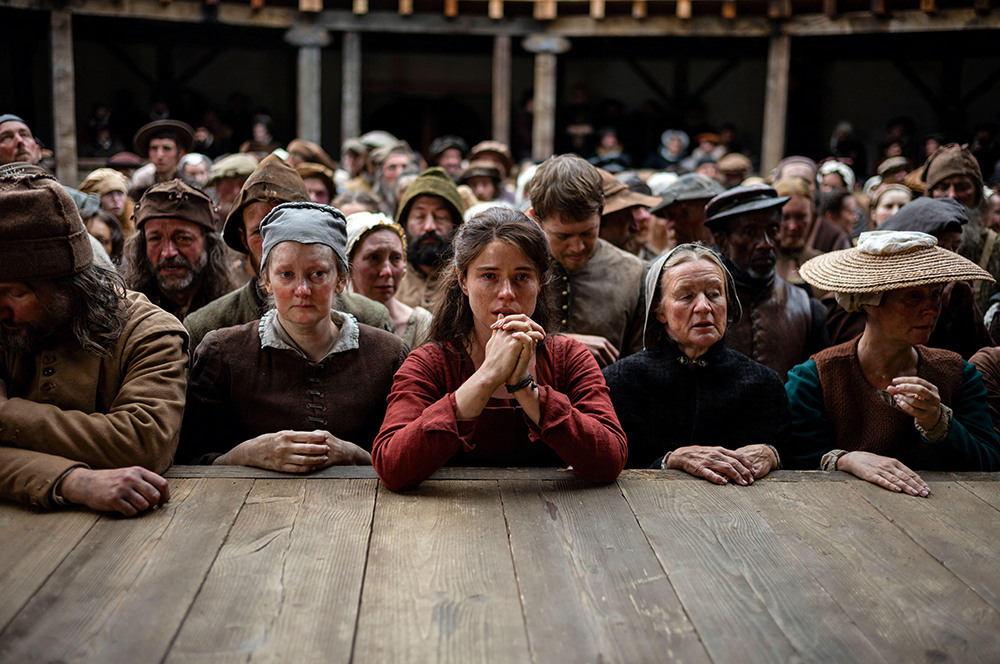
The film culminates in a performance of Hamlet at the Globe Theatre, which also happens to be the best part because Zhao has finally hired a better screenwriter: Shakespeare himself. Caveat emptor: outside of this brief, wooden sequence there is very little actual writing by Shakespeare about. Ostensibly this is to make space for the “untold story” (as the trailer promises) of Shakespeare’s wife and son, but Hamnet is so atomized, so fixated on scenes of performative grief and moody nature shots set to Hans Zimmer’s greatest hits album that it ends up being about hardly any of the characters at all.
Still, Hamnet is beautifully filmed in shades of forest green and earth brown. Mescal and Buckley keep a fan-fiction screenplay barely afloat. But at the end of the day, Hamnet is about as good as a prolonged session of primal scream therapy. Like Shakespeare’s Poor Player in Macbeth, it struts and frets its two hours upon the screen, all sound and fury, signifying nothing.
This article was originally published in The Spectator’s February 2, 2026 World edition.




Comments