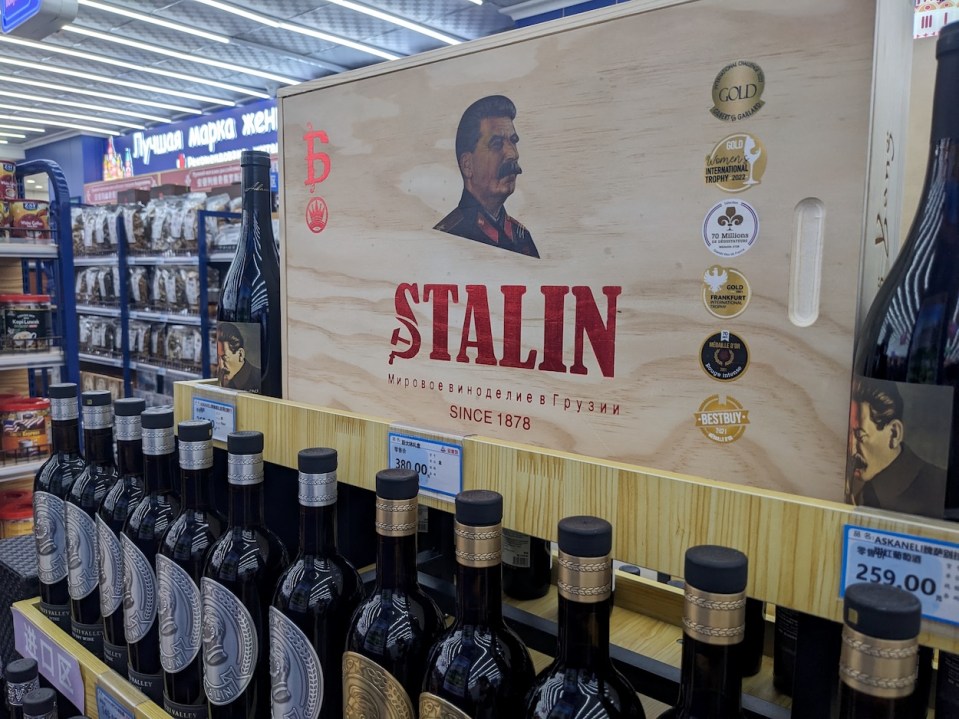
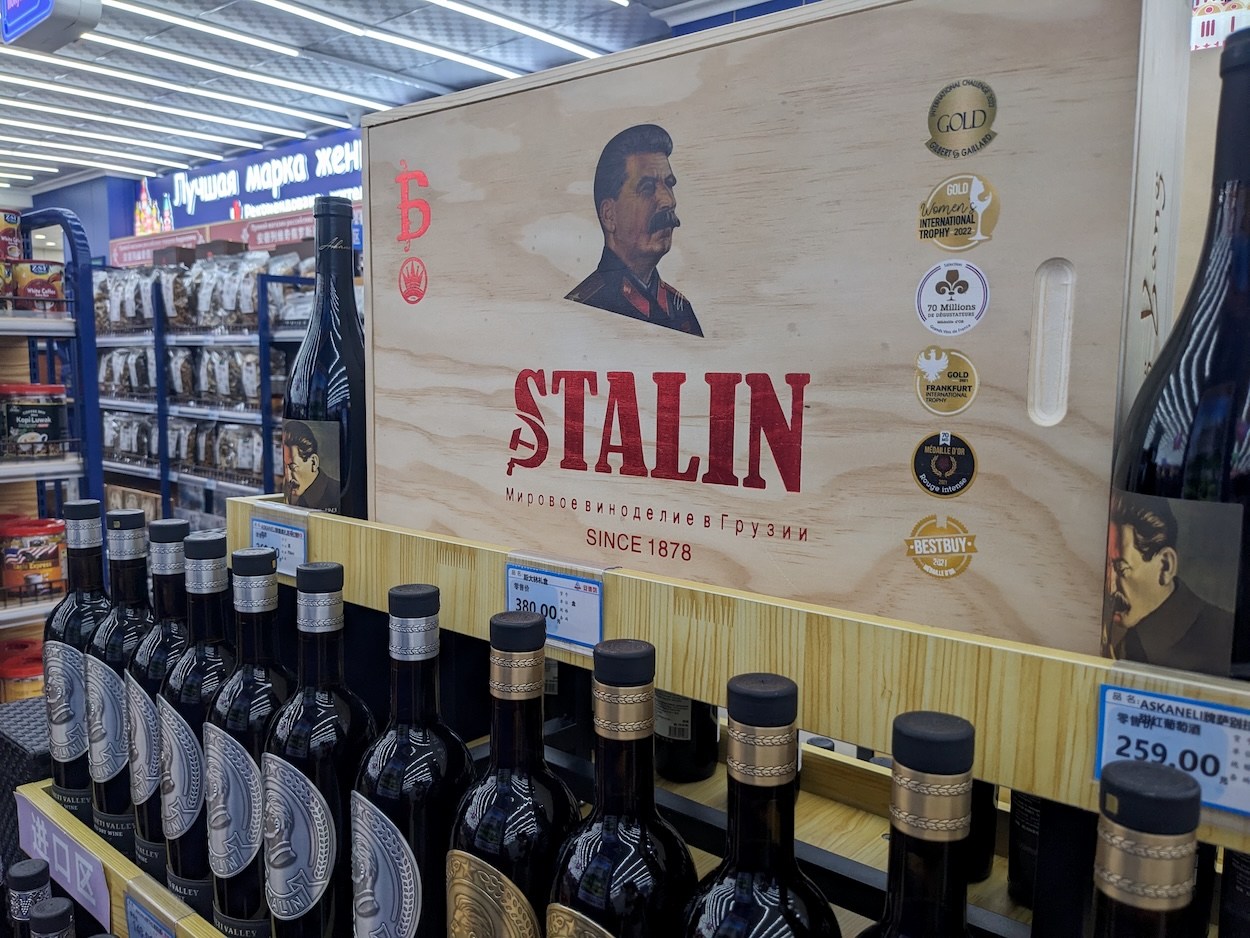
I had to go back and snatch a photo, just to confirm the evidence of my own eyes – to confirm that there really is somewhere in the world, and it’s not his native Georgia or recidivist parts of Russia, where the name Joseph Stalin remains a point of pride, as though Nikita Khrushchev’s secret speech, let alone perestroika, glasnost and the collapse of the Soviet Union hadn’t happened.
One of the biggest cities in China boasts a Stalin park, a Stalin statue, and – the subject of my snatched photo – supermarket tables and shelves stacked with Stalin-branded wine. Welcome to Harbin, a city of ten million people in the north-east of China, and one of the strangest places among the many strange places I have visited in my travelling lifetime.
A simple view of Russia and China as seen from the United States or Europe is of two giant, largely land-based, non-democracies that need to be kept apart, lest they form an alliance and gang up against us. There are many reasons, including their distinct geography and national interests, why I tend to think this is unlikely; after all, barely two decades of communist friendship came to a very sticky end with a fierce little border war in 1969. But Harbin, whose long history with Russia goes back to the construction of the Trans-Siberian railway in the 1890s, casts a rather different light on China-Russia relations today, and an at times jarring one, too.
Harbin (I had long wondered how this is rendered in Mandarin, and the answer is that it takes three Chinese characters, Ha-er-bin; as, by the way does Stalin, rendered Si-da-lin) conforms to a familiar pattern of Chinese cities today. If you arrive by train, as I did, you enter a vast industrialised landscape of warehouses, high-rises and solar panels, with a new airport-style high-speed railway station on its perimeter, What distinguishes Harbin, however, is its Russian dimension, which, it turns out, is not just historical, but newly conspicuous in a quite different way.
Harbin suddenly grew from its village and small town origins to a boom-town, after Russia successfully negotiated a corner-cutting railway route to Vladivostok via northern China. By the time the railway arrived in 1898 it was becoming a largely Russian city, with a well-off and well-educated population, and architecture and civic institutions to match. After changing allegiance several times during the Bolshevik revolution, it became a refuge both for stranded former railway employees and for Russians in eastern and southern Russia fleeing the Reds. In its heyday, the Russian population numbered more than 120,000. The late Professor Robert Skidelsky who made his career in the UK was among those who spent his early years in Harbin, as was a branch of my late husband’s family – which was one reason for my curiosity.
Now, the remaining Russian architecture is limited to two main central areas, the cathedral square, with the Orthodox cathedral of St Sophia – now a museum – to one side, and a few grand avenues lined by former banks and other institutional buildings.
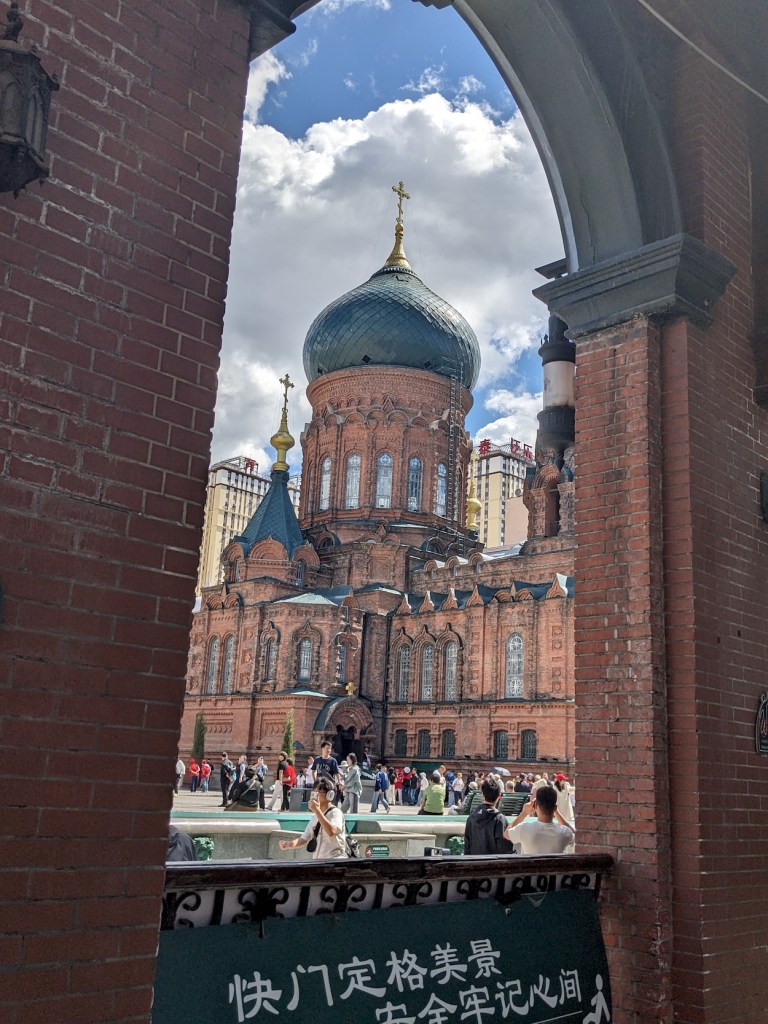
The cathedral, with its characteristic onion dome, was designated a Chinese national heritage site in 1996. Rather glossed over, though, is what took so long, with part of the answer being the Japanese occupation, which made Harbin de facto capital of the puppet state, Manchukuo, and drove many Russians to leave, and another part being the sacking and destruction of the cathedral in 1966 during China’s Cultural Revolution. So while its exterior is true to the original, the interior is a pale reflection of what must have been its former self, although further restoration is reportedly planned.
It might also be noted that, despite its roots, Harbin did not remain a Russian city for very long. Although Russians were still the largest ethnic group at the time of the Japanese invasion, many Russians fled, leaving just a quarter (around 30,000) at the end of the 1930s. Of these, any who failed to escape found themselves deported to the Soviet Union after the victory of the Red Army in 1945. By 1964, the Russian population was documented at a mere 450, falling to 30 by 1988. How many Russians may have arrived more recently is hard to establish, but I was hard put to spot any identifiably European faces when I was there.
A Russian presence of a kind has, however, taken on a second life. The cathedral square has become a favoured destination for young Chinese ‘influencers’, many dressed in elaborate white snow queen outfits, parading around taking ‘selfies’. A stair rail affording one of the choicest views of the cathedral dome now sports a multilingual warning of the dangers of climbing up to take pictures.
On and around the pedestrianised shopping concourse, Central Street, there are Russian restaurants (signs and menus in both languages), although so far as I could judge they were staffed by monolingual Chinese and offered only limited and semi-faithful renditions of the real thing.
Far more in evidence, though, are ‘Russian’, or ‘Russian-Chinese’ supermarkets, again staffed entirely, so it seemed, by Chinese, but selling almost exclusively Russian goods: from cosmetics through folk remedies, to frozen food, some stationery and leather goods, and inevitably perhaps a vast amount of alcohol, including that prominently displayed Stalin-branded wine. To judge by the prices, these Russian goods are regarded as luxuries and carry a high premium – but it is clearly one the local or visiting Chinese clientele are willing to pay for.
The Harbin of today is a huge industrial city, which mostly trades on its winter ice festival
As for what might be called Harbin’s real Russian legacy, beyond the architectural survivals, it is confined to a couple of floors in different blocks of the city museum complex. There is a glorious collection of mostly early 20th century paintings, with a handful from the heyday of Sino-Soviet friendship in the 1950s and captions suggesting they were preserved thanks to a few Chinese and Russian enthusiasts of the time. I had the place to myself, to the bizarre accompaniment of ‘Lara’s theme’ from the 1960s Western film of Doctor Zhivago, which I doubt was a hit at the time in China. Another mini-museum, housed in what was labelled the former hall of Sino-Soviet friendship, includes memorabilia from the arrival of the railway.
But that is yesteryear. The Harbin of today is a huge industrial city, which mostly trades on its winter ice festival. When the river freezes, the two banks of the city are united, and elaborate ice sculptures are a draw for tourists from around the world. I was repeatedly told – via the Chinese equivalent of Google Translate – that I was there at quite the wrong time of year.
By that gauge, though, the wrong time is more than half the year, so I was seeing its more normal self, when Harbin’s unique selling point is its now largely fantasy Russia dimension. This is a Russia with scant political or geographical significance, a Russia fading away into paintings of forests and sepia prints of a quasi aristocratic high life and resurrected as a purveyor of gaudy, luxury commerce. A Russia, in short, that eminently suits the China of today.





Comments