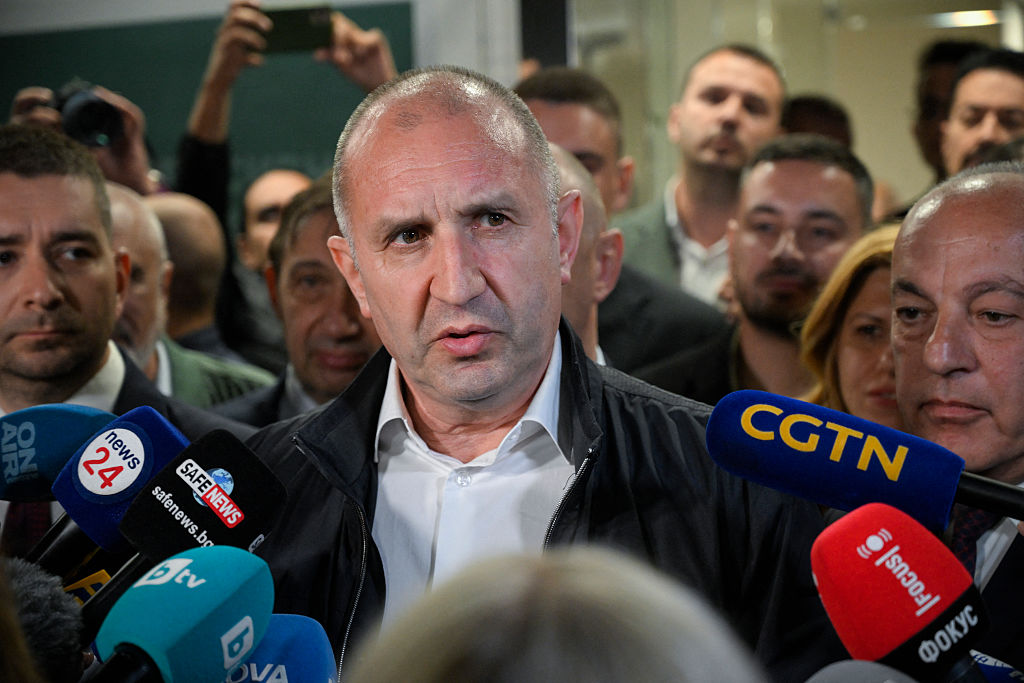
Rumen Radev won a majority in Bulgaria’s parliamentary election this week, giving him the ability to form a single-party government. It was Bulgaria’s eighth general election since 2021, and the first since 1997 to return an outright majority for a single party. After years of coalition churn, there might be a rare break from the near-constant voting.
Radev – a former air force chief, then president, now incoming prime minister – is one of the most recognisable and popular figures in Bulgarian politics. Early international coverage has already cast him as the EU’s next potential disrupter, following Viktor Orbán’s exit from Hungarian politics.
He certainly shares some of Orban’s views. Radev has argued that there is no military solution in Ukraine, criticised Western weapons deliveries and warned against long-term security commitments to Kyiv. He had also voiced concern about the euro, which Bulgaria adopted at the beginning of year, warning it could lead to price rises.
During an unfortunate exchange in Sofia in 2023, Ukraine’s president Volodymyr Zelensky rebuked Radev for calling for negotiations with Moscow, saying: ‘God forbid some tragedy should befall you and you should be in my place…what will you do? Would you say: Putin, please grab Bulgarian territory?’
This has made for easy headlines. Commentators have labelled him ‘pro-Russian’ or ‘Kremlin-friendly’, with some suggesting his victory gives Moscow a new foothold inside the EU.
But Radev has repeatedly said Bulgaria’s EU path is not in question, a line he restated during the campaign and after the vote. That stance paid off politically. His new party, Progressive Bulgaria, took around 18.5 per cent of voters from the pro-European bloc, Change Continues-Democratic Bulgaria (PP–DB).
Radev’s campaign instead focused on tackling corruption and dismantling what he calls the ‘mafia state’. Reforms to the judiciary will require a supermajority of at least 160 MPs in the 240-seat parliament, meaning cooperation with other parties is unavoidable. He has already signalled his intention to work with PP-DB, a strongly pro-European bloc that would not support an Orbán-style shift.
A further constraint is Bulgaria’s dependence on EU funds. As the bloc’s poorest member state, it is one of the largest beneficiaries of European funding relative to the size of its economy, leaving little room for confrontation with Brussels without major financial consequences.
As Georgi Angelov of the Open Society Institute in Sofia notes, Bulgaria is even more reliant on the EU because of its weakened fiscal position since the pandemic, the war in Ukraine and the global energy crisis, alongside rising defence spending needs.
Carnegie Fellow Dimitar Bechev has speculated that ‘Radev’s overtures to Russia will start on the energy front’. Yet Bulgaria has already made a sharp break from Russian energy since 2022. Once fully dependent on Russian oil and gas, it has diversified supplies through a pipeline link with Greece and LNG imports via Turkey. It no longer imports Russian oil or gas for domestic use.
Russian pipeline gas still transits Bulgaria to Serbia, Hungary and Slovakia, but it bypasses the domestic market, generating only transit fees. Meanwhile, the state pipeline operator is expanding infrastructure for alternative supplies, including US LNG via the Vertical Gas Corridor linking Greece, Bulgaria, Romania, Hungary and Ukraine.
The previous government committed to ending Russian gas transit by autumn 2027 in line with EU rules. Radev could attempt to slow the timeline, but this looks unlikely after Hungary and Slovakia failed to secure concessions from the EU.
US sanctions also narrow Radev’s options. In 2025, Washington sanctioned Lukoil, the owner of Bulgaria’s only refinery in Burgas. Sofia responded by taking operational control of the plant, allowing it to continue under temporary US licences, provided no funds reach the parent company. The arrangement has ensured stable fuel supplies but strained relations with Moscow, with Lukoil threatening legal action. Radev will have limited room to change course if he wants the refinery to remain operational.
Radev’s own record points to caution rather than confrontation. As president over the past nine years, he appointed a series of interim governments during prolonged political deadlock and steered the country through the pandemic, war in Ukraine and energy crises. He did not use his position to block EU sanctions on Russia or decisions related to Ukraine, and Bulgaria continued to supply Soviet-compatible munitions to Kyiv.
That is not the behaviour of a leader intent on picking fights with Brussels.
None of this means Radev will be an uncritical European partner. He may take a firmer line on aspects of EU policy, such as its energy policy and the Green Deal, and is likely to advocate for dialogue with Moscow as part of any eventual settlement in Ukraine. But he is unlikely to use Bulgaria’s veto to block major EU decisions. His immediate priorities lie at home.
As Maria Simeonova wrote for the European Council on Foreign Relations, Radev now has to deliver domestically on his promises. Until now, the former president has not had to make difficult decisions that undermine his popularity. As prime minister, Radev will be careful not to upset his broadly pro-European electorate.
After years of instability, Bulgaria has the chance to have a more durable government. A former fighter pilot, Radev is likely to focus on Bulgaria’s defence spending and military capabilities, where cooperation with Nato and European partners remains central. The priority, at least for now, is stability and the chance of long-delayed reform.




Comments