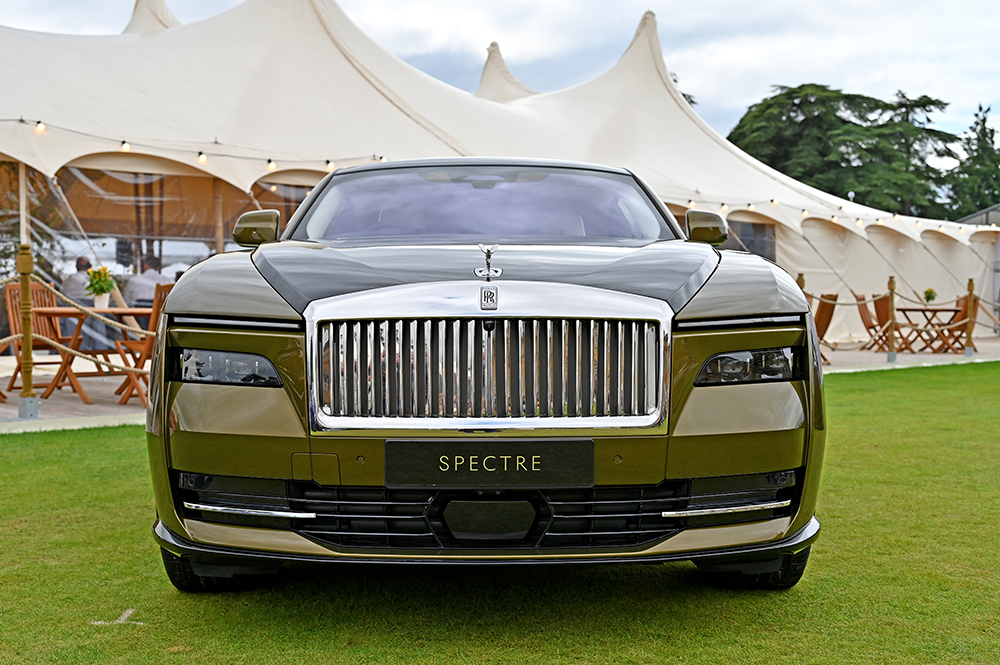

I think I know why Rolls-Royce names its cars for the spirit world. They are called Ghost (the saloon, though it inhabits the wilder shores of that name), Phantom (the flagship saloon with bespoke art gallery on the dash) and now Spectre (the coupé).
I think that, like the slave at the general’s triumph in Rome, it exists to remind the driver that he is mortal, and he will die. He is unlikely to die in a Rolls-Royce, it is true, though I heard a story about a Rolls-Royce driving through a forest in a storm. The collision light blinked, the driver slowed and saw the moose in the road, braked and saved both an embarrassing death. I appreciate this acknowledgement of the closeness of death in anything, but particularly in a car: it’s philosophy as add-on, like the picnic basket, paint colour or luggage. Or, if you live in the Middle East, falconry capability.
But this is typical, at least here. Take the Starlight Headliner: one must wade through copywriting, leather and lambswool to get to the essential savagery of these machines. Lawrence of Arabia did not requisition them for the lambswool. It is, essentially, the interior ceiling light: thousands of holes punched in leather and filled with fibre-optic strands to look like a constellation of stars. You can order any constellation you like – there is a Rolls-Royce designed in homage to a dog called Bailey, which I will get to – but the original constellation is the night sky above Goodwood on 1 January 2003, the night that Phantom, the first car produced under BMW’s ownership, was born and the company’s future assured.
I first meet Spectre II in the Carbis Bay Hotel. I’ve never seen a car with so much presence
That’s quite profound for consumer capitalism, more Tintoretto than Renault Clio, and I value it. If they have an in-house mage dealing in motoring scripture, they haven’t let me meet him.
I used to think that electric cars are like dodgems: two pedals, one for stop, and one for go. I don’t think that since Spectre II. I have listened to motoring journalists bemoan the end of petrol, because they – and I, and you – like to drive as if poised on the tip of a vast rotating tongue, and for reasons that are obvious to anyone with a basic understanding of Freudian psychoanalytic theory. But petrol cars existed only because the technology for electric cars was yet to be invented. ‘The electric car is perfectly noiseless and clean,’ Charles Rolls wrote in 1900. ‘There is no smell or vibration. They should become very useful when fixed charging stations can be arranged.’
I first meet Spectre II in the Carbis Bay Hotel. I’ve never seen a car with so much presence: it feels like a much older car – the 1952 Silver Dawn, for instance – though improved, and, like my neurosis and my dreams, much bigger than it really is.
I drive it at the Goodwood racetrack, and it is, as Rolls promised, near silent. But the power is there: 0-62mph in slightly more than four seconds in a car that weighs almost three tons. Press the brakes hard and you stop inside 100ft. I did this in Spain in a Black Badge Spectre, and I was done for the day. I couldn’t go through the cones after that, to demonstrate ease of manoeuvre. I was shaking too much.
An instrument of war, then, but merged with a grand hotel designed by your own happy subconscious. We tour the factory and learn that the leather is from cows living at altitude, so they are not bitten by mosquitos which would damage the hide; there are 44,000 exterior paint colours; a specialist timber procurement department; that the Spirit of Ecstasy has got smaller over time and, if you punch her, she retreats under the bonnet, as I would.
We discuss Spectre Bailey, the car made in homage to the labrador-golden retriever mix called Bailey. It was commissioned by an American family. The interior colour is the same colour as Bailey, who is photographed lounging in this shrine to himself: the Most Capitalist Dog. There is a picture of him in marquetry between the back seats; his pawprint is on the passenger side dash.
This is a level of obsession I identify with keenly. I am told there are eight woods in Bailey’s portrait, and four in his tongue alone. I think that when the war correspondent Martha Gellhorn said there is nothing as strange as human beings, she meant this. On the wall of the factory is a painting of the court of Versailles by Bradley Theodore, and I like this too. If you would buy a motorcar, let it be self-aware.





Comments