
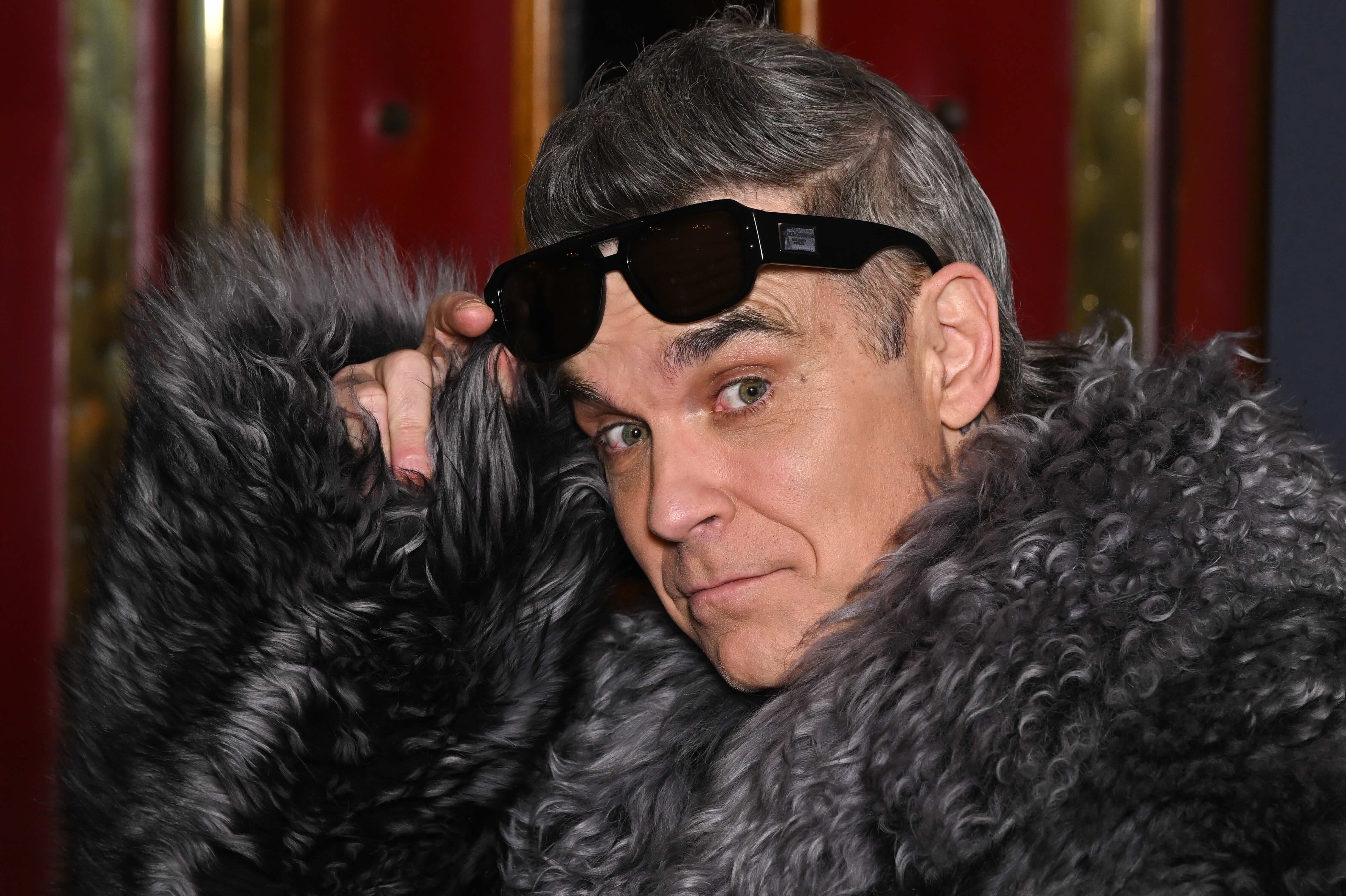
When I heard that Robbie Williams had written a song called ‘Morrissey’, I didn’t know whether to be delighted or irate. It’s no secret that I idolise Moz, and the idea of a somewhat seedy showman attempting glory by association made my hackles rise somewhat.

But on the other hand, Williams has co-written several songs which have caused my toes to tap over the years and has a history of acting gay when it suits him. (Indeed, Take That’s appeal might be crudely summed up as four lads who looked like rent boys and their concerned social worker, Gary Barlow.)
Then there was the ‘Shame’ video of 2010 by Robbie and Gary, in which the two principals start by exchanging copious meaningful glances in a shopping mall. Then we cut to a dancehall where the two men are each dancing with women, but still have eyes only for each other. Then they’re necking shots and fessing up: ‘So I got busy throwing everybody underneath the bus / And with your poster 30 foot high at the back of Toys R Us / I wrote a letter in my mind / But the words were so unkind / I must have meant them at the time / Is this the sound of sweet surrender?’ Then they’re stripping off and have their arms around each other! It was little surprise that the song came from an album called Swings Both Ways.
But I’m always keen on a bit of boy-on-boy (or rather, sexy-uncle-on-sexy-uncle, considering their ages and appearance) action, so the idea that Robbie had written a song about the ultimate sexy uncle of pop wet my whistle somewhat. After all, the backbeat of homoeroticism goes all the way back to the start of rock ’n’ roll, with Little Richard ceaselessly proclaiming how pretty he was. He may have been singing about girls named Daisy and Sue, but it’s very obvious that he got the hots from himself.
The English pop of the 1960s seemed a very different beast indeed to the primal rock of America. But anyone who watches early footage of the Beatles in big venues just after they’d made it – especially in America – will notice that the girls in the audience get especially overheated when Paul and George close their eyes, put their heads close together and make an ‘OOO!’ sound.
The Rolling Stones liked to tart themselves up with satin, tat and a whole lot of slap. Mick Jagger in particular appeared to enjoy prancing around like a little girl getting overexcited at her own sixth birthday party. Ray Davies of the Kinks was very ‘knowing’ in a way that could only be gay. But the real smorgasbord of swoosh was waiting around the corner in the 1970s.
Where to start? You couldn’t watch Top of the Pops in the 1970s without your dad swearing and leaving the room. It must have kicked off with that time in 1972 when David Bowie casually draped his arm over guitarist Mick Ronson’s shoulder while singing ‘Starman’. By the reaction of excitable teens and fuming parents alike, you’d think they’d been tearing each other’s clothes off on national TV.
From then on, they were all at it. The unfortunate ones like Elton John and Roy Wood of Wizzard knew they had little chance of passing as pretty boys but piled on the make-up and platform boots anyway. Then you had the wolves in flamingos’ clothing – Bryan Ferry, Marc Bolan and probably David Bowie himself after an early period of ‘experimentation’ – who were ferociously heterosexual but found it great fun to ponce around blind with mascara and heavy-headed with hairspray. And never forget Him From Sweet: Steve Priest, the campest man on TotP, which is saying something.
You couldn’t watch Top of the Pops in the 1970s without your dad swearing and leaving the room
‘Were our dads too masculine? Did we want men who looked like they couldn’t fight and win a war?’ says the writer Caraline Brown. It’s true that my dad refused to believe that ‘shampoo for men’ existed and he used a bar of soap on his head all of his life – but what absolute idiots we were in our adolescent desires. Now we’ve got a bunch of middle-aged children who’d rather play video games all day than fight a war, and are we pleased with them? Not one little bit, I’d venture.
Men learned the lesson that girls like boys who seemed gay. It could be seen all the way up to Brett Anderson of Suede, who memorably called himself ‘a bisexual man who never had a homosexual experience’. The concept of ‘shipping’ – online fan fiction which forces famous people, real or imagined, into homosexual romances – has been around for some time, running the gamut from Captain Kirk and Mr Spock to Harry Styles and his One Direction bandmates.
Indeed, Styles is the latest of the long line of English pop stars who pretends to be gay because it drives girls wild. The audience for his film My Policeman was mostly young women who could finally see him being with a man in a way they could previously have only dreamt of.
So back to the Morrissey song. Pathetic types like Martin Robinson have tried to sway it their way as ‘a hilariously sarcastic diss song which attempts to get under the skin of the former Smiths singer… Williams plays the part of a stalker who believes that the grumpy Mozza with his “divisive” views just needs a big hug: “Come here, let me hold you, for the rest of your life / Morrissey, it’s just you and me.” You can practically see Morrissey turning puce at the very thought.’
But Morrissey has a long history of embracing homoerotica: all those beautiful boys on the record sleeves, all those sweet and tender hooligans in the songs. And Williams, like Morrissey, is a big supporter of Israel, so not averse to being a bit ‘divisive’ (aka independent) himself. He had a show cancelled in Turkey for being a ‘Zionist’.
I’d wager that the song is more of a kiss than a diss – and that his Mozness is secretly tickled, not irked. After all, it’s just the latest wink and nudge in the boy-on-boy backbeat of pop.





Comments