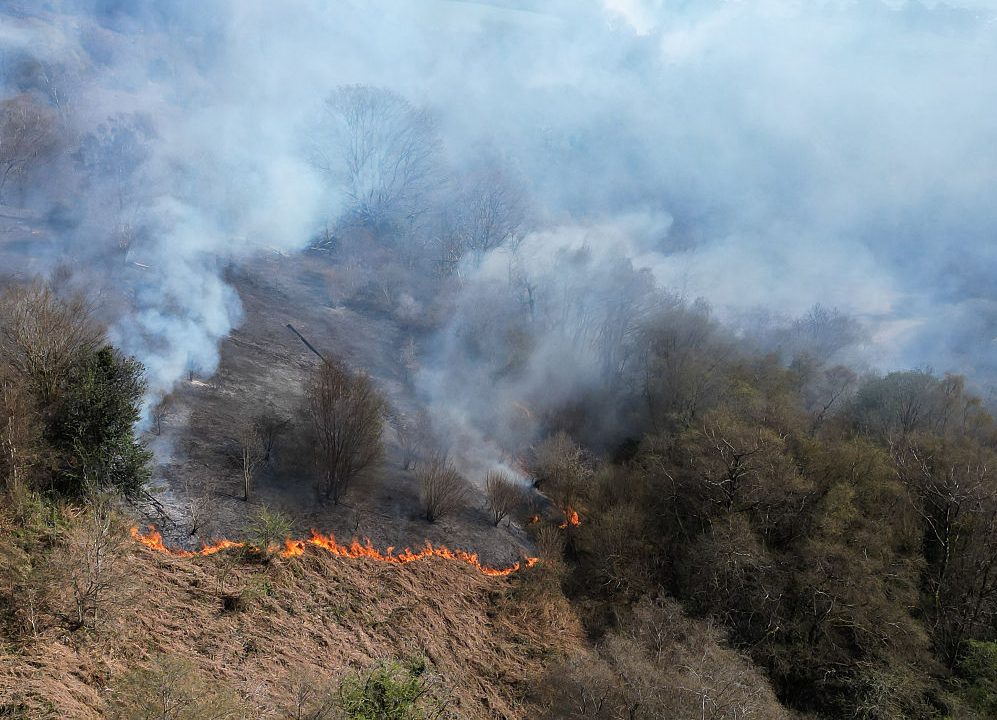
An enormous fire near Dovestone Reservoir in Oldham has been burning since 11 July, one of many this summer. Billowing black smoke can be seen (and inhaled) for miles around. Helicopters, fire crews and volunteers have been working the lines on blackened hillsides in conditions that are fast becoming routine in Britain. Our uplands are burning more, hotter and longer than at any point in living memory. This year’s tally (already over 21,000 hectares) follows a 2025 season that was the worst on record. Sheep farming representatives and grouse shooting interests are adamant that rewilding is to blame for the fires: the reduction in sheep numbers, the emergence of scrub and the build-up of fuel. But the precise opposite is true. It is only in recreating wilder, wetter upland landscapes that we will find true fire resilience.
The question is whether those who make policy about our uplands will finally have the courage to confront the nonsense
The poet John Clare described mysterious uplands endlessly swathed in great wetland mosaics known as blanket bogs, ‘the moors’ rude desolate and spungy lap’. The single most effective thing we can do to reduce the prevalence of wildfire today is to restore the wondrous, wet upland landscapes known by earlier generations. This is the clear conclusion of the IUCN UK Peatland Programme.
Centuries of drainage, carried out to replace living bog with grasses and heather that sheep can eat, have left our once-vast bogs desiccated and dominated by a relentless monotony of flammable heather and purple moor-grass. When a flame catches in these dried-out hills, it doesn’t just burn along the surface; it smoulders deep into the peat itself, producing the most destructive, unkillable wildfires we have in Britain. Blocking up the ditches and restoring the natural hydrology raise the water table to the surface almost immediately, slowing rank heather growth and creating powerful natural firebreaks.
Fixing our broken hydrology ought to be a priority not just in the uplands, but everywhere. Vast networks of sub-surface field drains, ditches and artificially straightened streams and rivers across nearly all our agricultural landscapes send rainfall barrelling fast to the sea. On its way it floods anything that lies in its path; and when it’s gone, the water table drops precipitously and we are left exposed to seasonal drought and wildfire far beyond the hills. It hasn’t gone unnoticed that it rained in Britain pretty much continuously from Christmas to Easter, and yet hosepipe bans were being declared by the water companies as early as late May. We’ve stripped our land of its ability to hold water.
At Wild Haweswater in the Lake District, the RSPB and United Utilities have blocked nearly thirty miles of drainage ditches. Sphagnum, a moss that holds many times its weight in water, is fast returning. Water quality in the reservoir was the primary aim, but the reduction both in wildfire risk and in winter flood peaks has been equally dramatic. The same work across the Peak District and South Pennines for two decades has been turning fire-prone moorland into a beautiful and fire-resistant sponge landscape. When a notorious wildfire raced for days in 2018 across the managed grouse moor above Saddleworth, a few miles from where the land is burning again right now, rewetted areas nearby proved noticeably resistant to its spread.

Add beavers and the effect is multiplied. By building strings of dams along streams and creeks, beavers create ribbon wetlands that raise the water table across valley floors. Ponds, scrapes and re-meandered streams, whether made by beavers or by people, serve as landscape-scale firebreaks, while providing new habitat for amphibians, dragonflies, waterbirds and wildlife of all kinds.
The answer, we’re told endlessly, is more rotational burning of the kind generally carried out on moorland managed for driven grouse shooting, so-called ‘cool burning’. This reduces fuel and therefore flammability, so the logic goes. Writing in these pages recently, my friend Matt Ridley made precisely this case.
What this argument overlooks is that grouse moors comprise continuous heather only because they have been deliberately drained and burned to produce it, heather being the preferred food of the grouse. The monoculture is not a natural condition of our uplands; it is manufactured. Rewetting the moors would reduce the heather and with it the grouse, hence the pushback. Absurdly, both driven grouse management and overgrazing by sheep actively accelerate the very climate change that is giving us hotter summers and increasingly unpredictable weather, by releasing vast quantities of carbon from the drying peat, and by destroying the bog, which does the exact opposite.
But it is sheep farming, not grouse shooting, which must shoulder most of the blame for the fires. Tens of millions of sheep have been an ecological disaster for Britain’s uplands. Sphagnum is suppressed not by sheep eating it – since it has almost no nutritional value – but by trampling. The damage persists for years and prevents recovery of the feathery carpet of moss. Sheep also graze out more palatable plants such as deciduous scrub and tree saplings that would otherwise compete with heather, further locking the landscape into the flammable monoculture we see today.
Far fewer sheep, at much lower densities, alongside native cattle and especially hardy upland ponies, are the surest pathway to fire resilience. Belted Galloways, Luing cattle and Fell ponies, all now grazing at newly rewetted Wild Haweswater, trample gorse and bracken, forage randomly, and help to restore the varied mosaic of trees, scrub, grassland and sphagnum bog that breaks fuel continuity.
Author, ecologist and native pony fan Benedict Macdonald has said: ‘For millions of years, wild horses, of which our beloved Exmoor pony is the closest descendant, have been the most powerful hoover of dry grasses in our landscapes. Horses are specifically designed to tackle coarse and dry matter. The New Forest, and even its open heaths, never drained and horse-grazed, is largely immune to fire. Reducing burn load is essential. Burning it is not. We need our native herbivores back on the land.’
Macdonald’s company Restore has recently acquired Emblehope, a 3,000-hectare Northumberland estate, which will become England’s largest single-owner private rewilding project. More than 800 hectares of degraded peatland will be rewetted, returning the land to a living tapestry of sphagnum bog, patches and sinews of bog woodland, and open water – the kind of landscape you might find today in Estonia or Finland, and a surface that simply does not support fire in the way drained, heather-dominated moorland does. Soon Emblehope will teem with wildlife, and with birds that were once vastly abundant in our uplands: curlew, golden plover, dunlin, snipe, jack snipe and more.
The rewetting of landscapes, the return of sphagnum, beavers and their ponds, native cattle and ponies, pockets of woodland in the valleys and on the slopes – this is how we achieve lasting fire resilience, alongside a host of other benefits which make restoration a no-regrets thing to do. None of this happens overnight; heather monocultures take years to yield even after drainage is reversed. But keeping our uplands locked in their denuded, carbon-belching state, and doing so in the name of fire prevention, only compounds the misery.
Rewilding is not the cause of Britain’s worsening upland wildfires. It is the answer. As the smoke drifts across the Pennines once again and helicopters return to Dovestone, the question is whether those who make policy about our uplands will finally have the courage to confront the nonsense and set in place incentives to restore magic to our desecrated but fabled uplands.






Comments