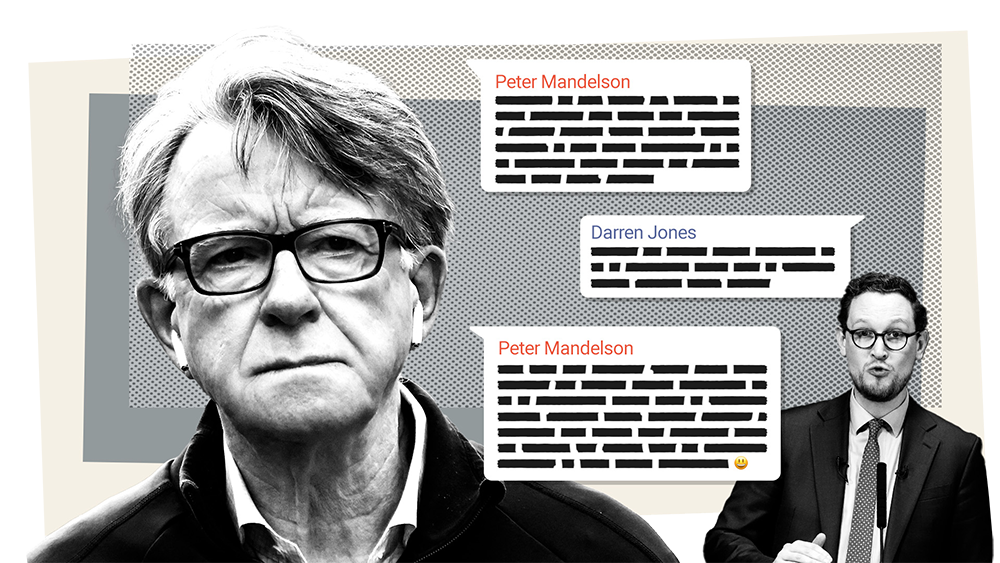


Darren Jones has become the government’s Walter Model, the general known during the second world war as ‘the Führer’s fireman’ for his deployment to shore up any position which appeared lost. In that capacity, Britain’s first Chief Secretary to the Prime Minister had the thankless task of presenting the government’s case to the House of Commons on Monday following the publication of 1,500 pages of documents relating to Peter Mandelson.
Jones himself was spared direct embarrassment because none of his exchanges with the disgraced peer came to light in the trawl of memos, emails and WhatsApp exchanges. Which is curious since The Spectator was informed in mid-April that messages between the pair were likely to emerge as part of the disclosure process and that Jones might find this somewhat awkward.
Surely it can’t be that Jones, a minister in the Cabinet Office, has had his blushes spared by the Cabinet Office?
Surely it cannot be that Jones, a minister in the Cabinet Office, has had his blushes spared by officials in the, er, Cabinet Office? Or that one of the most senior members of government failed to disclose such messages to an inquiry run by his own department?
But no, as the minister explained to MPs: ‘Some messages may not have been backed up where devices may have been changed or disappearing messages were turned on for reasonable and permitted reasons, including before the dismissal of Peter Mandelson or the passing of the humble address, myself included.’
Jones went on to ‘recall… having some limited exchanges with Peter Mandelson over WhatsApp’. But, rest assured, ‘these conversations did not involve transacting government business and were in line with official guidance on the use of non-corporate communications channels at the time’.
Phew! But while they may not have involved transacting government business – like a lot of the other exchanges published on Monday – they doubtless would reveal much about the behaviour of the political class. Jones himself said the episode highlighted the need for ‘better note-keeping’.

In the interests of helping the minister recall his, apparently deleted, messages, here are a few of them. It is perhaps understandable that on the very day Keir Starmer fired Mandelson as the UK ambassador to Washington for maintaining an inappropriately close relationship with Jeffrey Epstein, Jones does not wish to recall that he sent a gushing message about the peer’s achievements: ‘You’ve been doing such a great job, and you worked wonders with Trump. I’m so sorry about today.’
It is not a crime to be nice to a former colleague when they suffer a fall from grace, any more than it was wrong of Starmer to message Mandelson the day before he was formally appointed to tell him, as The Spectator reported two months ago: ‘You’ll be brilliant in challenging circumstances. And after many years of discussions, we get to work side by side. I really look forward to that.’
But it is legitimate to ask how and when these messages disappeared or were not deemed worthy of a public airing. And it is legitimate to raise an eyebrow when the tone of things being said privately contrasts so starkly with No. 10’s public approach: that Starmer himself did not know Mandelson well and that his appointment was the fault of Morgan McSweeney and Oliver Robbins.
Jones’s messages to Mandelson make clear that he, like many other ministers, was given to discussing government business far outside his brief and was not above criticising his cabinet colleagues. After Mandelson saw Rachel Reeves, he told Jones that growth plans were in the hands of the Chancellor, Angela Rayner and Jonathan Reynolds, then the business secretary. ‘It doesn’t fill you with confidence,’ replied Jones, Reeves’s deputy until last September.
When Mandelson criticised Reynolds’s special advisers and industrial policy advisers, Jones chipped in: ‘I lost faith in his spads when, on a call about Port Talbot, they repeatedly took a different position to us in HMT “because that’s what the unions want”.’ This message will reinforce the view of Labour’s critics that the party is too in hock to its union paymasters. It is the sort of leak which could find its way onto Tory or Reform campaign posters, just like another message from Pat McFadden, complaining that ‘Every meeting I have is “who can we tax in order to pay benefits to others”’.
It has been reported that Jones might fancy a tilt at the leadership himself, but grumbling about the influence of the unions is not likely to enhance his chances. Nevertheless he did seek Mandelson’s advice on how to advance his career. Last year, when he began ‘picking up reshuffle chatter’, Jones requested ‘thoughts/advice’. Asked which departments he fancied, he replied: ‘DBT [Business and Trade], DSIT [Science, Innovation and Technology] or DESNZ [Energy Security and Net Zero] in that order. I also like MoD but think that’s unlikely’ (because the Defence Secretary, John Healey, was ‘doing a good job’). But it does suggest Jones thought that ousting Ed Miliband as Energy Secretary was a possibility.
However, Jones made clear that his preference was to replace Reynolds at the DBT, offering his second criticism of the now chief whip: ‘DBT my preference – everyone fond of Jonny but perception that DBT not firing on full cylinders…’
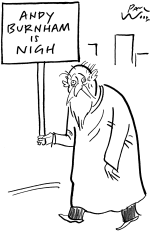
It’s not a surprise that bitchy asides and ambition are rife in politics. Jones is a talented minister, though not universally popular with colleagues, but it is curious these messages exist in some form, or they would not have been passed to The Spectator, but were somehow wiped, lost, deleted or overlooked.
The Mandelson affair is the Starmer government in microcosm – a PM and a party hardly drowning in political talent, forced to call upon the public skills and private advice of one of the supreme political operators of a different age to its own ultimate detriment. A prime minister who vowed to be whiter than white and pursue transparency mired in what has more than a whiff of cover-up.
As one former minister put it after seeing the reams of redactions to documents, including those relating to the Chagos Islands deal and comments from ministers about the inadequacies of the PM and his team: ‘As usual, the government made the wrong call. If they had left more (harmless) policy discussion in, it would have given people something else to think and write about other than how hopeless Starmer is.’
Instead, we can only wonder whether the smoke we can see is the result of the fireman’s pants being on fire.
Tim joins Patrick Gibbons on the latest Coffee House Shots podcast, to discuss his article, the latest Mandelson messages – and what they reveal about ‘government by WhatsApp’:



Comments