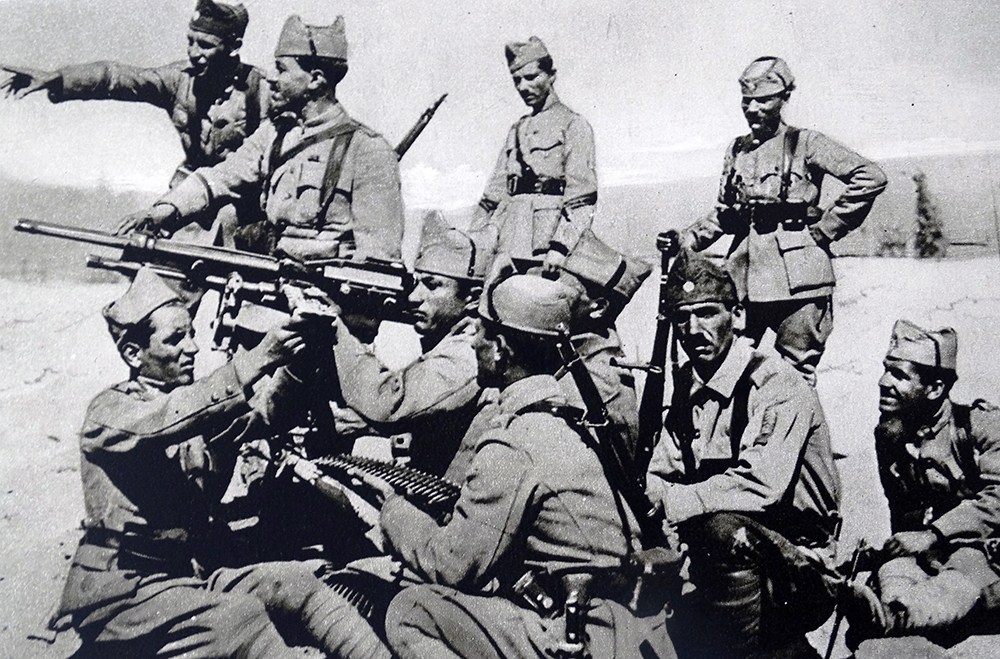
The Second Greco-Turkish War (1919-22) ended catastrophically for Greece and led to a massive population exchange: аt least 1.2 million Orthodox Christians were expelled from Turkey and around 400,000 Muslims from Greece. Gjak: Tales in Blood, a collection of short stories published in Greece in 2014, shows us the aftereffects of this war as experienced by the inhabitants of a small village north of Athens. The word gjak has a broad range of meaning: blood, bloodline or blood feud. Each story is a monologue by a returned soldier, spoken in heavy dialect with a sprinkling of Albanian. Dimosthenis Papamarkos shows us the difficulty of these soldiers’ homecoming with great subtlety. All have been traumatised, but this manifests itself in often unexpected ways.
Takis, the hero of ‘I’ll Cut Off Your Braids’, longs to avenge the rape and murder of a beloved older sister. This took place before the war, just outside the village. After being conscripted, Takis notices that one of his fellow villagers keeps to a rigid routine as he rapes and murders young Turkish women, always cutting off their braids and tossing them on the ground. This is exactly what had been done to Takis’s sister. Takis kills the man, correctly assuming him to be his sister’s murderer.

Eventually, Takis returns home. Halfway through a monologue, he says: ‘No one’ll tell you exactly what they did out there, but Antonis, we unlearned how to be human.’ Only from the very last lines do we discover that Antonis is the father of the girl whom Takis wishes to marry. ‘Think on it,’ Takis ends, ‘and decide whether you’ll give me your daughter or not… I’m not proud, but I’m not ashamed neither. I did what I reckoned best for my family. Now you reckon for yours.’
Each story is told to a single listener, and the role played by these listeners is crucial. Here, Takis is trying to negotiate some kind of accommodation between his wartime experiences and his community’s moral code. He has ‘unlearned how to be human’, but he wants to be accepted. Antonis’s response is left to our imagination.
The narrator of ‘Glass Eye’ talks about his homosexual relationship with a fellow soldier. Each of them, at different times, has saved the other’s life. The narrator is heartbroken when Thymios marries and loses interest in him. Again, the last lines are crucial. We learn that the narrator is speaking to a prostitute, probably the only person to whom he dares speak freely. He visits her ‘just so they don’t peg me as someone that dun’t like women’.
‘The Knocker’ tells how a young man answers all too truthfully when asked at his wedding to describe ‘what it was like at the war’. His account so appals his fellow villagers that he feels compelled to emigrate. He ends up working in a slaughterhouse in Chicago.
A seemingly jolly story may be the bleakest of all. After listening to a man boasting about the many random murders he carried out during the war, the narrator questions him: ‘You miss it that much? Was it really as good as all that?’ He leans over and says: ‘Even better than a woman.’
Central to the book is ‘Ballad’, 280 lines of pastiche folkloric verse that Sian Valvis, the book’s translator, describes as ‘the axis around which the tales revolve’. A fearless young widow threatens Charon, a personification of Death. Unless he returns her husband alive, Charon will be in trouble:
If you don’t give me what you owe, if you withhold what’s mine,
Then may this earth withhold its dead, and keep them all inside […]
So when a widow feels her loss, you shall feel it too.
And when a mother or a brother feels the pain of grief
Then Charon, too, shall feel no joy, and no hope of relief.
Valvis handles English verse skilfully, but her handling of the prose is still more remarkable. Dialect is notoriously hard to convey. Translating such stories into standard English drains the life from them. Translating into an existing English dialect usually leads to jarring absurdities. Through a deft command of rhythm and frequent slight deviations from the norm, Valvis creates a language that captures what she calls the ‘unruly, galloping force of the original’. Here is the moment when Takis first glimpses his sister’s dead body:
I see my pa and my uncle crouching down, half-hidden ahind a bush. I run over and just as I’m about to have a go at them for time-wasting, I see Syrmo. Lying on her back, her face covered in blood. My pa had taken his coat off and thrown it over her body, and my uncle was a-side him, in his hands her two braids, cut off and hanging there like dead grass snakes.
Valvis has already been awarded one prize for this translation. I am sure she will be awarded more.






Comments