
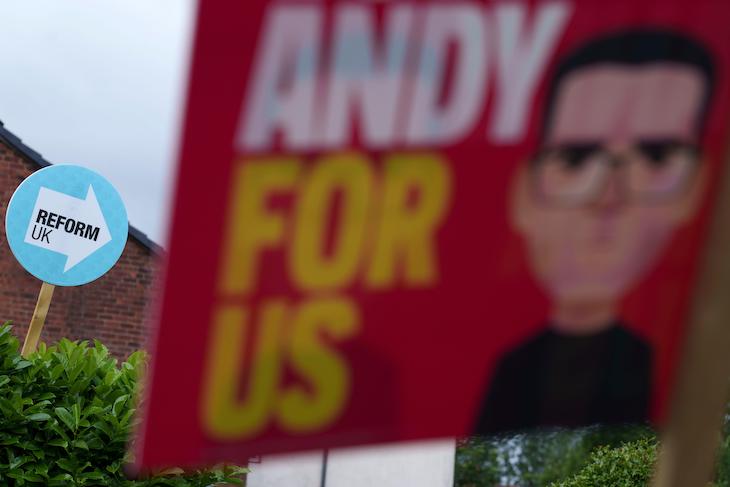
In what now seems like an inevitability, Andy Burnham not only won the Makerfield by-election, he did so comfortably. After weeks of hearing about how it was going to be a close race between the Labour candidate and Reform’s Robert Kenyon, Burnham triumphed by more than 9,000 votes.
Andy Burnham will now be prime minister. He will likely be as bad at the job as Keir Starmer
Some – including Jawad Iqbal on Coffee House – have pounced on this result as a disaster for Reform. It was unquestionably another example of Reform’s poor expectation management. Nigel Farage’s party approached Makerfield with a sense of entitlement, as if they couldn’t lose. Yet lose they did. Despite this, we might look back on the Makerfield defeat as a turning point in Reform’s fortunes.
It is now highly likely that Andy Burnham will be prime minister within the next few weeks, or even days. As Keir Starmer struggles to cling on to his job, there will be chaos within the Labour party. Expect multiple cabinet resignations, and the grim spectre of Starmer looking increasingly desperate and deluded.
But once he gets the keys to Number 10, Burnham will find his honeymoon to be very short-lived. It will soon become apparent that Labour has foisted on us a prime minister in the middle of a parliament, with no real mandate for anything he does – and no real plan for change.
Burnham could be as unpopular as Starmer by the end of the year. As Burnham’s promises fail to materialise, this could provide Farage and his party with a much bigger advantage than simply winning a by-election could have ever done. A Burnham premiership may well pave the way for a Reform government.

Too many Westminster pundits still misread what is happening with Reform. They often think that Reform must win every contest to have any chance of becoming the party with the most seats after the next general election. This blinds them to what is really unfolding in front of their eyes.
Reform is a party that is still coming together, still finding its way. Inevitably, as a result, the party is making mistakes along the way, but we shouldn’t forget, despite the defeat in Makerfield overnight, that Reform is still growing at a rate that is unprecedented in British political history. Reform have almost 2,500 councillors, and they have gained almost all of them across only two sets of local elections. If they have a similar sort of result to what they achieved last month in 2027, Reform will be the largest party in local government in the United Kingdom. And they will have achieved that from a standing start in only three years.
There were two other by-elections yesterday, both in Scotland: Aberdeen South and Arbroath and Broughty Ferry. In Aberdeen, the Conservative Party won big, getting almost 50 per cent of the vote. The Tories don’t have many opportunities to crow these days, so expect a lot of hype around how the Conservative Party has magically regenerated and that Kemi Badenoch is now on track to be the next prime minister after Burnham.
Don’t believe a word of it. The result in Aberdeen South simply shows us what the local election results did a month-and-a-half ago: that the Conservatives are becoming a party that can still win in certain parts of the country, under ideal conditions for them, but are pretty much dead everywhere else. In Makerfield, the Tories lost their deposit and came third among the right-of-centre parties in the running.
In Aberdeen, the Tories were able to win, partly through being the best placed in terms of the big local issue – jobs related to North Sea oil and gas – but mostly because, as in the English local elections, the Tories were able to capture the declining Labour vote almost fully. It isn’t that different to what happened in Westminster or Harrow last month, where the Tories gained at the expense of Labour in places with too small a Reform vote to matter.
In Arbroath, you could see this play out in a way that was not conducive to the Conservatives. The SNP not only won, they increased their vote share in the constituency by almost six per cent as compared to the general election. As happened in Aberdeen, the Labour vote plummeted, only this time the Tories weren’t the big benefactors of this, with Reform greatly increasing their vote share.
Andy Burnham will now be prime minister. He will likely be as bad at the job as Keir Starmer, burning the Labour party’s last remaining hope of avoiding electoral meltdown come the next general election.
Aberdeen South is a false dawn for the Conservative Party, simply demonstrating what we already knew about this dwindling party from the local elections. These results will be used to try and spin a story around how two-party politics as we knew it has finally reasserted itself, with Reform sidelined and Labour versus the Tories being the main event once again. Don’t believe a word of it.



Comments