
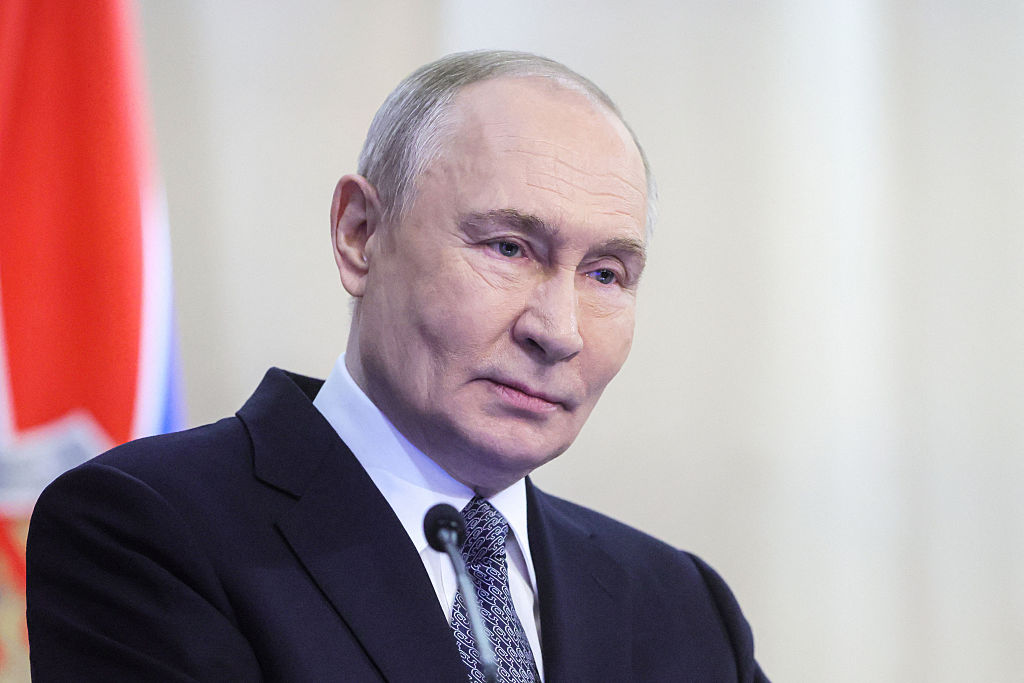
After Iran unleashed a torrent of missiles against its neighbors – including those with whom it had enjoyed friendly relations such as Turkey and Azerbaijan – few regional leaders are in the mood to congratulate the new Supreme Leader Ayatollah Mojtaba Khamenei.
Few, but not none. “At a time when Iran is confronting armed aggression, your work in this high office will undoubtedly require great courage and dedication,” wrote Vladimir Putin in an official message of congratulation to Khamenei Junior. “I am confident that you will honorably continue your father’s legacy and unite the Iranian people in the face of these severe trials.” Putin was also at pains to “reaffirm our unwavering support for Tehran and our solidarity with our Iranian friends” and claimed that Russia “has been and will remain a reliable partner of the Islamic Republic.”
Putin remains, as he has always been, an equal-opportunities disruptor
In addition to thoughts and prayers, the Kremlin has reportedly in recent days also offered something of more practical use to Tehran – satellite targeting for Iran’s missiles, including the location of US military targets in the region. If reports in the Washington Post that Moscow is helping to target US forces are confirmed, that represents a substantive involvement in Iran’s attempt to set the East ablaze as well as a serious provocation to Washington. So far, US official reaction to the reports has been muted, with Secretary of War Pete Hegseth saying that Russia and China were “not really a factor” in the ongoing military campaign against Iran.
Putin remains, as he has always been, an equal-opportunities disruptor. His major geopolitical skill over the last quarter century has been to seize opportunity when it presents itself.
On the upside, the US attack in Iran has spiked oil prices and allowed Putin to return to his pre-Ukraine invasion games of using energy as a political tool. On March 4, Putin, claiming to be “just thinking out loud” mused that it might be time to cut off energy supplies to Europe and explore other partnerships, as the EU has officially vowed to ban the import of all Russian oil and gas by 2027. That statement was, of course, Putin the troll at his most malign. Even as he spoke oil prices were climbing and natural gas prices rocketing. Yesterday, Putin appeared to change course, telling a cabinet meeting that Russia would “continue to supply oil and gas to countries that are reliable partners – including in eastern Europe.”
The continent has seen this kind of good-cop, bad-cop routine before through the summer of 2022 when Gazprom cut off, then restored, then cut off supplies through the Nord Stream pipeline, citing spurious technical reasons. This time around, with 20 percent of global oil supply cut off by the closure of the Straits of Hormuz and oil clocking its largest daily rise in history, Putin can openly afford to flaunt Russia’s status as the world’s largest non-Middle Eastern supplier.
Soaring energy prices could see wartime restrictions on Russian oil exports quickly discarded. Already, Donald Trump has suspended planned sanctions against Indian refineries importing Kremlin oil for a month. An ongoing row between Hungary, Slovakia and the EU over their continued import of Russian oil via the Druzhba pipeline (which runs through Ukraine) will take on an entirely different tone now that an era of cheap abundant oil has been abruptly replaced by a global supply crunch. And high prices of course benefit Putin in the short term and help him fill Kremlin coffers – even as long term trends predict a significant oversupply of global oil this year and sinking prices.
On the downside for Putin is the embarrassing fact that three of Russia’s so-called global allies – Syria’s Bashar al-Assad, Venezuela’s Nicolas Maduro and Iran’s late ayatollah Khamenei – have been taken out directly or indirectly by US power. Russia could do precisely nothing to intervene.
In fact, in recent years Iran has been a more helpful ally to Russia than the other way around. In early 2023 Moscow signed a $1.75 billion contract with Tehran to supply not just Shahed drones but the complete manufacturing blueprints too. Those have been used to produce up to 1,000 modified Shaheds – known as Geran – per day at a vast factory in Tatarstan. In addition, Iran has sold the Russians over $4 billion in other hardware, including Fath-360 ballistic missiles, surface-to-air missiles, anti-aircraft systems and hundreds of thousands of artillery shells. In return, Moscow offered (but did not actually provide) S-400 air defense systems, Su-35 fighter jets, as well as an expanded program of nuclear reactor construction. Moscow’s continued geopolitical cover at the UN Security Council was, of course, the unspoken part of the deal, which in early 2024 formalized into a 20-year “strategic partnership.”
Just as Israeli and US jets made short work of the evidently not-so-great S-300 missile defense systems that Russia did sell Iran, so Washington’s offensive has taken a wrecking ball to the Tehran-Moscow partnership. Possible target-sharing aside, Russia has once again found itself sitting by the sidelines unable to materially help yet another supposed ally.
Putin has his own delicate relationship with the US to preserve as he walks a tightrope between refusing to make concessions in Ukraine while at the same time not provoking Trump’s anger. For the time being Putin can collect the oil dividends of Trump’s war and meanwhile wish the new Ayatollah “sound health and strength of spirit.”



Comments