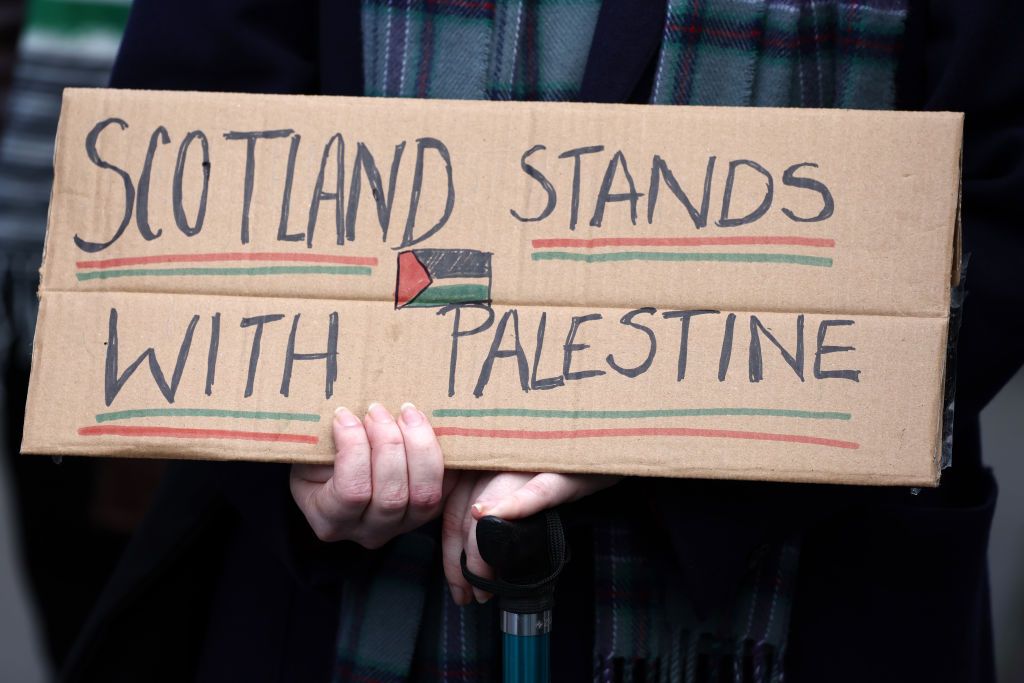
On Sunday evening, activists from the Palestine lobby gathered outside Giffnock Newton Mearns Synagogue, a shul located south of Glasgow and the largest Jewish place of worship in Scotland. They waved Palestinian flags and reportedly held signs reading ‘Zionism is racism’ and yelled slogans. Their target was an event featuring Shivat Zion, an organisation which helps Jews in the diaspora to make aliyah (emigrate to Israel). Given the baying mob outside, I’m guessing it wasn’t a hard sell.
No one attending a place of worship – Jewish, Muslim, Christian, or any religion – should be greeted by protests
Demand for Shivat Zion’s services has grown since the October 7 pogroms, an anti-Semitism super-spreader event on a par with the William of Norwich libel or the Odessa riots, and in one of those coincidences that suggests the Almighty has a dark sense of humour, the synagogue protest came on the same day as figures showing more than 5,000 British Jews have opened aliyah applications in the past three years.
I suppose if you must live in a balkanised, dysfunctional democracy under the threat of Islamist terrorism, you might as well choose the one with a Mediterranean climate.
The demonstrators say that Shivat Zion assists olim (Jewish immigrants) to find homes not only in Israel proper, but also in Judea and Samaria, the disputed territories which the world refers to as ‘the West Bank’. The western mind thinks about this conflict so entirely within parameters shaped by the Palestine lobby – in government, media, academia and the NGOs – that even people sympathetic to Israel never stop to ask why Jews can’t live in the West Bank. Jews have lived there for millennia. It is the land of their ancestral roots and, according to tradition, the final resting place of their patriarchs and prophets.

If international law and humanitarian norms demand that the West Bank becomes part of a Palestinian state, why can’t current and future Jewish inhabitants continue living there and become Jewish residents or citizens of Palestine? There are more than two million Arabs living in Israel today, one-fifth of the country’s population. Why would the prospect of 500,000 Jews living in the Palestinian state, making up less than one-tenth of the population, be a roadblock to peace?
The reason is that, in negotiations and pronouncements across decades, the Palestinian leadership has insisted on the expulsion of Israeli Jews from Palestinian territory. And the world goes along with this because, you see, under the terms of international law and humanitarian norms, this would be the good kind of ethnic cleansing. Reason and compromise will get you nowhere with westerners. It is the union of victimhood and aggression that is their weak spot. Make them pity you, make them fear you, and you can make them do whatever you want.
Let’s say you disagree with all of that. You reckon Israel’s occupation of the West Bank is, at best, ill-advised and counterproductive. You think olim should not be helped to settle beyond the internationally recognised borders of Israel. You can believe all this and still agree that hostile crowds gathering outside synagogues or other places of worship is not on. These kinds of demonstrations, whatever the intentions of those who participate in them, dilute what was once a bright red line: places of worship are off-limits.
Were we to decide that this assumption has changed, that Shivat Zion’s presence makes a shul a legitimate target for protest, we would establish a precedent that would not be long in expanding. It would give a green light for other protests outside synagogues, Catholic churches and Protestant kirks; or to put it in terms progressives care about, mosques. Demonstrating against West Bank settlements at synagogues is your thing, but someone else’s thing might be protesting imams who denounce the kuffar, condemn gays and lesbians and denigrate transgender people. Or marching to the local masjid to decry its segregated prayer rooms and demand that women be allowed to pray alongside men. Or chanting at the entrance to a mosque over a provocative guest speaker or fundraising for a controversial charity.
Under the Giffnock precedent, these rallies would be legitimate, though we know fine well that, presented with such an eventuality, progressives would pivot sharply and apply a different standard. We could spend time analysing why that is and try to develop a theory on the situational ethics of the left, but it’s honestly not worth it. Progressive politics is fashion and nothing more. Muslims are in this season and Jews are out.
Because a society can’t be organised on the caprices of its most emotionally dysregulated members, and because norms cannot be enforced or disregarded according to shifting placements on the hierarchy of victimhood, we need to agree rules that apply across the board and without regard to viewpoint. No one attending a place of worship – Jewish, Muslim, Christian, or any religion – should be greeted by protests.
Even where they are not intended to be, such gatherings are inherently intimidating and distressing. We already recognise this in Scots law, for it is the basis of buffer zones around abortion clinics. If little old ladies praying the rosary across the street from a hospital is a form of coercion, then a noisy, placard-brandishing throng outside a house of worship must also be coercive. If abortion clinic buffer zones are not an affront to freedom of speech or assembly, similar exclusion areas around churches, synagogues and mosques must also be reasonable exemptions.
The Israeli-Palestinian conflict is a profoundly polarising issue, and partisans on either side will continue to hold their views fiercely and express them robustly. But there ought to be, and among the general population likely is, a consensus that protesting outside sacred places is ill-advised, illegitimate and, given the risk of escalation, should be illegal. New rules in activism are going to require new rules in law.




Comments