It is likely that the ordinary man, not being an ideologue, would agree as he grows older with Arthur Balfour’s famous epigram: “In politics nothing matters very much, and few things matter at all.” This is only partly to do with sub specie aeterni, etc. For the rest, there is the simple recognition that politicians always make politics (and the questions and policies with which they concern themselves) out to be much more substantial and consequential than they actually are.
The “democratic process” consisting of popular debate and involvement in the form of public demonstrations, solicitation of opinion by the polls and private and public organizations, print and electronic journalism, commentators, editorialists, “influencers,” advertisers, public relations agents and activists further trivializes political issues far beyond their inherent insignificance.
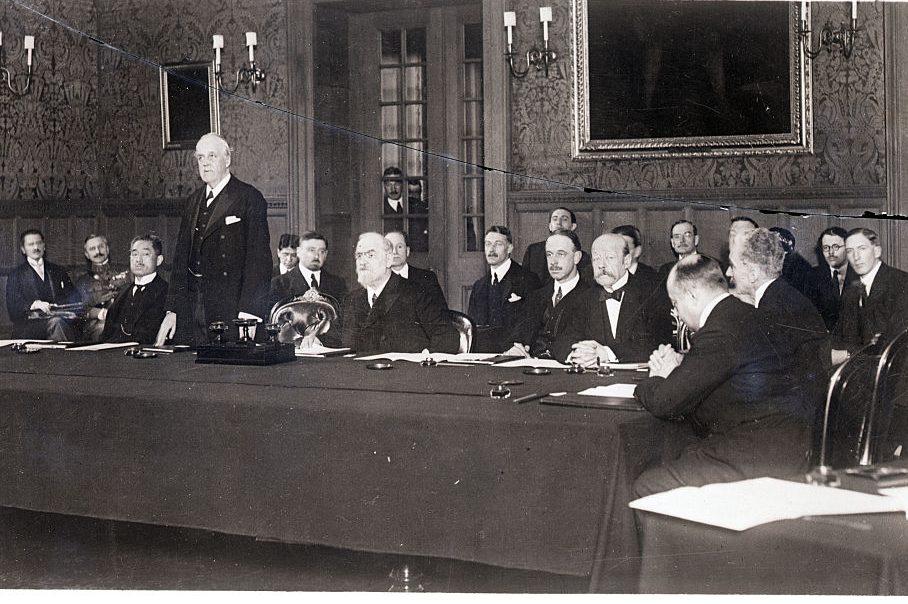
Anyone familiar with the history of the 20th century must be alive to the irony of the author of Lord Balfour’s epigram having been also the author, in his capacity as British foreign secretary at the time, of the Balfour Declaration of November 2, 1917, which committed His Majesty’s Government to favoring the establishment in Palestine of a national home for the Jewish people, “it being clearly understood that nothing shall be done which may prejudice the civil and religious rights of existing non-Jewish communities in Palestine, or the rights and political status enjoyed by Jews in any other country.”
Balfour’s Declaration, coming at the height of the Great War, was – of course – all politics. It was also a political act that produced innumerable results nearly every one of which “mattered,” and continues, 108 years later, to matter very much. Indeed, the Declaration was one of the most lastingly influential and portentous actions taken by any government anywhere in the history of the world. A further irony is that, as the response of a significant number of Diaspora Jews to the Israeli government’s war against Hamas following the massacre of its citizens on October 7, 2023 has shown, many of them – the younger ones especially – appear to have lost interest in Israel as a Jewish homeland, and even in the survival of Israel as a sovereign state in Palestine.

Hence the truth of Balfour’s dictum seems to have been both confirmed and denied over the course of the following century, only to be reconfirmed at a deeper and broader level of historical meaning. The intent of the British government was to assure the support of Jewish communities everywhere (not least in the United States) for the duration of the war, and also to strengthen Britain’s position vis-à-vis the Ottoman Empire following it. Arguably, the Declaration accomplished that purpose in the short run. Yet the fact that the Israeli-Hamas war today is one of many major domestic crises facing Sir Keir Starmer’s beleaguered Labour government could be offered as proof that, in the long run, the Foreign Office’s recognition of a Jewish state “mattered” not at all.
Indeed, where the Middle East is concerned, it may well be that no political decision on anyone’s part “matters” in the context of historically rooted cultural and racial hatreds and antagonisms that exist beyond the appeal to reason, and even to self-interest: the ancient “Masada complex” metastasized across an entire region of irreconcilable peoples, religions, and societies and governments. Politicians of every persuasion and in every country never quit promising their constituents more or less formulaic “solutions” to dire national and international problems, or claiming to have found them.
The likely truth, however impossible to prove by the historical record, is that no such “problem” has ever been resolved by even the cleverest “political” solution. Rather, it has simply been removed by extra-political means – meaning war – or what is even more likely, by time and circumstances themselves. Or, to put the thing differently, the effective agency in political history is not the political actors, no matter how much credit they may claim on their behalf, but time itself which resolves all things simply by moving on, over and past the problems of the moment. As used to be said of old soldiers, they never die, they just fade away.
And so, for all the mayhem and tragedy that Arthur Balfour’s Declaration has produced in subsequent decades, in one sense it has not mattered at all. Had he never written his fateful letter to Lord Rothschild informing him of his decision with regard to “the Palestinian question,” the results would almost certainly have been other than what they were: equally terrible, but in different ways.
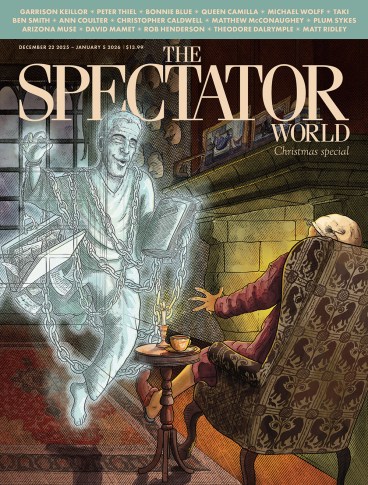
This article was originally published in The Spectator’s December 22, 2025 World edition.




Comments