MAX JONES: “What do you think of the Beatles as artists and people?”
BOB DYLAN: “Oh, I think they’re the best. They’re artists and they’re people.”
—Melody Maker, March 1965
For more than 60 years, people have been fascinated by the connections between Bob Dylan and the Beatles. All were born during World War Two. All loved the music of Little Richard and Elvis Presley and Eddie Cochran; all were blues fans swept off their feet by rock and roll. Dylan was a Minnesota boy who early in his life became the avatar of the American folk scene, and then a protean man containing multitudes, both musically and otherwise. The young men from Liverpool became the most famous and popular group in the world in 1963, retreated from touring in 1966 and disbanded, to global sorrow, in 1970 after a string of bestselling studio albums.
The Beatles were playing in English and European clubs while Dylan was wielding his guitar and harmonica in Minneapolis and Greenwich Village coffeehouses, and their rise from late 1959 to 1962 was simultaneous. Their first singles were released in 1962: respectively, “Love Me Do” backed with “P.S. I Love You” on Parlophone; and “Mixed-Up Confusion” backed with “Corinna, Corinna” on Columbia.
These are the bones of the beginning. In his just-published, largely conscientiously researched Where the Music Had to Go: How Bob Dylan and the Beatles Changed Each Other – and the World, Jim Windolf spins out a story of contemporaries, competitors and, above all, companions.
He is not heavy-handed in inserting himself into this book, as too many music writers can be when biographizing best beloveds. His focus is on the men, singly and together; what they listened to, what they wrote, how they composed, how they performed, when they showed up at each other’s gigs. He writes of their public image and reception, and how these reflected back on them all – and, as is evident from the title, what they took from and gave to each other as they were getting known, and long after they were famous.
Most of Where The Music Had to Go centers on the relationship and musical connections between Dylan and John Lennon. Dylan’s longtime friendship with George Harrison gets far less room, but as I read, I kept thinking about Bob and George, and a man of importance in the equation: Barry Feinstein.
Harrison’s friendship with Dylan was flourishing by November 1968, when George and his then-wife Pattie Boyd came to Woodstock for Thanksgiving with Bob and Sara Dylan and their children. (A Woodstock friend who was there with her brother tells me that Pattie spent much of the time trying to talk to a polite but definitely discouraging Bob, while George curled up on the living room floor and played with the many toddlers and small children present).
Letters and holiday cards from George to “Bobbie” are bright moments in the Bob Dylan Archive in Tulsa, Oklahoma, and it was Harrison who persuaded Dylan to join the Traveling Wilburys in 1988. After Harrison died in 2001, Dylan said, “He inspired love and had the strength of a hundred men. He was like the sun, the flowers, and the moon; we will miss him enormously. The world is a profoundly emptier place without him.”
Some quotations from interviews with Feinstein (who died in 2011), appear in Where the Music Had to Go, but the depth of his friendships with both Dylan and Harrison don’t register as they should. He’s best known today as a leading music photographer of the 1960s and 1970s, who shot the album covers for Dylan’s The Times They Are a-Changin’, making his 22-year-old friend look old as the hills and like a survivor of the whole sweep of America’s past; Harrison’s All Things Must Pass (it was Barry’s idea to surround George with garden gnomes); the Rolling Stones’ Beggars Banquet (initially banned, and with toilet graffiti supplied by all the band and Barry); and Janis Joplin’s Pearl (taken the day before she died). However, Feinstein was also a gifted graphic artist and designer who sketched the first bear mascot for the legendary music manager Albert Grossman’s studio, theater and restaurant complex in Bearsville, New York – though Milton Glaser’s “little bear” won that competition – and had had a long history in the movies and in Hollywood photography before the 1960s ever came around.
Born in Philadelphia in 1931, Feinstein was a decade older than Dylan and the Beatles, and had lived through and remembered the times that bore them, specifically World War Two. He began taking photographs professionally while serving in the Korean War, sailing with the United States Coast Guard. Soon Feinstein was working for Life magazine, and he then moved to Los Angeles in 1956 as a production assistant for Columbia Pictures. Dylan and the Beatles shared a major desire in that they wanted to star in, and also make their own, movies from the beginnings of their careers: Feinstein had already done all that, working on Pal Joey, 3:10 to Yuma and Bell, Book and Candle.
His photographs from his LA days are truly that overused word, iconic – the Hollywood sign from its frail crossbarred rear view, Judy Garland on set, Frank Sinatra grinning with John F. Kennedy, Marlon Brando marching for civil rights, the chloral hydrate bottle on Marilyn Monroe’s bedside table the morning after she died. Movie stars were his friends. Feinstein and one of his best pals, Steve McQueen, used to terrorize the Hollywood hills on their motorcycles after work, hellraising along Mulholland and up and down the canyons. Feinstein’s address book from the mid-1960s, on the same page of Ds, lists Bob Dylan’s home number in Bearsville, Sammy Davis Jr. and Bette Davis.
Feinstein and Dylan – and Feinstein and Harrison – bonded over cars. In the summer of 1963, Grossman, then the manager for Dylan and for Feinstein’s new wife Mary Travers, and the man who assembled Travers, Noel Paul Stookey and Peter Yarrow into one of the top groups of the folk revival, needed his Rolls-Royce Silver Dawn driven to New York City from where its transmission had died in Colorado. Feinstein volunteered and Dylan flew out to accompany him. The men evidently had a ball as they drove, behaving very much in a Kerouacian, on-the-road idiom as they crashed a rural camp meeting, raced a freight train somewhere in the Nebraska prairies and took a few photographs along the way. “We didn’t talk much unless there was something really to say. That’s how I am and it’s how Bob was too, so we got along fine. Over time we hung out more and understood each other,” Feinstein said much later, by way of explaining their friendship.
Feinstein and one of his best pals, Steve McQueen, used to terrorize the Hollywood hills on their motorcycles
In 1966, Dylan and Grossman invited Feinstein on the European leg of Dylan’s world tour. His images of that half-acoustic, half-electric, legendary series of concerts in which Dylan was backed by a group of musicians who would (with the reappearance of Levon Helm) become known as the Band, are among the best-known of Dylan: the thin young man in new-bought Carnaby Street clothes standing at the Aust Ferry; larking in front of a Sheffield betting shop rejoicing in a sign reading “LSD.”; sitting in a Liverpool doorway with a group of kids; and on streets and in hotels and limos, backstage and on stages across England, Scotland, Northern Ireland, Ireland and France.
In 1974, Dylan and the Band would hire Feinstein as their official photographer for their reunion tour. He and Dylan remained friends until Feinstein’s death, and their collaboration Hollywood Foto-Rhetoric: The Lost Manuscript (2008) features Dylan’s text and Feinstein’s pictures.
Harrison and Feinstein met during a photo session at which Feinstein’s friend Jim Marshall was the official lensman. By 1970, they were friendly enough for Feinstein to visit Harrison at Friar Park, which he’d continue to do for many years. Feinstein told me that when he arrived, George would often meet him “in one of his cars” – Harrison had dozens – and they would zoom to a garage or dealership with something spectacular for sale, or to a car show or race. In the summer of 1970, after that tragic Goodwood race in which Bruce McLaren died, Feinstein photographed Harrison at home for his first solo album All Things Must Pass, emphasizing the landscape of Harrison’s riverbank acres and taking images of him inside his house.
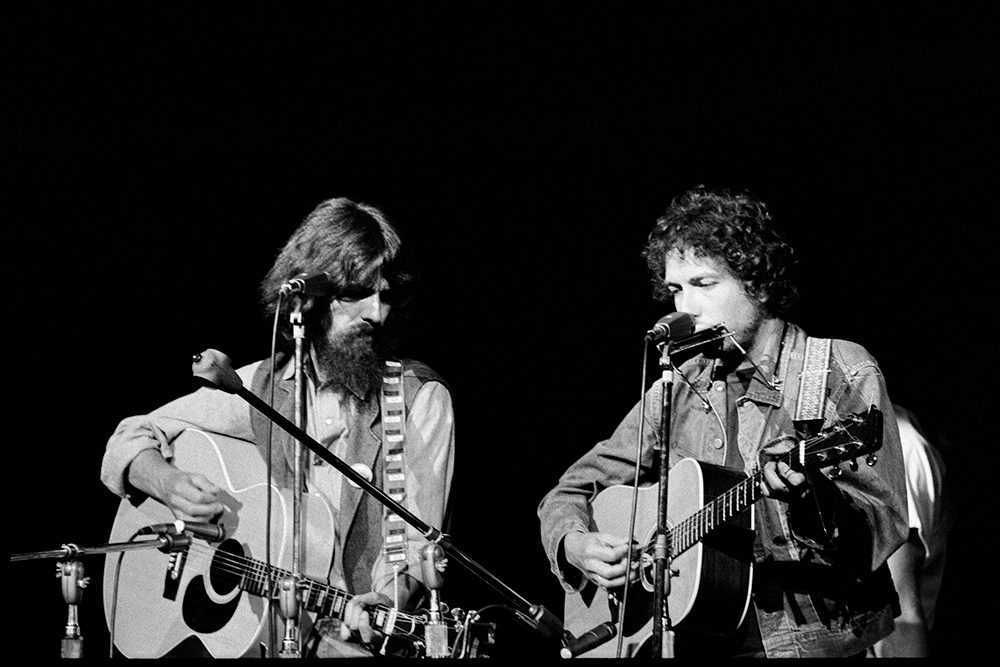
All three men joined together for a worthy and charitable cause in the summer of 1971, when Harrison and the Indian musician Ravi Shankar organized a benefit concert for the newly independent, war-damaged and famine-ravaged country of Bangladesh. Dylan, Ringo Starr, Jim Keltner, Billy Preston, Leon Russell and Eric Clapton, among many, performed two shows on August 1 at Madison Square Garden. Feinstein and his design partner Tom Wilkes were the house photographers, and only Feinstein was permitted at the rehearsals. If you want to know how Bob Dylan and the Beatles, or at least this Beatle, regarded each other and their arts, view them through Feinstein’s eyes: sometimes a picture really is worth a thousand words.
Only a handful of items traveled with Feinstein from home to home, Los Angeles to New York, Connecticut, Bearsville and ultimately to Woodstock, and remained in his old studio until the day he died. They are dispersed now, but among the few were one of Dylan’s Marine Band harmonicas from his 1966 tour, Feinstein’s gold record for The Bootleg Series Vol. 4: Bob Dylan Live 1966, The “Royal Albert Hall” Concert, a letter from Harrison thanking him for his work on the art for the album The Concert for Bangladesh, and a small silver Buddha on a chain, engraved from George to Barry – a talisman, a household god, a token of connection and affection. Artists and friends, the latter as enduring as the former.
Comments