
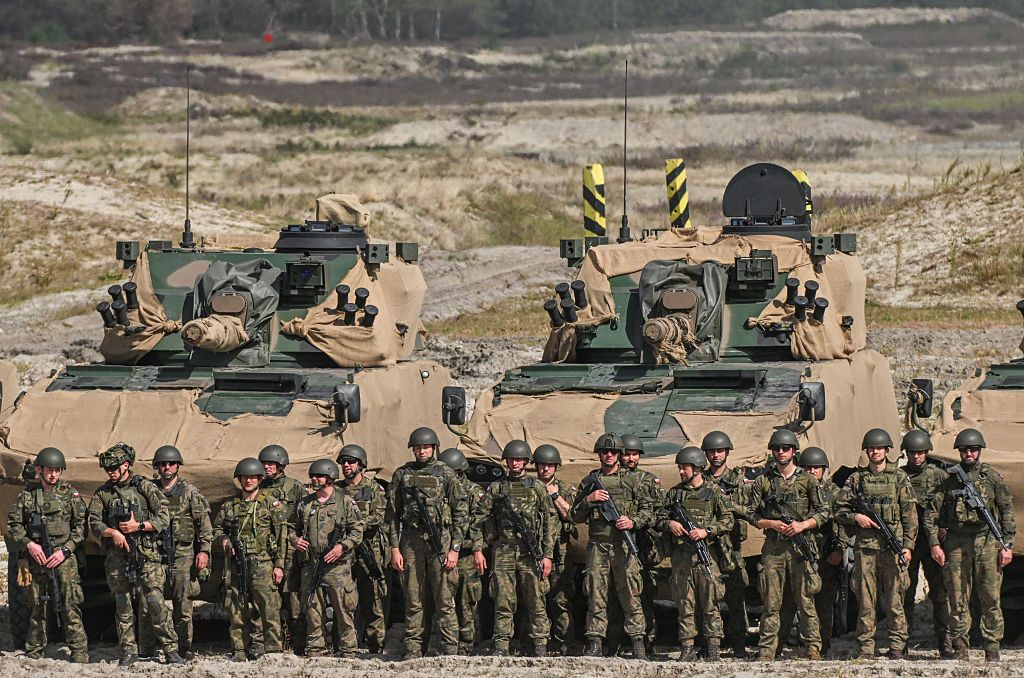
“GREAT NEWS,” hollered @realDonaldTrump on Truth Social yesterday. “Thanks to the bold leadership of my friend, Karol Nawrocki, President of Poland, major progress is being made toward establishing a US Army base in Poland.” A lot is going on on Europe’s Eastern Front. The Polish Prime Minister Donald Tusk declared around the same time that Russia is planning “hybrid strikes using drones and missiles against countries supporting Ukraine, including Poland.”
Team Trump appears to be using a diplomatic stick-and-carrot
Four days earlier, near the Polish-Ukrainian border, an apparent Russian drone strike blew up a train close to another train carrying former prime minister Boris Johnson, former CIA director David Petraeus, the historian Niall Ferguson, and various Baltic and Slavic leaders.
The dignitaries had all been in Kyiv attending the Yalta European Strategy summit, which is funded by the Ukrainian oligarch Victor Pinchuk, and sometimes called the “Ukrainian Davos.” Pinchuk became a top-tier oligarch by picking up major state industrial assets on easy terms while his father-in-law, Leonid Kuchma, was Ukraine’s president. In the following decades, he spent heavily on western politicians – including the Clintons – forums and philanthropy to recast himself as a good European benefactor.

At the YES summit, much of the talk was about Jared Kushner, another opportunistic son-in-law, and his fellow US diplomatic representative Steve Witkoff, who had been in Moscow and Kyiv the previous week for meetings with Vladimir Putin and Volodymyr Zelensky. Putin told Kushner and Witkoff that Russia was on the cusp of victory in Ukraine, to which Kushner reportedly replied, with respect, that the President had made the same claim last year.
Last week Kushner told the YES delegates, via videolink, that a new framework for a peace deal was within reach, if only the Ukrainians were “willing to move back to Putin’s desired line” on the disputed territories of the Donbas.
At the same time, Congress has passed an important bill, named after the late senator Lindsey Graham, sanctioning the Russian energy sector for supporting Putin’s war in Ukraine. Graham, possibly the most hawkish man in the Senate until his death in July, would be so proud, no doubt, while Trump has said he would sign the bill honoring his deceased friend.
But Graham might have been less enthusiastic about the other track of the Trump administration’s latest outreach to Russia. In order to show its commitment to a “reset” of relations with the Kremlin, the White House is now said to be offering to strike new business arrangements with Russia even before the fighting stops in Ukraine. This would be a change from Trump’s earlier position, which was that all Russia, Russia, Russia deals would have to wait “until we get the war settled.”
Team Trump, then, appears to be using a diplomatic stick-and-carrot: ramping up the threat of sanctions and increased military pressure, while bringing forward the possibility of lots of highly lucrative Russian deals.
In early 2023, at the very start of his successful presidential election campaign, Trump famously promised to end the war in Ukraine within 24 hours of re-entering the White House. Well, it’s been 20 months and the war goes on, killing thousands every week. The latest maneuvers do suggest that a new drive for an end to the conflict is under way. But – as with Trump’s Iran adventure – the lines between peace and more war are very blurred.
This article originally appeared in Freddy Gray’s Americano newsletter, which you can subscribe to here.






Comments