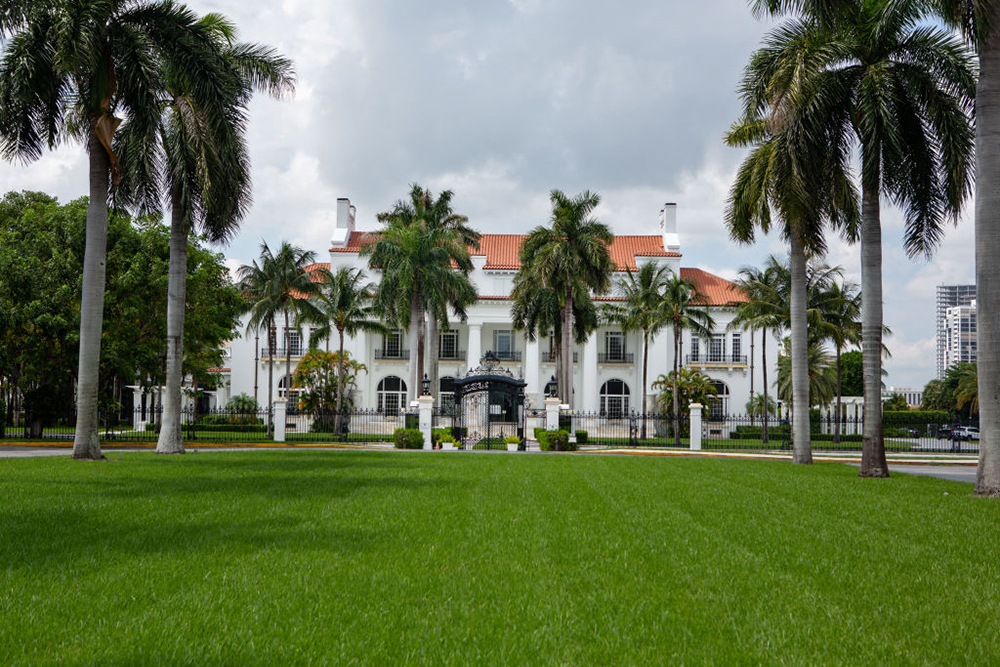

A reporter, writing in one of the local rags recently, observed that “Palm Beach does not take itself too seriously.” Er… wrong. Very wrong.
Palm Beach takes itself very seriously indeed and, as the location with the greatest density of billionaires, why not? And the two things it takes most seriously are money and property. As I have remarked here before, property prices are close to being a religion in Palm Beach. Not a day goes by without the local “shiny sheet” reporting the latest property price news, mostly a happily reassuring dollar figure for this condo or that beachfront palace.
Given this, well, preoccupation, it is no surprise that we now have two new concepts in property. These are “property promiscuity” and “polydomary.” The former is the practice of said billionaires buying up house after house, here, there and, yes, everywhere – multiple properties in Hawaii, Aspen, London, Southampton, Saint-Tropez, PB itself. One reason is hard-headed financial: property may not zoom up in price as some investments do, but on the other hand it rarely falls precipitately, as those other investments are prone to do.
But there is another, arguably more interesting reason, and this links property promiscuity to polydomary. It is the idea that, by owning a promiscuous number of properties, one can control – to an extent – who those properties are sold on to and so one has some say over the area where one lives.
In polydomary, equally rich friends buy houses near to one another so that they and their families can form small communities of like-minded people, of similar income, education and lifestyle backgrounds, all intended to make life more agreeable. It is in some ways a step forward from gated communities, where people may have similar backgrounds but may otherwise be total strangers. Polydomary also fits into the new trend here, say realtors, for entertaining at home. This is a trend, if it is a trend, that I have not noticed. Restaurants here are still packed to overflowing.
Another quite different property transaction is the proposal to renovate the historic Woodlawn Cemetery here into a sort of Central Park of Palm Beach. A group of wealthy locals, who say they find the cemetery “tired-looking” (which is true enough), want to spend millions on it, to create a place where people can stroll, relax on benches, have picnics, hear poetry readings and “listen to string quartets.” But a rival group of equally rich locals opposes them, arguing it will upset the many residents whose ancestors are buried there (and many of those ancestors were pioneers in the early days of Palm Beach), and deserve their quiet resting place. The local council is so far lukewarm on the idea, but it surely shouldn’t be beyond the wit of man to find a compromise.
Compromise doesn’t seem possible on the vexed matter of sociology. There have long been suspicions that sociology is not so much a scholarly discipline as a political ideology posing as a scholarly discipline. In March, the State University System Board of Governors voted to “disallow” introductory sociology classes from counting toward general education requirements needed for a bachelor’s degree. Instead, students could take the course as an elective.
This decision is the latest move in Florida’s attempts to tackle how universities teach racial and social inequalities. It reflects Governor Ron DeSantis’s battle against what he sees as “woke” ideologies. It has come to a head because certain academics in Florida have criticized a new sociology textbook adopted in some universities here and which, according to one of the local professors, was “crafted” to comply with state law, prohibiting general education courses from teaching a curriculum based on “theories that systemic racism, sexism, oppression and privilege are inherent” in America’s institutions.
Is sociology more important than history, literature, medicine? This is where ideology comes in
Opinions are so fraught that, although this latest move by the Board of Governors doesn’t prevent students from taking sociology courses, since they can still elect to take a course, some professors think it has created a “theater of intimidation,” with some saying that certain academics are being forced to teach sociology quietly (secretly?) without acknowledging that they are doing so, to avoid criticism. What it actually boils down to is that the new textbook removed about 400 pages from its earlier version, those chapters being about the media and technology, global inequality, social stratification, race, gender and sexuality. One critic went so far as to say that “deciding what can and cannot be taught to students is a form of censorship,” but how can that be? Courses can’t cover everything and forcing people to confront sociology is just as likely to turn students off the subject as to enthusiastically espouse it.
One unusual sociological problem we have right now concerns a woman who was discharged from a hospital here as long ago as October 6 last year but refuses to leave her room. Information is hard to come by; we don’t know why she was in hospital in the first place, whether she regards herself as not yet fully treated for her mysterious ailment, whether she is mentally ill, or simply that she has nowhere else to go.
So far that’s an administrative/psychological problem, not a sociological problem. The sociological problem will arise if her behavior catches on and the homeless, of which the Palm Beaches have a few, decide that treatment in hospital is a new way to stay warm and acquire a comfy bed.


Comments