
It took the stabbing of two Jews in Golders Green to bring Arts Council England’s decade of funding hate to a close. On Tuesday, Keir Starmer criticised the Arts Council (ACE) for funding organisations that promote the work of ‘anti-Semitic artists’. The Prime Minister also promised to force the body to ‘suspend, withdraw and claw back’ money from organisations that have platformed anti-Semitism.
It’s nice that Starmer has woken up to the fact Britain’s main arts and culture grant provider is using taxpayer money to fund hate. But one does have to ask where he’s been for the last decade?
British Jews will remember when ACE awarded £14,000 of funding to a Palestinian theatre group in 2015 to put on The Siege, a polemic glorifying the actions of Hamas terrorists during the Second Intifada? ACE did nothing when the play’s co-director, Zoe Lafferty, said that ‘to have to engage in whether Hamas and the Al-Aqsa Brigade are terrorists is the wrong question to ask’?
One does have to ask where Keir Starmer has been for the last decade?
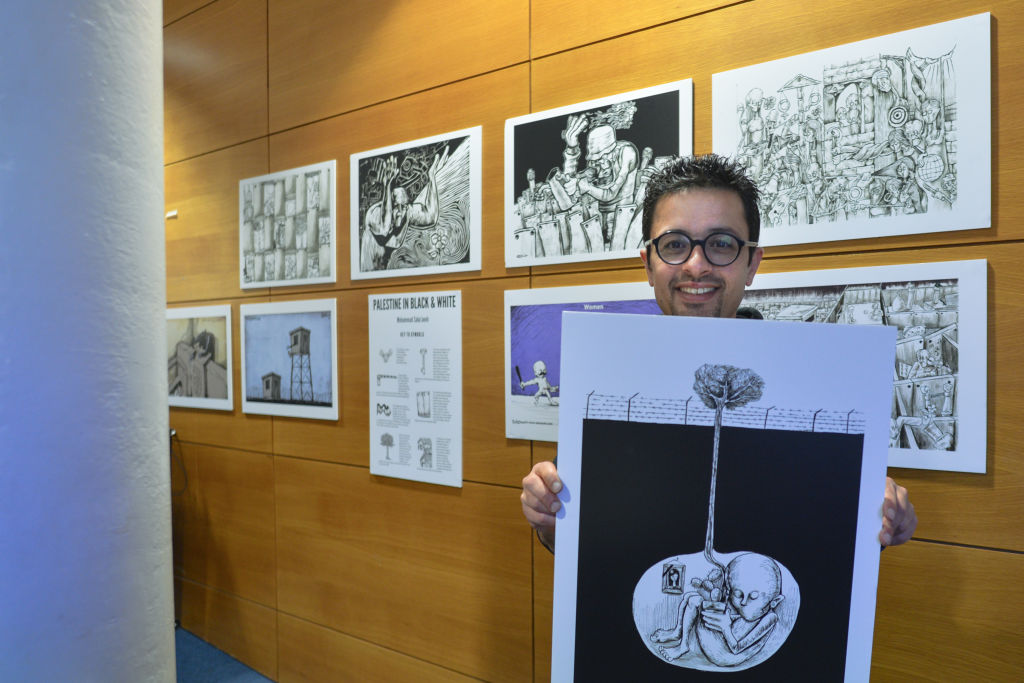
More recently, and during Starmer’s tenure as Prime Minister, ACE funded the Lakes International Comic Arts Festival, which invited Mohammad Sabaaneh to co-curate an exhibition on Palestinian comic-book art. Sabaaneh’s work as a cartoonist includes depictions of Israel as an octopus throttling the world, a Jewish-looking man nailing Christ (wearing a keffiyeh) to the cross, and a Jewish concentration camp internee transforming into an Israeli settler. ACE told journalists at the time that the onus was not on it to do anything about Sabaaneh’s scrawls because it is ‘not a regulator’. The government did nothing to intervene.
While activist artists have been churning out anti-Semitic bilge with ACE funding, Jews have been forced out of England’s culture sector. A report by Freedom in the Arts published this month charts how Jewish artists have been subjected to a wave of boycotts since the 7 October massacre. It attributes much of this to funding criteria ‘which leans towards arts as social activism’. When 1,200 musicians signed a letter demanding festivals drop Barclays’ sponsorship due to its investments in defence companies that supply Israel, ACE provided no guidance to the festival managers facing pressure to distance themselves from the Jewish community.
This is not the first time ACE have been warned about the content they platform. Last month, Darren Henley, the chief executive of Arts Council England, was hauled in front of the Culture, Media and Sport Committee to discuss a recent review into ACE. Throughout the session he exhibited no interest in the creep of anti-Semitism through his organisation and its funding networks. When asked for a response to warnings from the Antisemitism Policy Trust that Jewish artists are being cancelled, his answer was mealy-mouthed: ‘We absolutely have a policy on all forms of racism.’ He offered only platitudes, making no reference to the attacks on Jewish artists over the past two years, nor to the types of projects ACE funds and the types it excludes. But then ACE has consistently shown that it is incapable of standing up for any group which doesn’t enjoy the most outré position on the woke spectrum.
In 2022, the LGB Alliance was awarded a grant through ACE to make a film, Queens: 70 Years of Queer History. Impeccably inclusive, you might think. But the announcement prompted a backlash from trans activists, because while the LGB Alliance supports sexual minorities, it is also a gender-critical group that believes men shouldn’t be admitted to women-only spaces. This stubborn attachment to biological reality led the London Community Foundation (the body allocating ACE’s ‘Let’s Create’ Jubilee fund) to suspend the grant.
So when an ACE grant is funding anti-Semitic cartoons there is nothing they can do, but when some old-fashioned feminists are given funding, intervention is urgent.
When Denise Fahmy, an ACE employee, attended an online all-staff drop-in meeting to discuss the grant, the deputy chief executive accused the LGB Alliance of being a ‘divisive organisation that has a history of anti-trans exclusionary activity’. Another staff member later called the organisation ‘a cultural parasite and a glorified hate group’ with ‘supporters that also happen to be neo-Nazis, homophobes and Islamophobes’. The environment was so censorious that Fahmy resigned. She later received an apology and undisclosed payout. This surely was all the proof needed to show the quango is completely out of control.
It’s not as if ACE is a careful steward of quality in the arts. High culture has suffered at its hands. Cuts to funding for the English National Opera and the National Theatre (for the crime of being based in London) undermine creative endeavour. Indeed, ACE is explicit that its mission is ideological, not artistic. In the introduction to its 2020-2030 strategy, ‘Let’s Create’, Sir Nicholas Serota, the chair, announced that ACE would tackle three ‘key challenges’: ‘inequality of wealth and of opportunity, social isolation and mental ill-health, and above all of these, the accelerating climate emergency’.
How can an approach that ties funding to ‘social impact metrics’, tests of inclusivity and diversity monitoring produce good art? Some venues that house genuine artistic excellence, such as the Wigmore Hall, have walked away from ACE’s funding and struck out on their own because of the strategy.
This is not the first time that ACE have been asked to please stop funding extreme activists at the expense of the rest of the cultural sector. In March, Baroness Hodge, a Labour peer and former minister of state for culture, published her review of ACE. She tried to remind the body that it is not its job to ‘change society’ but to fund good art. More must be done, she warned, to ‘rigorously uphold the principle… that arts funding is protected from politicisation’.
Fundamentally, ACE is incapable of recognising that it itself is highly political. They have accepted the report’s recommendations but months later ‘Let’s Create’ is still the strategy in place. I can find no attempts by ACE to make amends for the hate they’ve funded so far.
When ACE published guidance in 2024 (now amended) advising funded organisations to avoid ‘overtly political or activist’ statements, it never seemed to occur to it that this criticism could be levelled at its own organisation. Like so many progressives, its members seem to think that their views on Gaza, transgenderism and diversity are orthodox and uncontroversial. They do not see how biased ACE’s funding processes are. Maybe the Prime Minister’s intervention will finally change that. But Starmer is dealing with an organisation reluctant to change.
After the attack in Golders Green, perhaps realising he was on thin ice, Henley published a statement promising that ACE is now committed to ‘backing the talent and ambition of Jewish artists and creative professionals’. It was ‘intolerable’, he said, ‘that any member of any community should be prevented from enjoying culture or working safely in our sector due to discrimination or fear’. Has he finally pulled his head out of the sand?
Henley’s patronising statement would suggest not. He claimed that ACE is ‘here to help’. So where is their acknowledgement of the harm that’s been done? Were they here to help when the Collections Trust, an ACE sponsored charity, described Hamas as ‘anti-colonial freedom fighters’? Or when the Trust’s (now removed) guidance on ‘inclusive’ terminology warned about the ‘pro-Israel Western media’?
Every year the taxpayer hands the Arts Council £450 million to distribute. In return, for a decade, ACE has refused to learn from their mistakes. Is it too much to ask that money extracted from working people’s wallets be spent on art that inspires rather than indoctrinates?





Comments