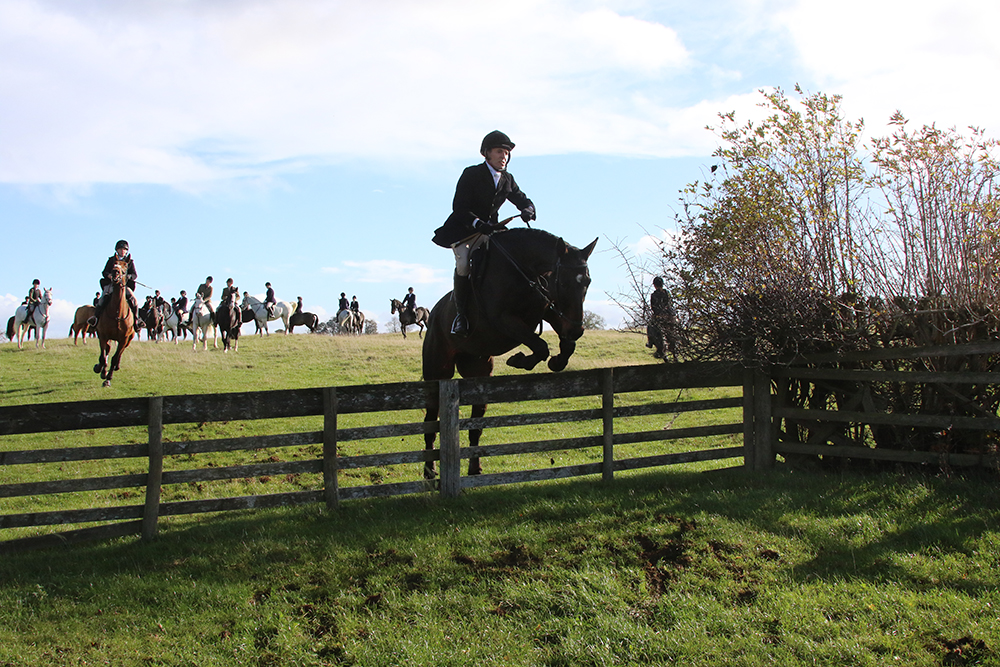


My favourite hunter has died and I am bereft. No disrespect to the myriad other horses I have known and loved over the years – Ianto, Alfie, Mr Darcy, Thurlow, Boris, Shannon, Etonia, Langford, Motown, Eddie Stobart, Foxy, Totto the polo pony, Sunshine, B.G., Barnaby and the legendary Spartacus. But Carpenter was in a league of his own.
‘You sound more upset about Carpenter than you are about Grandpa,’ said Boy, referring of course to my beloved late father Malcolm, whom I have just buried. ‘Yes, but Grandpa never carried me over hedges in life or death situations,’ I replied.
This is the thing that non-hunting people will never understand. Your mount isn’t so much a horse as he is your closest wartime comrade. You’ve been through hell together – wind, rain, mud, hail; you’ve braved fences, ditches, rivers, wire entanglements, rabbit holes, low branches; you’ve seen riders all around you come horribly unstuck, sometimes sustaining injuries requiring them to be helicoptered off the field. Yet somehow you’ve survived. And all thanks to the stamina and courage of the four-legged life-saver who has revelled with you in every moment.
Your mount isn’t so much a horse as he is your closest wartime comrade. You’ve been through hell together
I first met Carpenter after a long, painful period in which I’d been banned from hunting by my entire family because I’d sustained a broken collar bone and several cracked ribs, then got a pulmonary embolism, and they decided it was too dangerous. Eventually, they relented – but only so long as I found myself a decent horse rather than doing it Jorrocks-style on unsuitable borrowed nags. Carpenter’s name – same trade as Jesus – felt reassuring.
Unlike the sturdy Irish drafts I was used to, this handsome bay was a thoroughbred, which is a very different experience. One is like a Range Rover – solid, reliable, steady; the other is like a Ferrari – if it could jump over six-foot hedges, that is. Thoroughbreds also have the advantage of being relatively small, which means you can get off for a pee and, crucially, vault back on again if the hounds suddenly take off.
What struck me immediately was how smooth and eager Carpenter was in the jump. And also how ludicrously swift on the straight. He had at least six gears and you definitely didn’t want to let him go any higher than fourth. Once he’d lengthened his stride there was no hope of reining him in. He’d soon overtake the master and accelerate towards the hounds, which in hunting is considered poor form.
Afterwards, the lady who had hired him to me – the magnificent and redoubtable Diana Jack – asked how it had gone. ‘Well, it was great at first. He jumped everything. But then halfway through the day he kept refusing.’ Diana looked at me sternly. ‘You didn’t slip the reins, did you?’ she said. ‘I didn’t what?’ I said. ‘You’d better come in for a lesson before you ruin any more of my horses,’ she said.
Slipping the reins is a daunting technique. As the horse thrusts his head forward ready for the jump, you have to fight your natural urge to cling on to the reins for dear life and (using just the neck strap for support) instead let them slip through your fingers. Crucially, it stops you yanking your horse’s mouth and either getting pulled off over his head or bringing him down on top of you.
From that lesson on, all I wanted to do was to be worthy of Carpenter. Horses love hunting because they’re herd animals and they adore partying with their mates. It’s a huge privilege to be able to share in this special moment with another species, and the last thing you want to do is ruin their fun by pulling their teeth out or breaking their necks.
Because they do this sort of thing more than you do, the secret is to let them get on with it. You’re just a passenger; they’re the ones doing the actual jumping. I had to remember this one memorable day with the Warwickshire hunt below Brailes Hill, when we turned a dog-leg right and I found myself facing a wall of blackthorn which I would have given anything to avoid if there’d been time. But there wasn’t. All I could do was kick on, look straight ahead, slip the reins and hope for the best. ‘FUCK!’ I said, afterwards, unable to believe I was still alive.
My last ever day with Carpenter was in February at Thornby with the Pytchley. By this stage in his career, he would only accept a bridle called a hackamore. This has no bit – it’s just a leather hoop that goes around the horse’s nose, which means you can’t stop. I tried slowing Carpenter by tucking him in behind other horses. But he would always find a way through.
This was because of a key detail I haven’t yet mentioned. Carpenter was an ex-racehorse. And quite a serious one at that: Robin Oakley even wrote about him here in the days when he was called Wychwoods Brook and won five races, including the 2014 Peter Marsh Chase at Haydock.
Thornby was one of the most terrifying and exhilarating days of my life, as you might expect if you’re not a jockey on a very fit ex-racehorse with no brakes. Somehow, in the excitement, I broke my finger quite badly. But because Carpenter was on such form, jumping everything, cleverly saving my arse when on one occasion, mid-jump, someone else cut across our line, I kept going for two more hours till the pain and debilitation made it impossible.
My final memory is trotting him along the road towards the lorry and Carpenter, straining to hear and see where the hunt had got to, desperate to get back into the fray. Hunt horses never want to retire and Carpenter, bless him, had the fortune to die suddenly in his sleep aged 19, still fully active in his hunting prime. I wonder if he knew about the ban this awful government is planning – and quit while he was still ahead.



Comments