
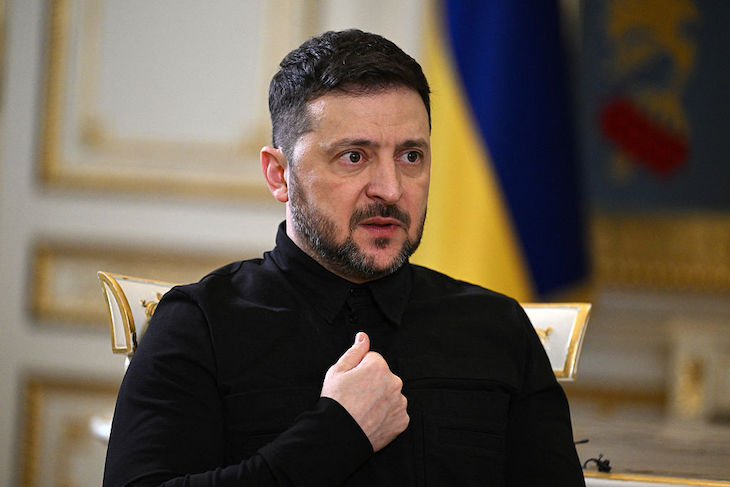
Ukrainian President Volodymyr Zelensky says that World War Three has already started. Speaking to the BBC on the eve of the fourth anniversary of the Russian invasion, it’s understandable why he would want to take this line, but he’s wrong.
What is striking about Putin is the lack of a messianic ideology
On an emotional level, Zelensky has seen millions of his citizens flee within and out of his country, its cities and infrastructure shattered and Vladimir Putin’s propagandists denounce him variously as a Nazi apologist, drug addict and western puppet. Of course he will frame this in the most apocalyptic of terms.
More to the point, Ukraine is now dependent on European aid. It is European money that keeps the government solvent, and arms the troops. At a time when budgets are tight and populist parties on the rise – and many are either more sympathetic to Moscow, or at least less indulgent of Kyiv – arguably Zelensky’s key role is to keep Europe engaged, and that means sometimes inspired, and sometimes terrified.
To this end, Zelensky needs constantly to reinforce the notion that Ukraine is fighting not just for its own sovereignty and survival, but all Europe’s. That every euro or pound, bullet or rocket, helps Ukrainians keep the Russian bear at bay. Does it really? Since before he was ever president, Putin has made it clear that he considers Ukraine part of Russia’s birthright. Yet, bar the odd rhetorical genuflection to the idea that “wherever a Russian soldier sets foot, that’s ours” (even Alaska, Paris, Kabul and Beijing?), he has never seriously expressed a desire for a war of conquest in Europe, that Russia is incomplete without Warsaw or Helsinki.
Zelensky may claim that “Russia wants to impose on the world a different way of life,” but what is striking about Putin is the lack of such a messianic ideology. He has turned to a toxic mix of nationalism, Russian Orthodox chauvinism and social traditionalism in a bid to legitimize himself now that his old social contract – shut up and let me run the country, in return for stability and prosperity – has been broken. There is no serious sense that he wants to export this, just exploit the failures and fissures in our own systems for pragmatic reasons.
Of course, rearmament is prudent, not just to deter any potential threat from Russia but also now that Europe is being forced to come to terms with the implications of lazily depending on the US, without considering that America’s interests may not always be its own. Nonetheless, this needs to be kept in context. There is too much loose use of terms such as “victory” and “defeat.” Russia is not in a position, even if the war continues for years, to roll into Kyiv, let alone all the way to Ukraine’s borders with NATO. Even the threat of an east/west division of the country along the Dnieper river now looks impossible. Nor do Poland, Finland or the Baltic States, the only nations potentially subject to direct land attack, look at all like easy targets. We do need to address the contradiction that we are forever told that Russia is on its knees, yet somehow also an existential threat to a continent several times richer and more populous.
Still, one cannot blame Zelensky for pushing the line that “stopping Putin today and preventing him from occupying Ukraine is a victory for the whole world. Because Putin will not stop at Ukraine.” His job is to advocate for Ukraine’s interests, and he does so extraordinarily well.
Yet we also have to acknowledge that there is a danger in such rhetoric, especially when it gets repeated by western leaders. The very concept of “war” is made meaningless by its over-use. To some, Russia’s campaign of assassinations and sabotage in Europe should already be considered an act of war. At the same time, are sanctions not simply a tool of economic warfare? If that is the case, then the West effectively declared war on Russia in 2014, after the annexation of Crimea. And does Donald Trump’s predilection for using tariffs as a means of coercion mean he is at war with the world?
Language matters, and if everything is war then the word becomes meaningless. As I wrote in my 2022 book The Weaponization of Everything, globalization, the way we now all operate in the same or intersecting economic, informational, social and technological worlds, means conflicts have sharpened, even as they are often fought by non-military means. Yes, the West is in a conflict with Russia, and probably will be to greater or lesser extent at least so long as Putin is in power. Yet we need to mind, and maybe redefine our language. Calling Europe “at war” with Russia normalizes the existing conflict (if this is war, well, it’s not so bad), plays to Putin’s own propaganda about belligerent westerners, and cheapens our discourse. If sporadic hacks and pesky disinformation is “war,” what will we call it when the missiles are flying?

Comments