
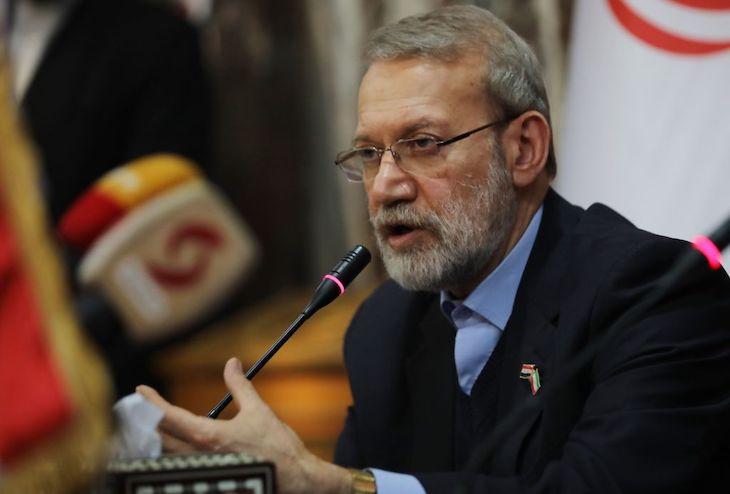
Iran’s most powerful leaders are being picked off one by one by Israeli and American military strikes. The latest scalp claimed by Israel is Ali Larjani, Iran’s security chief, and widely believed to be the most powerful figure in the present Iranian leadership. The reported killing comes just days after Larjani went on a public walkabout in Tehran, all defiance and bombast as he greeted members of the public during the Quds Day rally last Friday in the capital. Larjani also spoke to state media during the march, claiming that the Americans and Israelis were “running out of steam”. Well, not quite in his case, it turns out.
Few will mourn the demise of Larjani. Yet the success of this campaign of targeted assassinations poses deeper – and so far unanswered – questions
There is no disguising the significance and symbolism of this latest decapitation. It will leave what remains of the Iranian leadership ever more fearful of their safety. The Israeli military also made public that it has killed the Basij paramilitary force commander, Gholamreza Soleimani, another powerful hardline figure.
Few will mourn the demise of Larjani and his ilk. Yet the very success of this campaign of targeted assassinations poses deeper – and so far unanswered – questions about the ultimate end goal of this campaign. Is decapitation of the entire Iranian leadership the answer to the problem of what to do about Iran? Is this the really the quickest way to achieve regime change?
There is not much cause for optimism. Iran’s former supreme leader Ayatollah Ali Khamenei, and many of his most senior allies, were killed in the first few hours of this war. It was an extraordinary early triumph in this war. Khamenei was the all-powerful face of the regime, a hardliner who wielded control over the country’s security forces, its nuclear program as well as the proxy forces that caused mayhem across the Middle East and beyond. What could be more decisive than removing the head of the snake as a way of bringing about lasting change? It hasn’t quite turned out that way.
Khamenei has been nominally replaced by his son whose health and whereabouts remain uncertain. More significantly, the regime has moved quickly to reassert its control. The Islamic Revolutionary Guard Corps (IRGC) continues to function pretty much as before. So too the Basij, the vast paramilitary volunteer militia that patrols neighborhoods and keeps the population in check by ruthlessly crushing dissent. The regime’s survival mechanism appears intact.
More broadly, the lessons from the recent past in the Middle East suggest that regime change through decapitation does not always go as planned. Saddam Hussein’s Iraq is a case in point. The theory in 2003 was that if Saddam and his inner cabal could be removed, then the Iraqi people would rise up to take control after decades of brutal dictatorship. Instead what followed was a brutal and bloody insurgency.
It was the same thing in Libya after the Western-backed overthrow of the dictator Muammar Gaddafi in 2011. Gaddafi’s downfall led to a power vacuum ultimately filled by warring factions. The fate of Hamas offers perhaps the most sobering lesson of all. The group’s leaders have been repeatedly killed by the Israelis yet none of these undoubted successes has produced the desired result. Hamas and its noxious cult of martyrdom endures.
The current campaign against Iran is about more than military success. It is aimed at achieving specific political goals – namely a new Iranian leadership that does not pose a nuclear threat and is no longer a menace to the world. It is one thing to target the senior ranks of the leadership but then what? Who realistically replaces those killed, and under whose authority?
Killing the Larjanis of this world doesn’t solve the problem of who or what comes next. When those wielding power in places like Iran are removed in war, others (just as unsavory) move to fill the inevitable power vacuum. It is a recipe for enduring chaos. In Iran, the real challenge has always been the absence of any alternative form of civic or political leadership. This is a the deliberate and inevitable consequence of decades of brutal dictatorship and the ruthless crushing of all forms of dissent. The assumption that the removal of the key power players and decision-makers will automatically lead to the collapse of the regime is naive at best. It betrays a fatal lack of understanding of what the mullahs have done to Iran and its people.





Comments