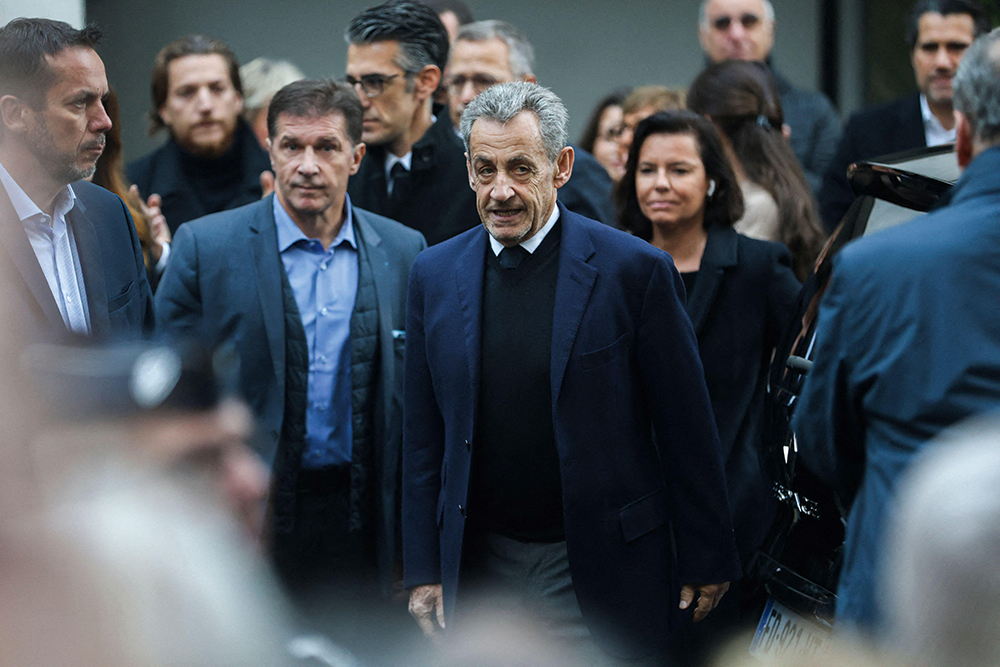

Nicolas Sarkozy’s prison memoir is a slender book about a short sentence that nonetheless makes for compulsive reading. It is unintentionally comic, occasionally moving and almost always politically calculating. This, despite the weight of its author’s self-importance, moral evasions and intermittent self-awareness.
Sarkozy, 71, was sentenced to five years for criminal conspiracy linked to Libyan money in his 2007 presidential campaign. He served less than three weeks in Paris’s La Santé prison before being released under judicial supervision to finish his punishment at home, pending an appeal to be heard in March. He used the time efficiently, producing more than ten pages of writing a day. The result is a compact 200-plus-page chronicle of noise, bad showers and damaged pride.
Emotionally, the book oscillates between genuine shock and carefully curated indignation
Le Journal d’un prisonnier (or A Prisoner’s Diary) offers no confession, however, but instead delivers a performance. It is part meditation, part defense brief, and its tone alternates between furious and fatalistic, confirming that even behind bars, the former French president remains a man for whom existence without an audience is inconceivable. The cell becomes a studio; the journal, a stage.
Where many political memoirs seek to sanitize a career with history in mind, Sarkozy’s is all jagged edges: raw, argumentative, self-justifying. He writes as though still campaigning, addressing an invisible electorate that must be persuaded of his innocence and his indispensability. “By trampling on my innocence, France is brought low,” he writes. It is a quintessentially Sarkozyan line: patriotic, wounded and barely aware of its comic effect.
Yet the book’s theatricality is also its strength. In isolation, sans entourage and cameras, Sarkozy is forced into an intimacy he both craves and fears. The passages in his journal describing his first nights in prison are vivid and unembellished – the claustrophobia of the narrow bed, the echoing clang of the evening lockup, the ragged tempo of thought when time seems interminable. Then, abruptly, he slips back into declamatory mode, recounting each injustice as if in a closing speech: we are reminded that he was a lawyer before he was a politician. The pivot between private doubt and public posture animates the text and, finally, defines it.
“France has not judged me,” he declares, “she has indicted herself, through me.” Few politicians could turn disgrace into narrative propulsion quite so instinctively. Sarkozy’s writing voice, alternately indignant and melancholic, recreates the peculiar electricity of his time in power: a blend of velocity, vanity and genuine conviction. He ricochets from descriptions of the din in the prison corridors to meditations on injustice, from the temperature of the showers to the temperature of public opinion with the breathlessness of a man permanently leaning into the next headline.
The best pages are the least presidential, where he fusses over the jail’s menu, the feebleness of the showers and the etiquette of dealing with fellow inmates who mock him. One gets a strangely domestic epic: he’s a slippered Edmond Dantès, the hero of The Count of Monte Cristo (a copy of which Sarkozy brought with him to prison), railing at the plumbing, determined to emerge both martyr and creator of his own legend.
Emotionally, the book oscillates between genuine shock and carefully curated indignation. Sarkozy insists on his innocence, casting himself as a latter-day Alfred Dreyfus – wrongly condemned, stripped of honors, the victim of politically motivated judicial vengeance – while conceding that his short stint behind bars scarcely compares to four years on Devil’s Island.
Yet his reactions to prison life – gratitude toward some staff, distress at separation from family, stunned empathy for those with no exit – do ring true. When he writes that his life, in some strange way, “restarted” in La Santé, one senses a man mortified by his fall yet intoxicated by the pathos it offers his autobiography’s final act.
The contrast with my sister Ghislaine’s sentence is almost farcical: Sarkozy’s 20 days have been instantly monetized into a book and a media tour. Ghislaine is six years into a 20-year sentence. He leaves La Santé to judicial supervision at home; she transitions from one US federal facility to another.
He paints La Santé as an “all-gray” arena of “inhuman violence,” where the atmosphere is “threatening” and the doormat reads “WELCOME TO HELL!” Set for a moment Sarkozy’s “hell” in a structured, albeit grim, French prison against Ghislaine’s crushing time as a pretrial detainee in the notoriously dysfunctional MDC Brooklyn.
They were both placed in isolation cells: his measured 12 meters square, hers just five. Besides their prison bunks, Sarkozy’s cell had a desk and chair, shower, fridge, hot plate, TV and a telephone for outgoing calls to prescreened numbers; hers had none of those amenities. He was entitled to 50-minute visits from his family three times a week; during the six weeks following her arrival at MDC she was only allowed two 15-minute phone calls a month.
At night, behind his locked door, he slept as peacefully as anyone can in a prison he describes as “louder at night than during the day.” Ghislaine on the other hand was woken constantly and subjected, for all 17 months of her pretrial detention, to a wholly unnecessary “suicide watch” involving a guard shining a flashlight on her face every 15 minutes “to check she was breathing,” quite literally preventing her from sleeping. This is not to invalidate Sarkozy’s discomfort, but it certainly puts it into perspective.
What Sarkozy’s memoir reveals is less a chronicle of punishment than a dissection of pride
Both invoke, in different registers, the rhetoric of persecution – he as a victim of political justice, she as a scapegoat for Jeffrey Epstein’s crimes – but for now only one can punctuate that narrative with a tasteful signing session on the Rive Gauche. It remains to be seen whether Ghislaine’s recently filed habeas petition – her last throw of the US judicial dice – for wrongful conviction and imprisonment will succeed in the light of her disclosure of new and government-suppressed evidence. Will it persuade the Southern District of New York’s Federal District Court to provide her with meaningful relief?
What Sarkozy’s memoir reveals is less a chronicle of punishment than a dissection of pride. It offers a case study in how power survives its own eclipse. Stripped of office, Sarkozy reconstitutes it through narrative; denied the podium, he builds one right off the page.
The larger question is what the book tells us about France. For readers weary of moral fatigue in politics, the memoir provides a telling analysis of the Fifth Republic’s contradictions: its yearning for authority matched only by its suspicion of it, its appetite for spectacle masquerading as accountability. Sarkozy’s self-portrait becomes, inadvertently, a mirror of the country that produced him – impatient, theatrical, addicted to crisis.
As literature, the memoir is erratic, self-absorbed, and endlessly quotable. As political document, it is indispensable. One finishes the book neither persuaded of Sarkozy’s innocence nor immune to his charm. Ultimately, A Prisoner’s Diary is less about redemption than about control: of narrative, of legacy, of the meaning of failure. Even from confinement, Sarkozy writes with the conviction of a man dictating to posterity rather than confessing to it. The result is a memoir about power in its pure and modern form – dematerialized, self-referential and performative to the last.
It is hard to admire Sarkozy. Harder still to excuse him. Yet strangely impossible to remain indifferent.
This article was originally published in The Spectator’s February 2, 2026 World edition.





Comments