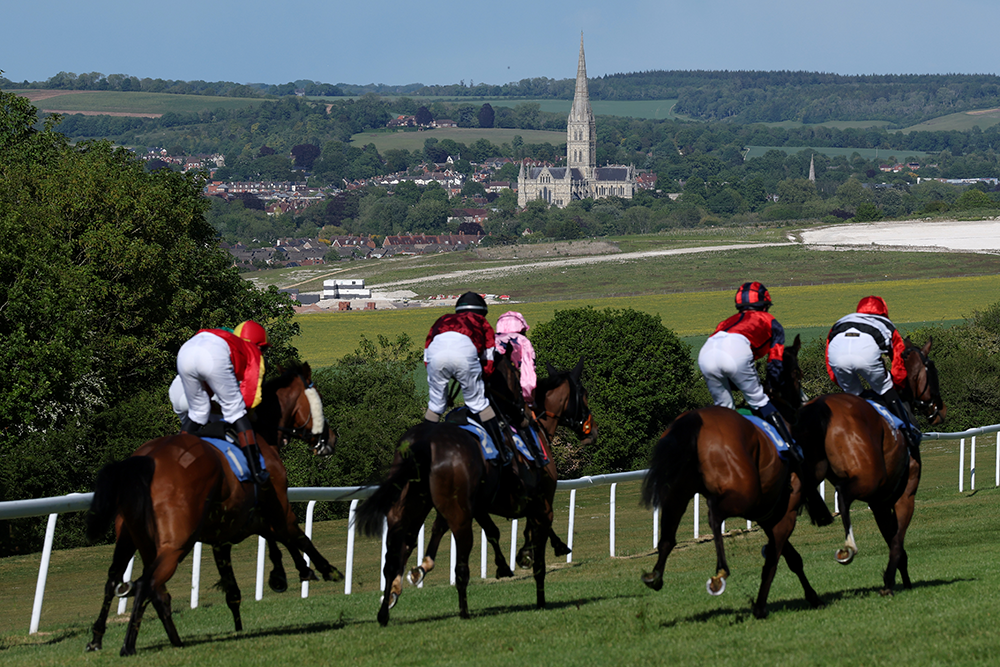
The importance of Royal Ascot can never be overstated. It was beautifully summed up by His Excellency Mansoor Abulhoul, the UAE ambassador to the UK, last week: ‘There is no finer expression of what the British do best; a celebration of horse, history and craft that has run, almost without interruption, since 1711.’
But if it is longevity that appeals to the ambassador, he must venture out to the Salisbury plains to savour Salisbury racecourse, where there has been racing since 1584. I now love this racecourse, although I’m ashamed to say I’d never been to it before a couple of weeks ago. Ashamed, because you can’t call yourself a racing fan if Salisbury doesn’t feature in your diary.
The first thing that strikes you as you enter the second-oldest racecourse in England is it is a loved, happy place
It’s in the middle of nowhere, with a glorious view of the cathedral across the valley. And one just gets the feeling that this is a haven for people who want to get up really close to the horses: many of the racegoers have been at the cattle market down in the town before they come up for a bit of lunch. In the 1800s the action on the racecourse was augmented by fortune tellers, freak shows, black-faced minstrels and prostitutes. These days they rely on children’s face painting. The first thing that strikes you as you enter the second-oldest racecourse in England is that it is a very loved, happy place. All the staff here radiate that.
Take Mary Jane, for example, the wonderful lady who looks after the jockeys’ food requirements. Obviously, they’re not coming for the Full Monty, but they have to fuel themselves with something. In the old days it would have been a stewed cup of tea and a curled-up sandwich. But Mary Jane cooks omelettes to order and jockey-sized steaks. And every racecourse should have a Bobbie, who personally welcomed me. I wanted to take him home with me.
I ate an enormous lunch from the carvery in the main restaurant, although I did confine myself to roast pork. Lord Margadale, the racecourse chairman, had his eye on the crackling, so it was ‘guests hold back’ – and he hadn’t had any breakfast.
One of the directors, the Earl of Huntingdon, had the beef and the pork. Can’t say I blamed him: the beef was lovely and rare. I think the Earl must have been placed into some witness protection scheme, because he used to be called William Hastings-Bass when he was a trainer. And a bloody good trainer he was, too.

Salisbury has a multitalented, philanthropic board. Alex Goodwin and Peter Treadgold are also trustees of the Injured Jockeys Fund. Goodwin, who brings a wealth of experience with him from the world of rugby trauma injuries, is interesting on the general welfare and care of injured jockeys. ‘Does your daughter’s school still have Douglas Bader’s legs?’ he asked me, as only a medic can, while we were looking through the runners for the first race.
Make no mistake, this racecourse is run by people who really understand racing, and how clever of them to recruit local farmer Minette Batters onto the board. Or should I say Baroness Batters, given her appointment to the House of Lords as a result of the brilliant job she did as the chair of the National Farmers’ Union.
The Baroness wasn’t racing last week, because she was out and about promoting her new book, Harvest: A Farmer’s Story of Heritage, Home and Hope, which is a must-read. By coincidence, I heard her being interviewed on Times Radio on my way home, and I was so blown away by her that I immediately bought the audio book (yes, I did pull over) and listened to it.
I’m told she applied for the position of chair of the British Horseracing Authority when Lord Allen was appointed and didn’t even get interviewed. WTF? Thank God they’ve appointed new headhunters in their search for the next chair. The Baroness rode out for David Elsworth in her younger days, was married to a jockey, rode in point-to-points and sits as a cross-bencher in Westminster, which would presumably make her very effective at lobbying on behalf of racing. I very much doubt she will reapply this time around for the chair, having been treated so disrespectfully last time, so someone on the BHA nominations committee should get off their arse and beg her to.
Salisbury is basically a not-for-profit operation and it has to make some difficult decisions about the races it runs. If it puts on a moderate six-furlong handicap, it gets loads of runners and the maximum media rights payment. But who, quite frankly, wants to watch more of that type of race than they have to? However, if it puts on a race such as the Persian Punch Conditions Stakes, which can attract stars like Trawler-man and Trueshan, the race is unlikely to attract eight runners, and it gets punished under its media rights obligations. So what is it to do? Try to attract interesting, diverse horses that appeal to racegoers, or just put on cannon fodder handicaps?
In Salisbury’s favour, the ‘on the collar’ climb to the winning post makes it a fantastic track for young horses. Its maiden and novice races attract seriously nice young horses, something its knowledgeable crowd loves.

It’s no coincidence that Salisbury is the second-oldest racecourse in England. Not only is the topography perfect, but it is chalk-based, as are the surrounding areas, which explains why so many good training yards are close by; Richard Hannon, Ralph Beckett and Marcus Tregoning to name but three.
The list of great horses who have run here also underlines what a good track it is: Mill Reef, Tap On Wood, Brigadier Gerard, Warning, Indian Ridge, Dashing Blade, Balanchine, Sir Percy, and the Arc winners Alpinista and Bluestocking.
If His Excellency wants to see the foundations of the great sport that ties the UK and the UAE together, he will never have a better day in this country than a day out to Salisbury… as long as he doesn’t have to drive down the A303 to get there. I recommend the train. Or a helicopter.





Comments