Since the launch of Operations Midnight Hammer and Epic Fury, Israeli and US strikes have thinned out Tehran’s political, military and security elite with a series of decapitation strikes.
As the Trump administration seeks to explore diplomacy with the remnants of the Iranian regime, a core group of hardened men remain. The new Supreme Leader Mojtaba Khamenei has been injured and hasn’t appeared in public. Surrounding him are a group of influential Islamic Republic loyalists. They include parliament speaker Mohammad Bagher Ghalibaf; the new secretary of the Supreme National Security Council (SNSC) Mohammad Bagher Zolghadr; military advisor to the Supreme Leader Mohsen Rezaei, and commander-in-chief of the Islamic Revolutionary Guard Corps (IRGC) Ahmad Vahidi.
As the Trump administration seeks to explore diplomacy with the remnants of the Iranian regime, a core group of hardened men remain
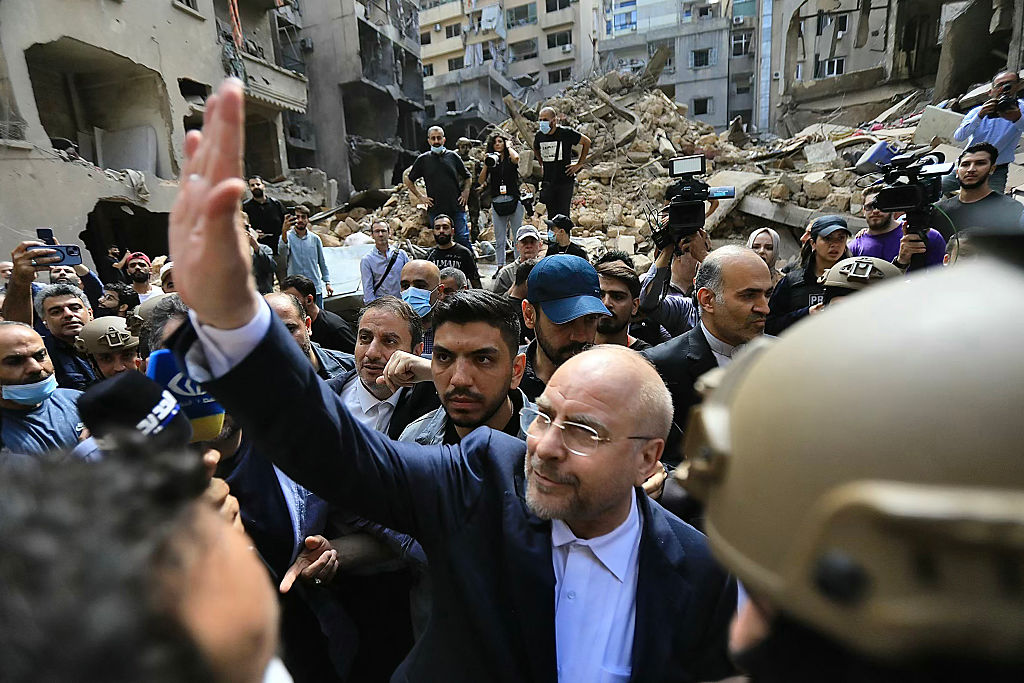
The Trump administration is currently weighing up Ghalibaf as a partner and potential leader of Iran. Ghalibaf is the ultimate survivor of Iranian politics. Born in Torqabeh near Khamenei’s hometown of Mashhad, as a young man he signed up to the IRGC during the Iran-Iraq war and allied with a group of commanders such as the late Quds force leader Qassem Soleimani and his successor Esmail Ghaani. He also frequently met then-president Ali Khamenei, during Khamenei’s visits to the battlefield.
Ghalibaf’s rise coincided with Khamenei’s appointment as supreme leader in 1989. He was first appointed deputy commander of the Basij, then commander of the IRGC’s economic conglomerate the Khatam Al-Anbiya Construction Headquarters, then commander of the IRGC’s air force. Ghalibaf has always been something of a hardliner. As head of the air force, he signed a letter threatening then-president Mohammad Khatami with consequences if he didn’t decisively quash the 1999 student protests.
Following the protests, the head of the Iranian police was dismissed and Ghalibaf was brought in as his replacement to upgrade the force. Later, Ghalibaf entered politics, launching several unsuccessful campaigns to be president. From 2005-2017, he served as mayor of Tehran and rebranded himself as a technocratic problem-solver overseeing construction and infrastructure projects. Even though he does not have extensive diplomatic experience, Ghalibaf is used to performing for western elites, and made an appearance at the World Economic Forum at Davos in 2008 to court investment. Since 2020, Ghalibaf has been speaker of parliament.
As speaker, Ghalibaf has served as a member of the SNSC – Iran’s top foreign policy and national security policymaking body, where he has taken a number of hardline positions. In 2020, for example, he supported a law ordering the expansion of Iran’s nuclear program if US sanctions were not lifted within two months.
Ghalibaf has marketed himself, a bit like President Trump, as a brash dealmaker. He has called Trump a formidable opponent, remarking, “when we are facing an enemy like Trump who does not behave with integrity, we have to be calculative in our behavior.” Given Ghalibaf’s experience as a builder, manager and his political ambition – he at one point described himself as an “Islamic Reza Shah” – some in the US government view him as a man with whom they can do business. Nevertheless, Ghalibaf, who has been ensnared in multiple corruption scandals, is loathed by the Iranians who have been protesting against the regime. And he has spent his life trying to preserve Iran’s repressive system.
Ghalibaf is joined at the helm by the new secretary of the SNSC, Mohammad Bagher Zolghadr. Zolghadr, who has been under UN sanctions, has in the past been deputy commander-in-chief of the IRGC; deputy chief of the general staff of the armed forces for Basij affairs; deputy interior minister; and a deputy to the chief justice. Most recently he was secretary of the Expediency Council – an advisory body to the Supreme Leader. Zolghadr is part of the old guard of the IRGC and was a member of the Mansouroun guerilla network which worked against the Shah in pre-revolutionary Iran. Unlike his predecessor as SNSC secretary, Zolghadr has no diplomatic experience – he is very much a product of the military establishment, with stints in various administrative posts. Zolghadr has a checkered history when it comes to human rights. In the 90s he worked with the Basij and Ansar-e Hezbollah, a radical group responsible for acid attacks against women in Esfahan, to repress Iranians.
Military advisor to the Supreme Leader, Mohsen Rezaei, has had a similar career. A former commander-in-chief of the IRGC, Rezaei was also a member of Mansouroun and is the subject of an Interpol red notice for his role in the bombing of a Jewish community center in Buenos Aires in 1994. Both men are septuagenarians whom Khamenei put out to pasture as secretaries of the Expediency Council after long careers in the IRGC. The reemergence of Zolghadr and Rezaei shows how many top brass IRGC commanders have been taken out by Israel and America this year. It also suggests there will be increased repression in Iran and continued aggression abroad.
The final man running Iran is Ahmad Vahidi, the new commander-in-chief of the IRGC, who reportedly exerted pressure behind-the scenes to name Zolghadr as SNSC secretary. This shows Vahidi is playing a dominant role. He has been an extreme actor on the Iranian political and military stages. A commander of the Quds force, Vahidi is also subject to an Interpol red notice for his role in the 1994 terror attack in Argentina. He has been a senior IRGC strategist, once leading the Supreme National Defense University, and previously served as defense and interior minister, including during the crackdown on protesters following the death of Mahsa Amini in 2022. His experience in the Quds force, as well as Zolghadr serving as the co-founder of the IRGC’s Ramadan Headquarters that later morphed into the Quds force, may signal a doubling down on extraterritorial terror plots as Iran seeks revenge.
Some have suggested that Operation Epic Fury has led to hardliners and the IRGC taking control of Iran. This misunderstands how the regime works – these factions were already empowered long before the war. Take Ali Larijani, the former secretary of the SNSC, who was killed in an Israeli strike on 17 March. While some westerners portrayed him as a pragmatic moderate, a scholar of Immanuel Kant, he served in the IRGC and oversaw the industrial-scale slaughter of Iranian protesters this year, when 30,000 Iranians were killed. While there may be differences in the style, tactics and tone of certain figures, no one can rise to the top in Iran without being truly committed to upholding Khamenei’s legacy. It is for this reason that many Iranians have feared “moderates” in the regime more than the conservatives. The former could well be more dangerous if they fool western elites and help prolong the rule of the Islamic Republic.
As for the current crop of militant officials leading Iran, they are not hiding their extreme views. We can only hope that they overplay their hand, and that their hubris hastens the downfall of the Iranian regime.





Comments