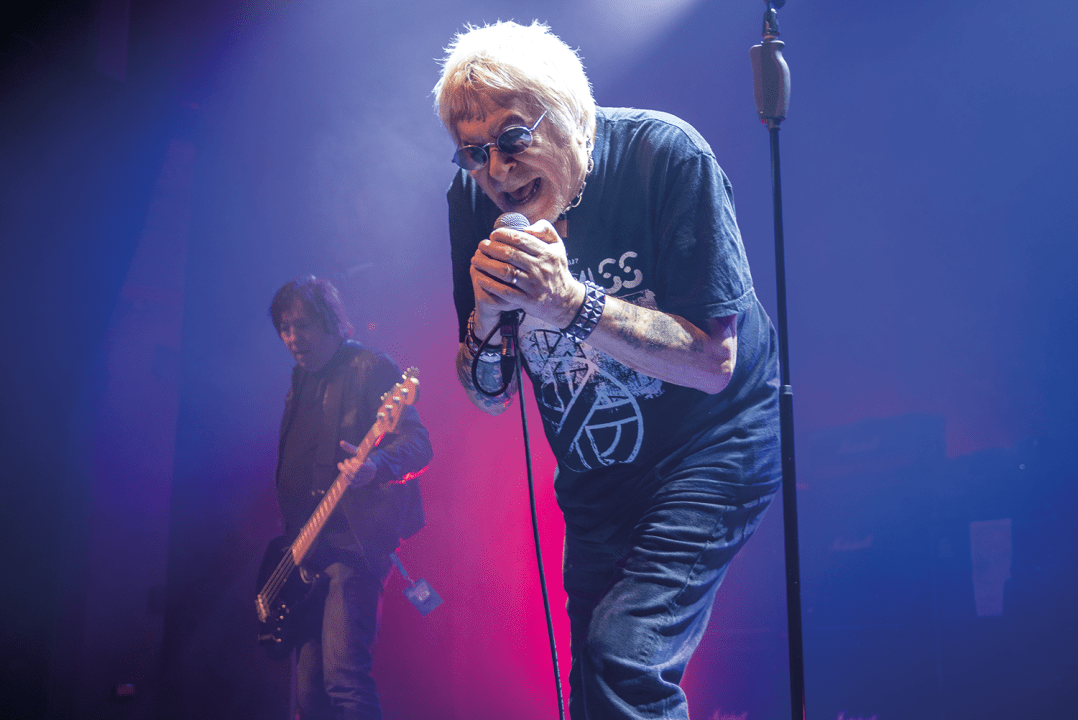
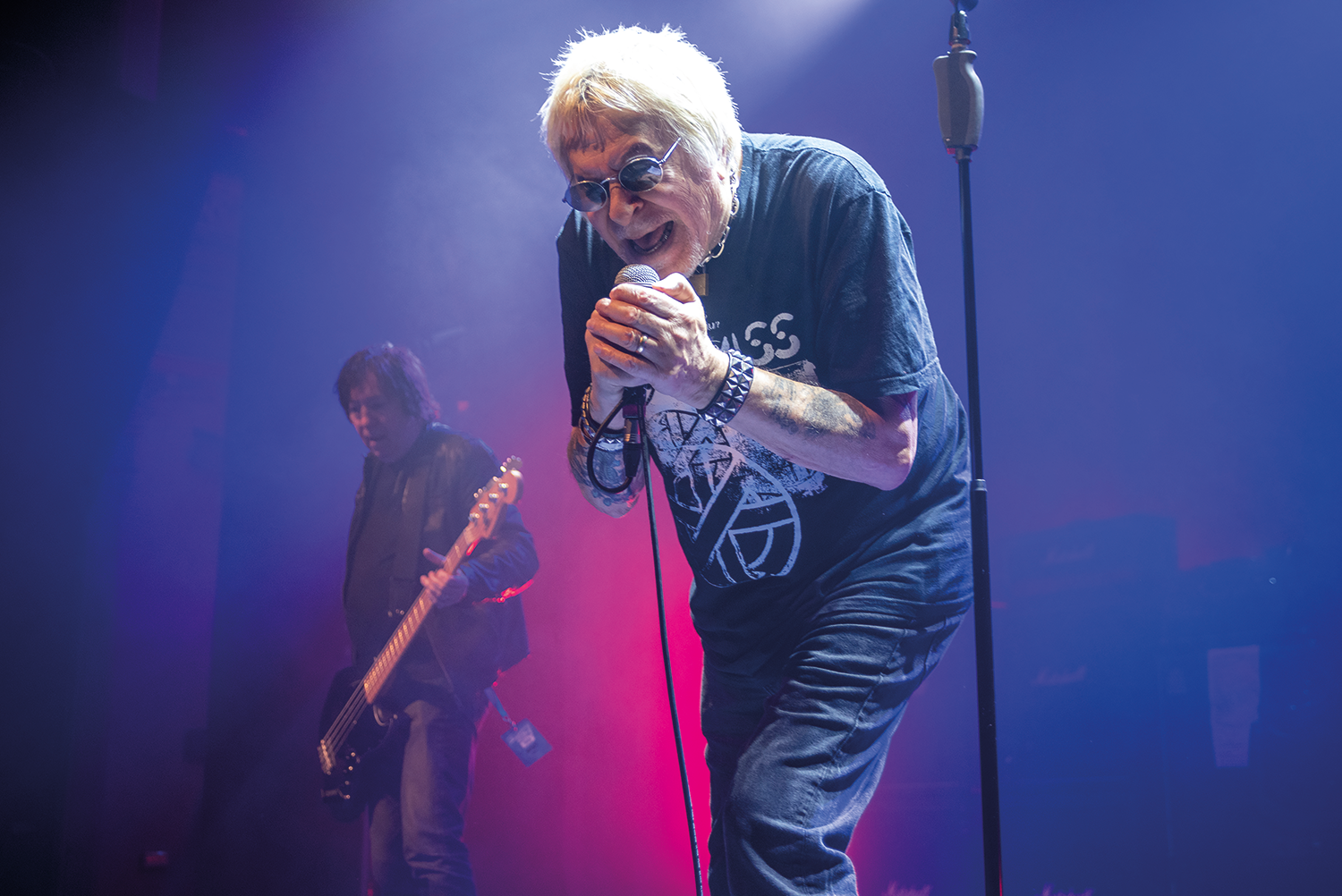
It’s 50 years since an assortment of scruffy youths from the leafy suburb of Bromley, the grimy streets of Finsbury Park and under the Westway gathered together, often in art colleges, to form ‘punk’. They will be celebrated this summer – but more for what they became than what they were.
The Clash became the towering public statues of rebel rock. Johnny Rotten again became John Lydon – musical adventurer and perpetual irritant. Siouxsie Sioux became the unwitting, and unwilling, inventor of goth. The Damned became national treasures. The ones we remember wrote books, took up acting, went where the wind took them. They didn’t stay punks. Not like Charlie Harper. When he first came across the punks, he didn’t see anything new. They simply reminded him of when he’d been a kid.
‘Rock’n’roll came to town in the mid-1950s, and I was one of the first in school to latch on to that. I ended up being social secretary and putting on dances.’
Harper wasn’t like the other punks. The first record Harper remembers wasn’t Elvis doing ‘Heartbreak Hotel’, or the Stones doing ‘Satisfaction’, or Bowie doing Ziggy. It was Vera Lynn singing ‘The White Cliffs of Dover’: he was born in 1944, a war baby, and a decade older than everyone else at the Roxy.
Still, in the great game of ‘I woz a punk before you woz a punk’, Harper wasn’t quite among the absolute first. He wasn’t at the first Sex Pistols show in 1975, but the bassist of his then band was and came back and told him all about it. Harper started to go to a gay club in Covent Garden called Chaguaramas, which one week turned into the Roxy, London’s first punk club, and he was sold. His pub rock band, the Marauders, became his punk rock band, UK Subs, and he was away. He’s never stopped: he’s still the singer of UK Subs, and UK Subs are still a punk band.
Though born in London, he didn’t spend his youth there; after getting in trouble he was packed off to Sussex, to Littlegreen School, which practised non-traditional education for ‘maladjusted’ kids.
‘Summerhill was for rich people’s kids,’ he says, referring to the famous Suffolk school. ‘And they could do what they liked. Ours wasn’t quite like that – you had to attend school – but I loved it, and for me it was a nice life. There were animals all around – when I came home to my friends I told them all what I was doing and how I wished they could be there with me.’
Part of his learning meant working on local farms, and Harper – then still David Perez – was chairman of the school’s Young Farmers’ Club. He could have gone the way of Jeremy Clarkson. But the farmyard held no siren call, and the teenaged Harper moved to London.
He followed the bands of the early 1960s R&B boom, and he busked, playing the music of his heroes. ‘We were into Big Bill Broonzy, Huddie Leadbetter, all those guys. But we couldn’t touch them.’ Then hippiedom came along and Harper embraced that, too. ‘I didn’t go on the Aldermaston marches, but we went to a demonstration about Vietnam in Grosvenor Square in front of the US embassy.’
He married, became a hairdresser, and started playing in casual bands in pubs: ‘We did covers of Led Zeppelin and J.J. Cale. One was a heavy metal band, one was a boogie band, one was country’ – and he might have thought that his light would never turn green. And then it did. Once he met the guitarist Nicky Garratt, the Subs found their sound: what Americans would later define as ‘street punk’, a kind of rock shorn of all pretensions, shorn of anything other than brutal directness.
It would be fair to say the critics have always favoured art-school punk over street punk. ‘Yeah, I mean we love bands like Wire – they’re one of my favourite bands – and a lot of that art-school stuff was really the best. But we were proud to be street punk, because down the Roxy, every band only played for 20 minutes and the headliner for 30. We didn’t want to let go of that.’
Once they started putting records out in 1978, UK Subs had a run of hit singles and albums, but no one bar the diehards remembers them because they were a year later than the originals. Like the Ruts or Sham 69, they represented something different. If you search the internet, you can find assorted documentaries – films such as 1980’s D.O.A.: A Rite of Passage – which portray punk not as the BBC Four documentarists do, but as the thing it actually became: scabby and spotty, something that had moved out of art schools into a place where the only impulse was rage. That was the punk UK Subs championed, and were champions of.
What I can’t work out is why he never moved the Subs on, when his own musical curiosity extended so much further. Did he never fancy trying dub, like the Clash, or psychedelia, like the Damned? Something other than the same three chords.
Punk rock became his job, and it still is, at the age of 82
‘Nothing was planned like that,’ he says, a little defensively. ‘It was just how the songs came out.’ He pauses for a moment. ‘I write pretty fast, and from the old R&B days I know all you need is three chords. And in the early days we had to do four singles and two albums a year, so it was, “Wow. We’ve got to work at it.” I was lucky, I did quite a bit of speed at the time, so it was easy for me.’ He’d actually managed to consume enough amphetamine to give him a heart attack in 1977, before he’d even managed to release a record. ‘I was just a weekend raver,’ he says. ‘Just a little line would do for me.’
‘There was a time when we were riding pretty high, thought we could do no wrong,’ Harper says of the days when they appeared on Top of the Pops, performing songs like ‘Teenage’, ‘Warhead’, ‘Tomorrow’s Girls’ or ‘Stranglehold’. But watching those clips, you understand why the high passed quickly: it was a limited formula, and it crystallised the idea of the Subs as another thug punk band.
America saved them and gave Harper his career. Young, angry, suburban men began propagating the idea of ‘hardcore’ punk – punk that eschewed all frills and melody in favour of aggression and velocity. Instead of singing, frontmen barked, just as Harper did on those hits.
‘We brought the hardcore thing to America and then it went really over the top,’ he says. ‘Everyone tried to be faster than everyone else. And now these bands look on me as the godfather of hardcore.’
And so for the past 40 or so years, Harper has given people what they want. Punk rock became his job, and it still is, at the age of 82. The band is still enraging enough to some people that last year the three other members were refused entry to the US for a tour. It didn’t stop him: ‘I got a band together in LA and it went down great. They asked me to stay in the States and tour with them.’ Over the years, somewhere north of 70 others have served alongside Harper in the Subs at one point or another.
Punk is one of the great alchemical processes. ‘People used to say of Judy Garland that she was this little hunchbacked girl but she goes on stage and it becomes magical.’ He’s not comparing himself to Judy Garland. Apart from anything else he has two types of arthritis – ‘and sciatica’, he adds. He means that punk was similarly able to transform itself in performance. ‘A lot of people are like that. They go onstage – people like Dave Vanian from the Damned – and…’
And?
‘They’re just mindblowing.’




Comments