

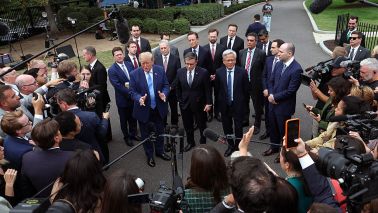
The biggest beneficiary of Robert Jenrick’s defenestration and defection was neither Kemi Badenoch nor Nigel Farage but Malcolm Offord. He is the former Tory peer whose unveiling as Reform’s Scottish leader was in progress when the purring notifications orchestra struck up among the assembled reporters and Reform staffers. The news of Jenrick’s ouster dominated the remainder of the proceedings, which was fortunate for Offord because his first media event as leader was a handy reminder of his shortcomings.
Reform is trying to have it both ways with Offord, selling him as a political outsider and a safe pair of hands with experience in parliament and government. If he truly were a political outsider, it might mitigate some of his unimpressive responses to media questions. Take taxes, a current and salient issue in Scotland because of the devolved Scottish rate of income tax and the higher bands the SNP has created. Offord dealt promptly with a question on whether he pays the Scottish rate – he does – but was plainly unprepared for the question of whether he would release his tax returns.
Beyond the registering of financial interests, I’m not sure why the public is any more entitled to know about a candidate’s tax affairs than they are his medical history, personal life or religious convictions. The releasing tax returns, however, been successfully imported into British politics. Unprepared, all Offord could do is say he would think about it. Farage, by contrast, showed what a superior politician he is by stepping in to help Offord while volunteering, flatly and firmly, that he wouldn’t be releasing his own returns. You needn’t like his answer, but he had it ready to go.
Then there was independence. That issue only came up because Offord had previously suggested to a newspaper that there could be another referendum in ten years’ time. For Reform’s target voters in Scotland, many of them lifelong Tories, there is no more important issue than keeping the United Kingdom together. They won the day the last time around, in 2014, but have grown frustrated by SNP efforts to return to what they deem a divisive subject. They disdain — nay, despise — even hypothetical talk of another vote. Yet given the chance to clarify, Offord instead went off on a tangent about the threat from Russian subs, again leaving Farage to give the substantive answer.
He struggled again in one-on-one interviews with the broadcasters. ITV’s Peter Smith tried to pin him down on a controversial Facebook ad Reform previously ran which critics said was racist towards Scottish Labour leader Anas Sarwar. Smith – who, in the interests of full disclosure, is a mate – can take care of himself, but Reform’s poor handling of the interview was telling. Within just two minutes a female Reform staffer had stepped in and tried to shoo the troublesome journalist away, warning him: ‘I’m asking you nicely.’ Reform Karen did everything but demand to speak to his manager. But wait, isn’t Reform different from the Tories and Labour, a party that wants to be straight with the punters? Why is it showing itself to be even more control-freaky than the mainstream parties? Why does it reckon its new Scottish leader can’t handle questions for longer than two minutes at a time?
Another one-on-one with Sky’s Connor Gillies saw Offord pressed on a party candidate who had called for illegal migrants to be placed in camps. After several rounds of dancing around the terminology, maintaining that people should be treated ‘humanely’, the best Offord could essay was: ‘It depends, I guess, on what you mean by “camps”.’ Little wonder another Reform staffer stepped in and cut this interview short, too.
Offord was a good businessman, but the skills required in his past and present careers are different
This isn’t a matter of ‘optics’ or driving away potential voters. Most voters don’t know Reform has a Scottish leader, let alone that it’s Offord. And almost none care about his handling of press conferences. All that is insider scuttlebutt. What should perhaps concern Reform voters and candidates is that the leader who was going to bring political and media savvy to their operation was unable to do so at his inaugural press conference. Reform’s Scottish political opponents and the media will have watched Thursday’s event and noted Offord’s difficulties. The more broadcast time he gets, the more they will try to exploit these difficulties to trip him up or prompt him into an error.
Malcolm Offord was a very good businessman, but the skills required in his past and present careers are different. While Farage is a gifted politician, Offord is still a rookie. There isn’t much he can do about this in the short term – Scotland’s devolved elections are in May – and he will have to hope he doesn’t prove a deadweight on his party’s fortunes. Reform is still in a strong position for those elections. The priority for its new leader should be not wrecking his party’s chances.




Comments