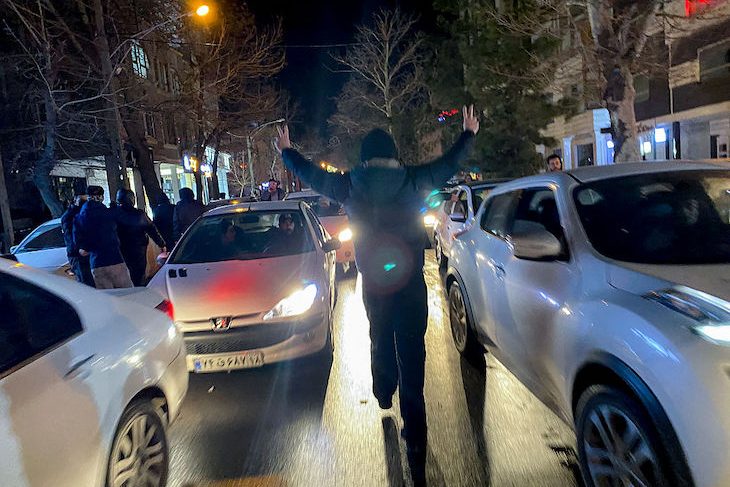
On the afternoon of December 28 in a Tehran electronics bazaar, shopkeepers (known as bazaaris) shuttered their shops and walked out, outraged at a planned gas price rise and crippled at the continuing slide in the value of the Iranian currency and the government’s powerlessness to shepherd Iran’s economy toward something better than corruption, unemployment and inflationary cycles. Tehran’s Grand Bazaar was quick to follow suit. A day or so later, several of Tehran’s most prestigious universities staged demonstrations. Smaller cities and towns have since taken up the baton of resistance, with government offices attacked and people openly calling for Khamenei’s death and the return of the Pahlavi dynasty, at a time when one of Iran’s major international allies, Venezuela, is in the process of having its state dismantled by US air strikes and military operations. The fall of the Maduro regime has the distinct potential to galvanize the Iranian opposition as yet another of Tehran’s foreign policy pillars comes tumbling down.
The Islamic Republic has only bad cards to play
Yet as the protests enter their sixth day, it’s important to stress that daily life in Iranian cities large and small continues relatively uninterrupted. “It’s not yet on the same scale as it was in 2022 when millions joined in the Women, Life Freedom protests,” one Iranian said to me yesterday. And although some of Tehran’s bazaars remain shuttered and protests are continuing, Friday prayers across Iran went ahead as planned, showing that for the time being, the Islamic Republic remains in control. But as the regime marks the anniversary of the death of Qasem Soleimani and celebrates a public holiday to mark the birth of the First Imam, few in positions of power will be anything other than extremely uncomfortable at where this could lead, especially after a summer and fall which saw striking Iranian workers, a military humiliation at the hands of Israel and the US and a steady increase in executions of political dissidents.
Iran’s embattled president Masoud Pezeshkian, cutting a forlorn figure, said yesterday that he had instructed the interior ministry to “listen to the legitimate demands of the protesters through dialogue with their representatives.” And at the same time, he performed a pointless reshuffle at the Central Bank of Iran, and the government’s announcement of a bank holiday that might calm things down both smacked of desperation. Bank holidays are surely for celebrations, not voids in which to bury bad news. Iranian hardliners, reaching for the nearest hoary cliché, have been quick to blame it all on Israel and the US.
Wherever these protests lead in the coming days, what is abundantly clear is that the Islamic Republic has only bad cards to play. It has no economic cushion with which to remedy the currency crisis, a short-term imperative to replenish its missile arsenal in preparation for the next Israeli attack and a sense of acute vulnerability that drives it to execute anyone it suspects of being an Israeli spy. Khamenei will rely on the Islamic Republic’s enforcers, the Basiij (a volunteer arm of the IRGC whose ranks now allegedly swell with Syrian and Afghans drafted into kill Iranian protesters) to terrify protesters into remaining at home. There will be more deaths, more arrests and more executions in Iran’s prisons.
Accordingly, Donald Trump’s full-throated support for the protesters came cloaked in a threat that should the Islamic Republic kill any more protesters, the US is ready to intervene. As I’ve written before in these pages, Iranian nationalism, be that on the streets or in the corridors of power, is hardwired to react badly to the faintest whiff of foreign intervention. For all the hatred of the Islamic Republic, any direct US intervention to support the protestors carries a huge risk of discrediting those brave protestors in the eyes of those Iranians who remain at home, but who nonetheless despise what the regime is doing to their country. We saw this over the summer when Bibi Netanyahu tried to rally the Iranian opposition; it largely fell flat. No one in Iran wants to be seen to be doing the bidding of a foreign power.
Trump and other foreign powers must strike a balance between supporting protest and avoiding falling into the trap of discrediting those protestors by associating them with notions of “foreign subversion.” This would play directly in to the hands of Khamenei who loves nothing more than to paint all those who disagree with him as “agents of the West and the Zionists.”
‘Long live the Shah!’ is a slogan that is guaranteed to infuriate the mullahs
Much has been made, as is often the case, of the chants calling for the return to Iran of Crown Prince Reza Pahlavi, the son of Iran’s last Shah. It was always a beloved trope of UK Foreign Office diplomats to reach, lazily, for the “no one in Iran likes Reza Pahlavi” stick, pointing out that his father’s rule was a long time ago and not nearly as sepia-toned and wonderful as its apologists claim. And while there isn’t a huge amount there with which to disagree, as the Islamic Republic’s wheel of repression turns yet again, the Pahlavi prince’s popularity has only increased. Iranians, pushed to the point of starvation and threatened by Israeli and US bombs, find themselves reaching for the half-light of a partially remembered idyll when their country was richer and freer. Not the stuff of revolutions, those sage mandarins would have you believe, from behind a desk in Whitehall.
But surely the half-light of partially remembered idylls is exactly the sort of hazy counterpoint that drives revolution? Ayatollah Khomeini’s own revolutionary ideology as communicated on scratchy cassette tapes passed around Iran reached back into an almost totally fictional Islamic past, with a dollop of anti-imperial rhetoric. He famously refused to elaborate on his vision for a post-Pahlavi Iran, choosing instead to reach back into a past that never existed, from which he himself claimed to be an emissary of sorts, and talk in angry generalities about the evils of “imperialism” and exhorting the Iranian people to throw off the mantle of oppression, and so on.
That Crown Prince Reza Pahlavi is in no way interested in (or perhaps suited to) the role of the next ruler of Iran is, perhaps, beside the point. The protesters themselves know this too; “Long live the Shah!” is a slogan that is guaranteed to infuriate the mullahs. That he is in no way minded to return to Iran to lead the revolution is by the by, it seems. But as the chants, no doubt amplified to the nth degree in anti-Islamic Republic Western outlets, calling for Reza Pahlavi to return to Tehran in triumph reverberate across Iranian cities, we must look seriously at the power of memory in Iran and the role an idealized memory of his father’s rule might play as the crisis unfolds. And in the absence of any real alternative to the Islamic Republic, perhaps something is better than nothing?
Comments