
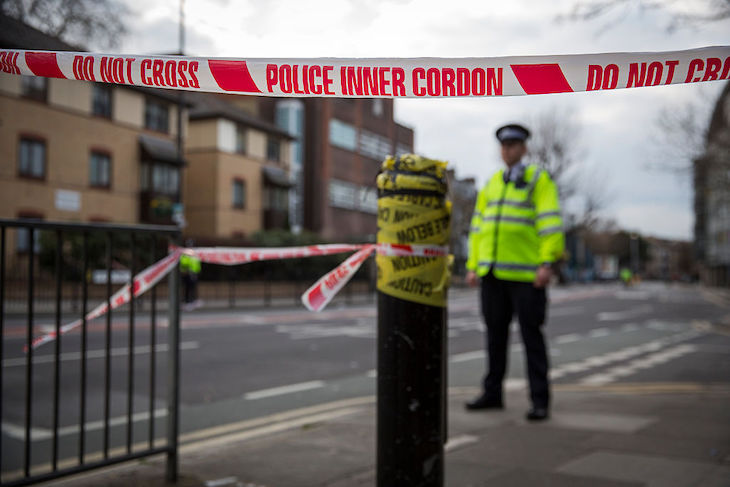
I disagree with Sam Leith’s recent piece entitled ‘London hasn’t fallen’. He took at face value Sadiq Khan’s claim in a recent speech at a ‘disinformation summit’ that social media posts drawing attention to London’s rising crime rate – particularly knife crime, shoplifting, mobile phone theft and violence against women and girls – were either mis- or disinformation and were probably posted by bots, presumably based abroad. But is that true?
What the mayor and his researchers fail to acknowledge is that some of the anxiety about crime in London reflects things that are actually happening
Khan himself is guilty of spreading misinformation about knife crime. In 2024, the Mayor of London’s claim that ‘knife and gun crime, homicides and burglary have all fallen since 2016’ was challenged by the Office for National Statistics (ONS), which pointed out that while knife crime with injury involving victims under 25 had fallen, total knife crime had increased significantly since 2016.
Khan’s most recent speech relied on data supplied by research he’d commissioned himself and which was carried out by a research unit in City Hall. This purported to show that ‘London in decline’ narratives on X have grown by 150 to 200 per cent in the past two years, while migration-related narratives are up by over 350 per cent. The culprits include ‘extreme right-wing groups’, pro-Kremlin or pro-Beijing agents of influence and MAGA-aligned keyboard warriors. Khan demanded that Ofcom take enforcement action to protect Londoners from these bad actors.
But the methodology Khan’s research unit used is a little suspect. The headline figures are based on what the document itself describes as ‘keyword-defined samples of X posts over two time periods’ that ‘should be interpreted as indicative, as results are sensitive to query design, time windows and event-related activity’. That’s some caveat. Change the keywords slightly, or pick a different time period, and the numbers change significantly, as do the whereabouts of the posters. This is not rigorous social science.
In addition, the authors of the report confess that access to platform data ‘has become more restricted’, meaning they couldn’t get a reliable sample of what people are posting. And since overall London-related posting on X increased by only 7 per cent over the same period, the obvious alternative explanation – that real events, such as the Southport attack, the riots that took place in several major cities in the summer of 2024 and high-profile victims of violent crime drove organic interest in London’s crime problem – goes unexamined.
The annex to the report claims that ‘UK extreme right-wing ecosystems’ accounted for around 39 per cent of phone snatching and knife-crime content. But the authors don‘t say how ‘extreme right-wing’ is defined and in my experience it’s often too broadly. For instance, gender critical feminists posting about child sexual offences committed by transwomen are frequently dismissed as ‘far right’, when they would describe themselves as left-wing.
What the mayor and his researchers fail to acknowledge is that some of the anxiety about crime in London reflects things that are actually happening. Between 2016 and 2023, knife crime rose 54 per cent in London. Robbery rose 57 per cent over the same period. Mobile phone thefts rose from 91,481 in 2019 to 117,211 in 2024. These are not fabrications by Vietnamese bot farms. They’re official figures.
Then there are the concerns about violence against women and girls committed by people who have entered the country illegally. When this issue has been raised by London Assembly members, Khan’s stock answer is that there’s no data to suggest this is a growing problem in the capital. That’s true, but only because the police only seem to include information about the immigration status of criminals on a case-by-case basis.
Based on the data that is recorded elsewhere, the picture suggests these concerns may be well-founded. Foreign nationals make up 10.9 per cent of the population but accounted for a quarter of sexual assault convictions and more than a fifth of rape convictions in in 2024. The Baroness Casey audit confirmed that in Greater Manchester, 52 per cent of suspects in multi-victim, multi-offender grooming cases were of Asian ethnicity, against a local population that is 21 per cent Asian.
By commissioning research that reframes public anxiety about crime in London as mis- and disinformation, Khan is gaslighting his critics. It’s not hard to work out why: if he can persuade Londoners that rising crime is a false narrative put about by ‘extreme right wing’ groups and Sri Lankan-based trolls, he will have a greater chance of being re-elected in 2028. His recent speech might also help some of Labour’s beleaguered candidates in the upcoming local elections, where Labour is expected to lose control of several London councils, including Camden, Wandsworth and Westminster.
As a free speech campaigner, I find Khan’s call for Ofcom to do more to censor his critics particularly troubling. As Louis Brandeis, the famous Supreme Court justice observed, the remedy for speech you think is harmful is more speech, not enforced silence. If Khan believes he’s done a good job of protecting Londoners from crime, he has a very large platform on which to make that case. Troll farms aside, the people he’s really trying to silence are ordinary Londoners concerned about crime they can see every day with their own eyes.





Comments