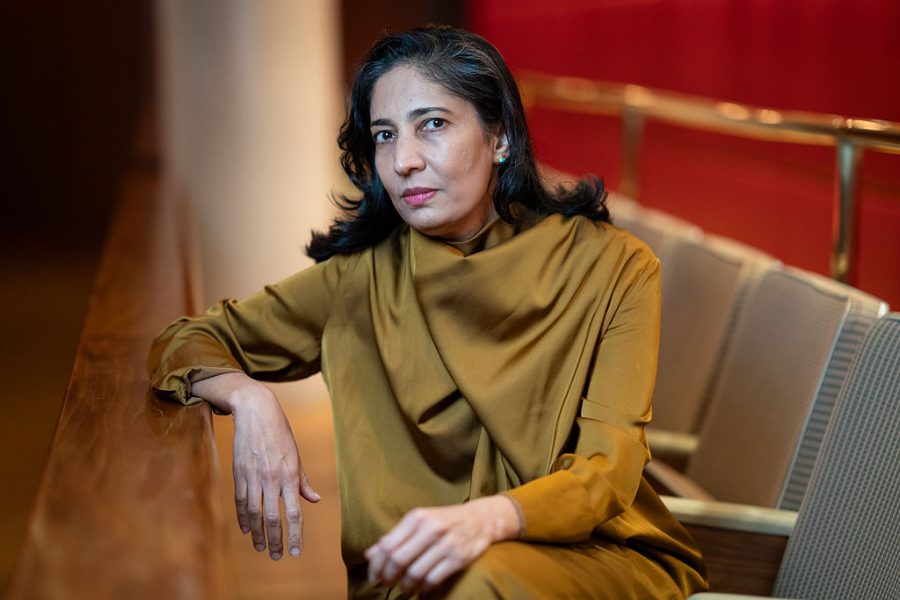
It wasn’t until a painting arrived in her post, a gift from the Italian artist Francesco Clemente, that Kiran Desai’s latest novel – The Loneliness of Sonia and Sunny – came into being, eventually finding its way onto last year’s Booker Prize shortlist.
Desai was worried about losing her subject matter when she left India
The haunting artwork from Clemente’s 108-watercolours series, titled Emblems of Transformation, depicted a black, faceless, eyeless deity adorned with jewels, suffused with ochre, with a heart for an abdomen at the centre of its body. Drawn to its mystical pull, Desai anointed it the ‘Badal Baba’ – ‘hermit of the clouds’ – and was compelled to thread her novel through it. The novel is about Sonia, an aspiring writer, and Sunny, a journalist who emigrate to the United States in search of love and opportunity. As they move between India, the States and Mexico, they realise their yearning for coherence and belonging in a post-9/11 world is making them ever lonelier. To navigate this in-betweenness, of seeing but not being seen, Sonia carries an amulet of Badal Baba, a symbol of the emotional currents the novel carries.
Sitting in a hotel café, Desai reflects on how her protagonists feel the gaze of others as they migrate. She tells me:
‘The secret structure of the book is who is captured by whose gaze, who is in whose purview, when it applies to nations, race, gender – all these divides I chose to see as kinds of loneliness.’
Kiran, who migrated to the United States at 15, has found herself morphing into a strange creature, too. She admits that reinvention has come at the cost of what Hannah Arendt once described as losing a singular unselfconsciousness. ‘It isn’t that the longer I stay in the United States, the more at home I feel. Not at all. Perhaps even less so as time goes on.’ Though political currents have left her unsettled, a deep estrangement persists despite living 40 years in the States. She notes that even her mother, the thrice-Booker-nominated writer Anita Desai, lives ‘like an exile’.
Looking outside the window, she gestures towards the dusk and recalls a scene from the novel. Sunny is in Goa doing yoga stiffly on the verandah as the sun slats through the palm trees, and he wonders if India will always be more familiar to him than he is to himself. She confides she has felt the same. ‘Something about the light in the morning, or the dusk, when I am back in India, feels more familiar to me than I am to myself.’
Desai retreats into a familiar privacy, much as she did after becoming the youngest woman to win the Booker Prize for her second novel, The Inheritance of Loss, in 2006 — and then disappearing for nearly two decades to write this expansive narrative.
Much of The Loneliness of Sonia and Sunny, she says, explores the longing to be known – the modern hunger for fame that arises when people feel uprooted and anonymous, whether through migration or the erosion of older social structures. Since losing the Booker to David Szalay for his novel Flesh last autumn, Desai has felt an unexpected lightness. ‘I am well aware that there is an upside to this loss,’ she says. ‘My mother said to me, “Now you’re free.”‘
In the novel, Sonia feels a similar sense of exaltation as she eventually rids herself of ‘the gaze’. But Badal Baba, the eyeless demon, refuses the gaze and becomes ‘a message to displace vanity, a human self, a male self, a female self’, and in turn the idea of validation that Sonia had been tenuously seeking.
As an artist, Desai was worried about losing her subject matter when she left India:
‘I thought I would never find that depth of history and emotion elsewhere. But I’ve found the diaspora itself is a place you can write from – disconcerting sometimes because there’s no firm geography, but there is still firm emotion.’
It is from that place of metamorphosis that Desai continues to challenge Indian writing, which the Western gaze has been quick to label ‘magical realist’. She argues that the term, invented by a German scholar in the 1920s, was always false and reductive.
‘All cultures are rooted in magic much more deeply than that term suggests. Magic realism is seen as something non-Western, applied to Asian, Latin American, or African writers. But the truth is, it could be true of a writer from Iceland as much as from Nigeria.’
By stripping away the label, Desai is able to view the surreal not as a literary device but as life itself casting us ‘out of ordinary daylight’. She observes that the primal dreams of our prehistoric ancestors, be they the visceral fear of drowning or being hunted by predators, have become the literal, real-life occurrences for the modern migrant. Whether it is a boat capsizing in the dark or the ‘hallucinatory’ trauma of being sent to a prison like the Alligator Alcatraz, she argues that these nightmares are now inseparable from the reality of the diaspora.
‘I was surprised to include these elements, because in The Inheritance of Loss I deliberately did not. I had been persuaded by arguments against writing like this. But this book is much more personal, and I couldn’t leave out how nightmares transform our days,’ she says. Acknowledging that she may invite criticism for giving a form to ghosts and demons, she deliberately chose to write about the jungle of our unconscious minds.





Comments