
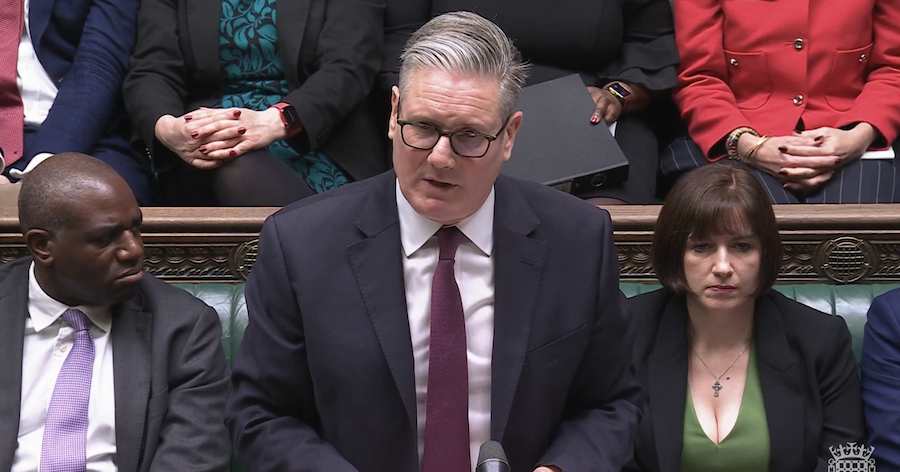
Keir Starmer tried to use Prime Minister’s Questions today to deliver what he hoped was a tough new line on Donald Trump. It wasn’t quite a Love, Actually moment – mercifully; more of an ‘Er, actually’, but still.
In his first answer to Kemi Badenoch, Starmer told the chamber that:
I want to be clear with the House: I will not yield. Britain will not yield on our principles and values about the future of Greenland under threats of tariffs, and that is my clear position.
The Prime Minister then added in his second answer that:
President Trump deployed words on Chagos yesterday that were different to his previous words of welcome and support when I met him in the White House. He deployed those words yesterday for the express purpose of putting pressure on me and Britain in relation to my values and principles on the future of Greenland. He wants me to yield on my position and I’m not going to do so. Given that was his express purpose, I’m surprised the leader of the opposition has jumped on the bandwagon.
Starmer didn’t face much difficulty from his backbenchers in this session
It was a notable shift from the way Starmer has previously dodged commentary on Trump’s behaviour, or indeed public disagreement. Instead of using mollifying lines about engaging with America as Britain’s closest ally, he was now saying in public that he wasn’t going to yield.
Starmer might have been pleased with himself had the session ended there, but as is so often the case, his prepared lines started to wobble as the questions went on. Badenoch was not on top form in terms of the way she structured her questions, but she did enough to highlight that Starmer was still not giving full answers.
Indeed, Starmer ended up flanneling about with jokes about Tory defections and his increasingly regular and prim scoldings of Badenoch for the questions she asks and the stances she takes, which are ultimately not relevant given he is the prime minister. He told her off for having ‘chosen naked opportunism over the national interest’ because – he claimed – she was querying his stance on supporting Greenland. He then said that Badenoch had described Greenland as a ‘second-order issue’ (she had in fact said Trump’s threats were second order compared to the situation in Iran, which presumably Starmer would accept were he prepared to read the full quote).
Later in the exchanges with the Tory leader, Starmer brought up that ‘second order’ line again, melding it together with Liz Truss’s mini-Budget in what sounded like a man sticking prepared answers together in order to get through to the end. By this point, Badenoch had wandered a bit by talking about funding for the armed forces, then got back on track with a refrain about him being too weak:
Back to the national interest. Instead of acting in it, the Prime Minister just tries to get through the day. On the Chinese spy hub embassy, he’s too weak. On Chagos, he’s too weak. On funding for the armed forces, he’s too weak. On protecting our veterans from prosecution, he’s too weak.
The Prime Minister then had to deal with Ed Davey, who had two very predictable questions: one on why he wasn’t following French president Emmanuel Macron’s example in standing up to Trump, and then the second on ‘why won’t the Prime Minister get on with buying great British helicopters made in the West Country?’. This was a wonderfully parochial and Lib Dem approach to talking about defence.
Starmer didn’t face much difficulty from his backbenchers in this session: a planted question at the start allowed him to talk about the importance of ‘making life affordable’, which is a phrase he is trying to use more often. Later on, Steve Witherden, a Labour backbencher on the left of the party, ended up suggesting that Starmer was ‘the weakest link’, which was a blowback to the 2000s that no-one had expected:
The thug in the White House has shown that he doesn’t listen to grovelling or sycophancy. He’ll continue to harm British interests no matter how compliant we are and, like all bullies, he will always find the weakest link.
Witherden asked whether Starmer would ‘close ranks with our European allies and commit to retaliatory tariffs?’ Starmer demurred but won’t have been unduly bothered by that question. He seemed pleased with his new line – which is still an acknowledgement that the approach he had previously taken to Trump no longer works.


Comments