
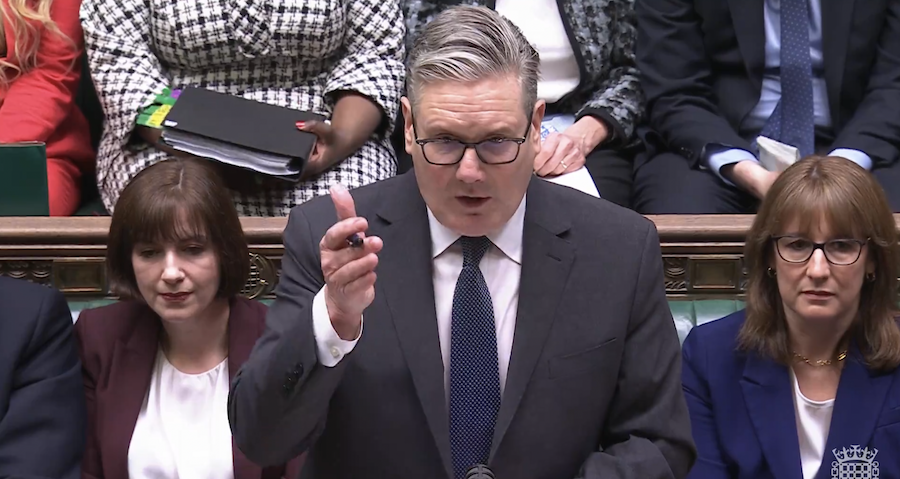
Prime Minister’s Questions today saw a leader under repeated attack for a ‘screeching U-turn’ and their suitability to be Prime Minister called into question. Unusually, though, Keir Starmer was the one making that accusation, rather than being on the receiving end of it. He came to the chamber determined to tell Kemi Badenoch that she had made the wrong call on whether to join the US-Israeli action in Iran and that he, therefore, didn’t need to take lectures from her.
Badenoch was, as it happens, not really lecturing Starmer; she just wanted to know whether he was going to go ahead with the planned rise in fuel duty in September. The Prime Minister didn’t want to give her the answer, so the pair spent the entire session talking about their own preferred topic and ignoring one another. Badenoch opened with the question, ‘Why does the Prime Minister think now is the right time to increase the cost of petrol?’ Starmer replied:
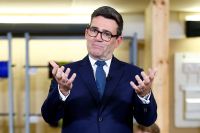
The Prime Minister had an air of confidence about him
We are not increasing the cost of petrol. We are absolutely clear in taking the measures that are necessary to deal with the impact of the conflict in Iran. We are dealing with that with other allies. We are taking the necessary action.
But the best thing we can do is to work with others to de-escalate the situation. As I said to the House last week, I took the decision that we should not join the initial US-Israeli offensive against Iran. The Leader of the Opposition attacked me for that decision relentlessly. She said that the UK should have joined the US and Israel in the initial offensive strikes.
Then yesterday, in the wake of the economic consequences, the Leader of the Opposition totally abandoned her position. She told the BBC ‘I’ve never said we should join.’ She told the BBC ‘I haven’t said we should have gone in with the United States.’ That is the mother of all U-turns on the single most important decision a Prime Minister has to take: whether to commit the United Kingdom to war or not.
It was worth showing that exchange in full, if only because it remained the template for the five questions and answers that followed. Badenoch retorted that ‘the mother of all U-turns is him saying that they are not increasing fuel duty: that is news to us.’ She ridiculed Starmer’s statement at the start of the year that the cost of living was his priority and asked how the increase in fuel duty would help with that. He replied:
Fuel duty is frozen, it is going to remain frozen until September, and we will keep the situation under review in light of what is happening in Iran.’
This was not, by the way, a new line: Rachel Reeves had said exactly the same thing at Treasury Questions yesterday. But it is still significant in that it is yet another crumb from the government about a decision it doesn’t need to take just yet, given the rise doesn’t come in until September.
Starmer then quickly went back to lecturing Badenoch on her position, saying loftily that ‘this is one of the most important decisions a Prime Minister or Leader of the Opposition ever has to take, whether to commit your country to war’. He then listed other ways in which the Tories had contradicted themselves over the past week on this question, accusing both Badenoch and Nigel Farage of having ‘jumped into supporting a war without thinking through the consequences’.
It was a well-prepared and lengthy response, to the extent that Starmer could have done the entire session with someone pretending to be Badenoch – something he’d presumably done earlier that day with a member of staff.
The Prime Minister had an air of confidence about him, and it wasn’t just driven by the Tory position on the war. It is also because he is – currently – largely in the same place as public opinion on the conflict in Iran, even if the public is not prepared to give him any credit for that.
Badenoch complained that he was answering last week’s questions, whereas she was asking about fuel duty. Back Starmer went to his ‘screeching U-turn’ narrative, followed by yet another pontification on how to do his job:
In this job, you don’t get a second shot on making the right call on taking your country to war. If she were prime minister, we would be in the war and she would be coming back to parliament a week later to say, ‘oh sorry, I got that one wrong’!
At this point, Lindsay Hoyle decided that he’d had enough, too. While he couldn’t just stop the session early to save all of us further iterations of the same questions and answers, he reminded Starmer that this was Prime Minister’s Questions, not Opposition Questions. Badenoch then claimed that if she had been Prime Minister, HMS Dragon ‘would have left a week ago’: one of the lasting weak spots for Starmer.
The pair then got rather more personal: Badenoch joked that the only time the Prime Minister had taken decisive action was in blocking Andy Burnham from standing in the by-election. Starmer claimed that she had been talking down RAF pilots, and demanded that she apologise: something Badenoch denied doing. She then told the Commons that Starmer had worked with ‘traitor to this country’ Phil Shiner and said she wouldn’t take any lectures from him. Starmer replied that he wasn’t going to take any lectures from her, either.
It was an unproductive session, one that ended with the political equivalent of two children telling each other they weren’t invited to their birthday party. Still, at least we now know that Starmer thinks he’s got a call right – which is unusual.


Comments