The Music Man, The Sting, Catch Me If You Can: movies and theater have a rich tradition of stories about imposters who manage to fool a lot of people. The literary branch includes the Duke and the Dauphin in The Adventures of Huckleberry Finn, and Herman Melville’s riverboat epic, The Confidence-Man. Indeed, tricksters are found almost everywhere stories are told. Native Americans have their tales of Coyote. Ananse, the spider, a key figure in West African and African-American folklore. We admire the cleverness of such cozeners, at least in fiction. Their victims often get what they deserve.
The DEI agenda, as long as it prevails, will ensure a long line of Jason Arday fabulists
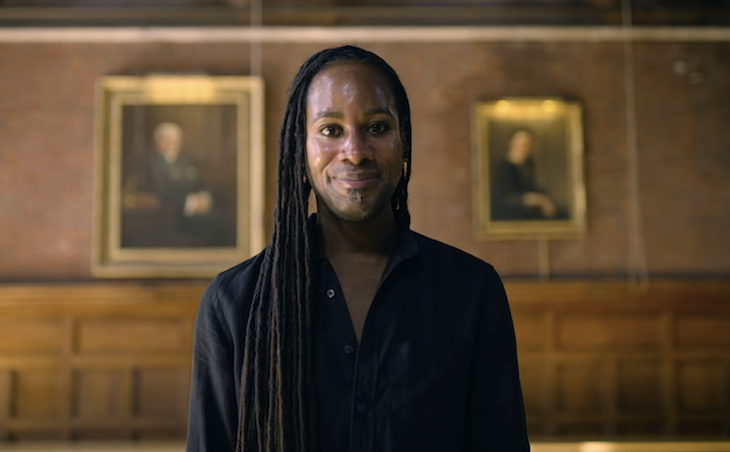
And this may be the case with Jason Arday too. To catch up: until a few days ago, Arday was a professor of Sociology of Education at the University of Cambridge. He has a PhD in education from Liverpool John Moores University. A Wikipedia page – not yet scrubbed at this writing – describes his origin and some of his accomplishments. But beware. So much of what Arday claimed about his past has now been exposed as confabulation, that nothing can be accepted at face value. The exposure of deceptions is what led to his resignation.
As of today, the New York Times, in an article a few steps behind, anticipates the arrival tomorrow of his memoir, Great and Unfortunate Things, published by Simon & Schuster. It would be wonderful if Simon & Schuster proceeds, and even more hilarious if the New York Times Book Review grants it a celebratory welcome. Surely it has already commissioned one based on an advance copy.
But publication of his memoir may be too much to hope for. More likely, this is a scandal to be buried by the light of the moon. On his appointment to Cambridge, Arday was touted as the youngest black professor in the university’s history. Therein lies both the explanation for recklessness in his appointment and the awkwardness in his disappointment. Arday takes his place beside Claudine Gay, who was exposed as a serial plagiarist in December 2023 and stepped down from the presidency of Harvard. A spate of plagiarism allegations of other figures in the DEI movement, many of them black, soon followed.
But the Arday affair is about more than plagiarism. It connects in a painful way with other humbugs intertwined with racial themes, as well as showing how America’s DEI mania replicates itself on the other side of the Atlantic.
The most famous, of course, is Jussie Smollett, the TV soap opera actor, who claimed in January 2019 to have been the victim of hate crime. Smollett claimed he was attacked in Chicago late at night by two men, one of whom he identified as white. He said they assaulted him, poured bleach on him, and put a noose around his neck. Police found that Smollett staged the incident himself. He was eventually convicted of disorderly conduct (later overturned on due process grounds) and sentenced to a jail term.
The Smollett affair was only the most publicized of many instances in which a black individual presented a false tale of being a victim of a hate crime in which the perpetrator or perpetrators were white. Wilfred Reilly’s book Hate Crime Hoax: How the Left Is Selling a Fake Race War (2019) cataloged dozens of such incidents, including the Tawana Brawley affair in 1987, which Reilly described as “the first and still the biggest” such hoax – but that was before the Smollett story.
Brawley, a young black woman, had been missing for four days when she was found lying in a trash bag near a New York City apartment where she had once lived. She was smeared with feces and told a story about having been abducted and raped by three white men, one of whom was a uniformed police officer. The Reverend Al Sharpton seized the case and amplified it into international news. But a grand jury was unconvinced and the story was eventually exposed as a hoax.
Then we have the Duke rape crime hoax of 2006, in which Crystal Mangum, a stripper, claimed to have been gang-raped by members of the Duke University lacrosse team. The accusation, like the Brawley story before it, was amplified by authorities and by the press, but was eventually exposed as a fabrication. We are fortunate in this instance to have a scrupulous record of what happened in the form of KC Johnson and Stuart Taylor Jr.’s book, The Campus Rape Frenzy: The Attack on Due Process at America’s Universities. Mangum was black; the lacrosse players white.
Why bring these matters up in a story about Jason Arday? Why can’t his story be more like The Music Man, The Sting, or Catch Me If You Can? A recognition that tricksters, though not innocent, inflict no deep damage?
The trickster classically takes advantage of the insecurities of his mark. In Arday’s case, his mark was Cambridge University, which one might think is secure in its 800-year history. But no, Cambridge like every other Western university is fraught with anxiety over “racial justice.” It is eager to prove itself “on the right side of history” by hiring and promoting black scholars. And nowhere would this be more true than in the Faculty of Education. In the hierarchy of academic fields, education ranks near the bottom for intellectual rigor. When someone comes along promising to elevate their status by performing as an academic superstar, it is almost too good to be true. Or at least too good to check.
Arday presented himself as a miracle: diagnosed as autistic as an infant; non-verbal until puberty; illiterate until 18; and then in a flash, a performer who was off-the-charts. It was implausible enough, however, to attract the attention of a postdoctoral researcher at Ghent University, Nathan Cofnas, who took the trouble to examine Arday’s 2015 dissertation and found numerous places where Arday duplicated a 2009 dissertation by someone else. Cofnas published his findings in July and, predictably, was brushed aside by the authorities at Cambridge. I’ve been through this routine several times in other plagiarism cases. The usual response is a version of “How dare you accuse this outstanding scholar!” But plagiarism allegations are hard to stamp out with indignation. The facts are there for all to see.
The usual response is a version of “How dare you accuse this outstanding scholar!”
In cases where the accused is black, the next step is to portray the allegations as racist, which is how the liberal media in England handled the matter. The defense, however, faced an uphill battle in view of Arday’s habit of preposterous self-promotion. He claimed awards he had never received, positions he never held, and athletic feats beyond human capacity. For his part, Arday has denied all allegations of plagiarism and of lying about his achievements, though has conceded he could have “corrected narratives” about raising millions for charity.
Arday is an inverse Jussie Smollett. Smollett invented himself as a veritable victim. Arday invented himself as a nonpareil victor. The right questions for Cambridge now are who examined his credentials? Who approved his appointment? Who will ensure that this never happens again? The right question for higher education on both sides of the Atlantic is whether the Arday case will at last put a stop to racialized academic appointments? The DEI agenda, as long as it prevails, will ensure a long line of Jason Arday fabulists to come, albeit a little more circumspect. It was Arday’s grandiosity that marked him out as suspicious.
Our colleges and universities these days have plenty of coyotes skulking the corridors and spiders hanging by silken threads over academic opportunities. Arday was but a symptom. The Dukes and Dauphins of DEI are to be found on every campus. We cannot realistically hope that they will all go away. Diversity actors have a rich repertoire to perform before an audience besotted with racial guilt. But Arday shows us that they can indeed go too far. The guffaws start and the curtain comes down.





Comments