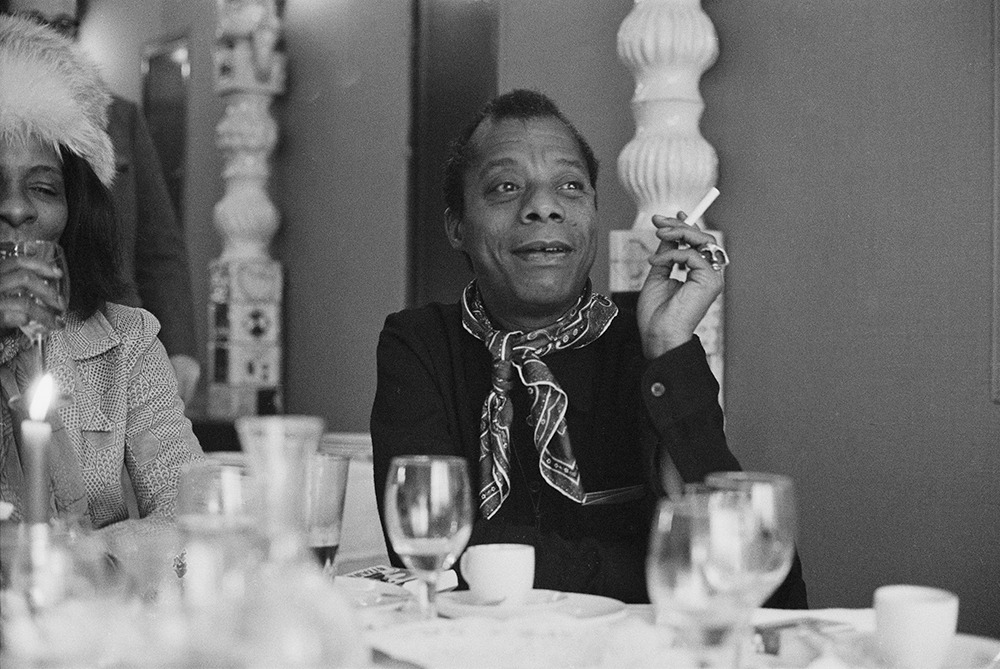
James Baldwin, like many American novelists before him, F. Scott Fitzgerald and John Dos Passos included, spent his formative years flitting restlessly between New York and Europe – New York being a source of fascination but also of creative burnout.
He completed his first novel, Go Tell It On the Mountain (1953), not in Harlem, where he grew up and set the book, but in a Swiss chalet owned by the family of his then boyfriend, Lucien Happersberger. As he lived and worked in Loèche-les-Bains, Baldwin reasoned that the village children who shouted ‘neger’ at him did not mean to be unkind. They were simply curious and could never have known ‘the echoes this sound raises in me’.

In Paris, when Go Tell It On the Mountain was published, Baldwin was astonished to find a parcel of inspection copies from his publisher when he dropped by the American Express office hoping to receive a cash handout sent by his family. Now he was published, but he remained penniless.
It would be a decade, and then some, before he became the public intellectual who regularly held forth about civil rights on chat shows, whose prodigious output as a journalist would have been an exceptional legacy in its own right but who kept a steady stream of novels bubbling alongside. Nicholas Boggs’s virtuosic biography charts with fine-grained detail Baldwin’s journey from Harlem, where he was born in 1924, to that hard-fought fame and subsequent emergence as a moral touchstone for continuing discussions on race.
A theme constantly returned to is how precariously balanced Baldwin’s achievements were. The distance between his completing a project and not knowing how then to proceed was slight, and he was often dogged by painful uncertainty. He never knew the identity of his biological father; and his mother Emma’s later husband, David, was emotionally abusive and coercive, always in a fury over young Jimmy’s absorption in books and his insistence on bringing his Jewish friends home. But even at this early stage the precarious balance tipped in Baldwin’s favour, as his teachers recognised an innate brilliance, took him to his first Shakespeare play and ensured that he was never short of reading matter.
He soon realised that he was attracted to boys of his age, not girls, and his first sexual encounter, aged 14 – lured into an alleyway by an older man – proved traumatic. Boggs’s subtitle, ‘A Love Story’, might seem incongruously glib to express such a tumultuous and hard-lived life, but by the end we realise how well chosen it is. Baldwin’s habit of falling for men who, while open to exploring same-sex relationships were essentially straight and ended up marrying women, snared him in cycles of emotional turmoil. Giovanni’s Room, the novel he wrote after Go Tell It On the Mountain, exploring gay love in Paris, leant heavily on his experiences. The gestation of his third novel, Another Country, was agonisingly protracted (writing began in 1948, but it wasn’t published until 1962) and Boggs presses the point that progress stalled on his fiction until he’d unravelled difficult realisations in his personal life.
Mountain mined Baldwin’s childhood experiences in Harlem; Giovanni wrestled with his sexuality; then Another Country proved a hurdle because Baldwin was now determined to deal explicitly with race. One of the most haunting images we are left with is of Baldwin on a research trip to the south locking eyes with an older black man on a segregated bus in Atlanta. No words were exchanged during an encounter that perhaps lasted only seconds, but the two communicated their mutual pain, although the older man had clearly suffered ‘all his life’, Baldwin said, to a degree he could only imagine.
As a journalist, Baldwin interviewed both Elijah Muhammad, the leader of the Nation of Islam, and Martin Luther King. His meeting with the ardently separatist Muhammad was distinctly uncomfortable and, although he shared many points of view with King, his own thoughts on race, about blame and responsibility, cannot be easily pigeonholed. His accusation of ‘white innocence’ – the stubborn refusal of many white Americans to acknowledge culpability for their country’s race problem – was hardly controversial. But his sense that racism was a moral failing that disfigured all Americans, white and black, was not what the likes of Muhammad or Malcolm X wanted to hear. Baldwin acted as a bridge, in favour of King’s message of integration, while also acknowledging the fury Malcolm X felt over white supremacy.
Baldwin’s habit of falling for men who were essentially straight snared him in cycles of emotional turmoil
Baldwin’s essay ‘Stranger in the Village’ (1953), later included in the landmark collection Notes of a Native Son, contained one of those striking statements – ‘We are trapped in history, and history is trapped in us’ – designed to upend received opinion and make people think. Boggs’s summaries of Baldwin’s positions on race are expressed with admirable clarity and wind back to his subtitle. Baldwin considered racism to be rooted in fear. Love, he proclaimed, was the necessary antidote, although not in any sentimental sense of the word. To be a truly transformational force, love had to be worked at. It involved seeking truth and seeing the best in people. Hatred destroys, whereas love ‘takes off the masks that we fear we cannot live without’.
We know – because Boggs plots it so carefully – about Baldwin’s own struggles to find genuine love with someone around whom he didn’t have to wear a mask. The pain he felt towards the end of his life at finding himself dismissed as old school and out of step leads Boggs to reassess the later novels, especially If Beale Street Could Talk, the only one narrated by a female voice.
This first Baldwin biography for 30 years supersedes the previous go-to text by David Leeming, Baldwin’s friend and assistant. It is also worth reading Ed Pavlic’s excellent 2015 book Who Can Afford to Improvise? James Baldwin and Black Music, the Lyric and the Listeners, which takes a deeper dive into the roots of Baldwin’s rhythms in jazz and blues than Boggs has space for. Baldwin turned up in Loèche-les-Bains carrying a portable typewriter and two Bessie Smith records – and it was Smith, Baldwin said, ‘through her tone and cadence who helped me… remember the things I had heard and seen and felt. I had buried them very deep’.




Comments