
If you’ve stuck out my cookery writing for long enough, you’ll know that I am a bit of a Labrador when it comes to different dishes: greedy, ready to try anything, and likely to enjoy it. Food is where my general cynicism and air of ennui gives way to unbridled enthusiasm. There are very few dishes that, when done well, I won’t chalk up in the ‘good’ column.
For a long time, crème caramel was the exception to that rule. To be fair, my experience of it had been limited: childhood self-catering holidays in northern France meant that my introduction to the crème caramel did not show it at its best. Dished out from the under-counter fridge came supermarket versions of what Raymond Blanc has called ‘the French National Dessert’: yoghurt pots filled with bland, bouncy custard infused only with the flavour of the plastic casing. Out they would come with a loud slurp, followed by a dribbling, tawny-coloured, thin liquid. I didn’t know what these French people were on, but they seemed to be undiscerning about their puddings.
I didn’t know what these French people were on, but they seemed to be undiscerning about their puddings
Judging the pudding on its shop-bought, plastic-encased version was perhaps unfair, but the punishment was just: I spent the next 15 years convinced I didn’t like crème caramels. I’d look at them on menus and on other people’s plates and wonder: didn’t they know there was a crème brûlée or tarte tatin available? Who would choose a Gallic milk jelly sitting in its own sauce? I avoided it assiduously.
My second encounter with it therefore was not a voluntary one. At pastry school, the dreaded slimy jelly turned up on my syllabus. They took custard seriously there: two weeks out of our eight-week first term were devoted to the stuff. But crème caramel was the recipe I was least excited about.
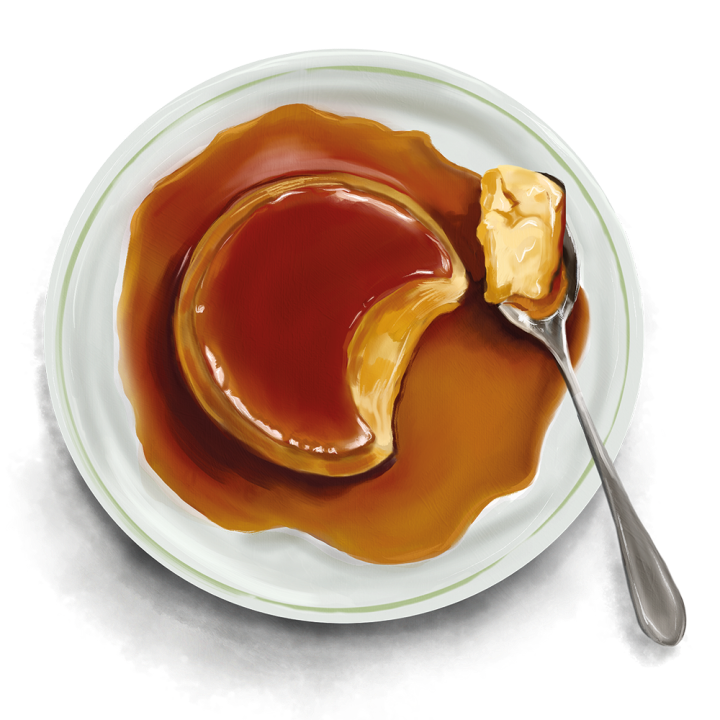
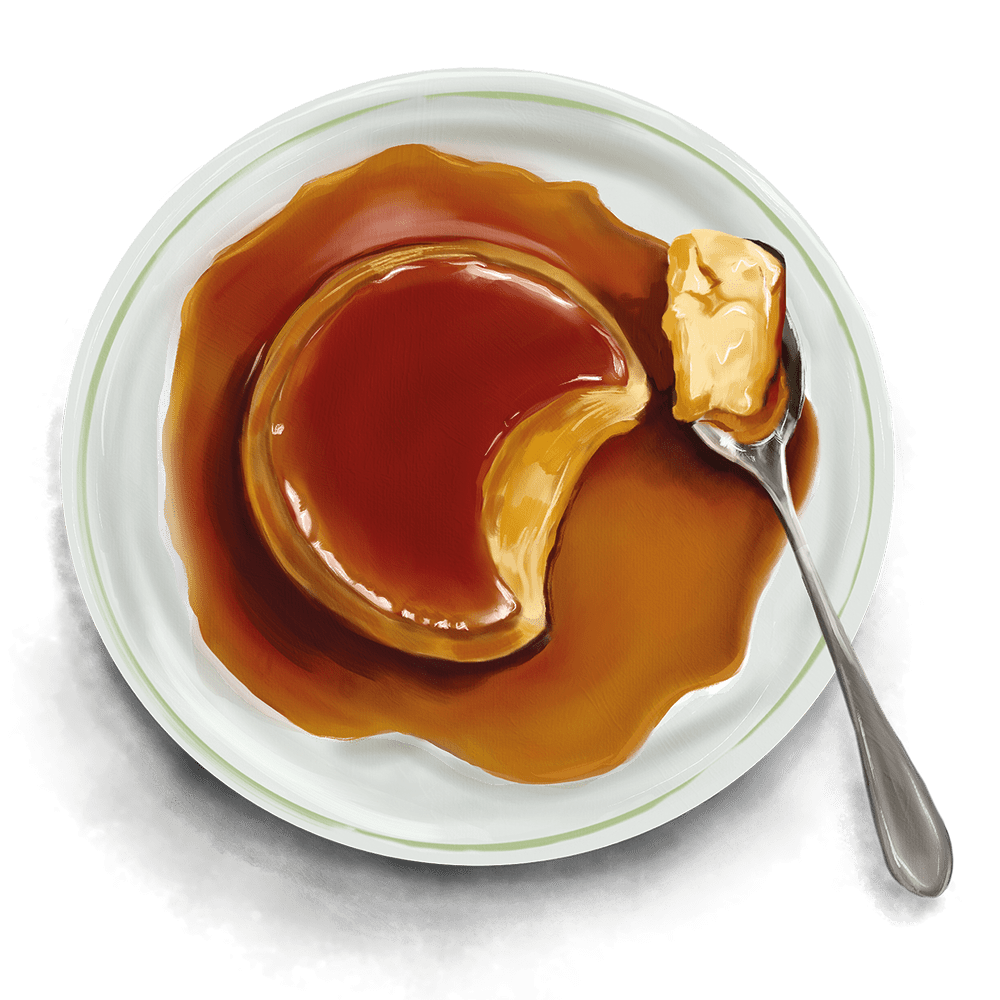
Like all the stuff we produced in class, we were allowed to take the finished crème caramels home with us at the end of class, so I shimmied my puddings into my trusty Tupperware, and held it tenderly as we swayed up the length of the Victoria line home. I’d intended to keep it for my husband, less from magnanimity, and more because – let’s remember – I had no interest in eating a crème caramel. I’m still not quite sure how I came to be standing in front of my fridge, door open, spoon dug deep into the pudding. But the fugue state continued until I had eaten the whole thing. And suddenly I understood: the gentle jiggle of the vanilla-freckled, soft custard sat against the near-bitter, smoky caramel – dark mahogany and unrecognisable from what I had eaten more than a decade before. Now I understood what the fuss was about. And I was going to have to start making my own.
Now, I will confess to a small cheat in my recipe: usually, a crème caramel uses only whole eggs, as opposed to a crème brûlée which uses only yolks. That’s why you can turn a crème caramel out and it will keep its shape, whereas you have to eat a brûlée from the pot. The whites give needed jiggle and natural jelly to the crème caramel – but those extra yolks bring a custardy richness that might not be strictly ‘correct’ but are delightful nonetheless. That’s a good enough reason for me.
Crème caramels must be cooked slowly, in a low oven, using a water bath to diffuse heat: this ensures the softest, smoothest of custards, with just enough structure to be turned out. Ah, the turning out! Always a moment of anxiety, even for the confident cook. The trick to that turning out comes in two parts: first, an overnight rest in the fridge, which hydrates the caramel into the sauce coating the outside of the custard, so you’re not left with a brittle puck of toffee. Secondly, go slowly: run a knife around the edge of the ramekin, and gently wiggle the custard until you feel the caramel release. Then you can confidently invert the mould and reveal your beautiful pudding.

Serves: 4
Hands-on time: 15 minutes plus overnight chilling
Cooking time: 45 minutes
For the custard
- ½ a vanilla pod
- 200ml whole milk
- 200ml double cream
- 2 eggs
- 2 egg yolks
- 65g caster sugar
For the caramel
- 100g sugar
- 1 tbsp warm water
- Heat the oven to 140°C/120°C fan. Halve the vanilla pod and scrape out the seeds. Place the milk, cream, vanilla seeds and vanilla pod in a pan and bring to steaming, then set to one side to infuse.
- Place the sugar over a medium heat: do not stir but, once it is melted, swirl to keep the mixture even. Cook until the syrup turns a deep mahogany. Carefully pour the water into the caramel – it will spit! Once smooth, (carefully!) pour the caramel into four 150ml ramekins. Leave to set hard for a few moments.
- Put the ramekins into a roasting tray, and boil a full kettle. Whisk the eggs and yolks with the sugar in a bowl. Sieve the warm milk directly onto the egg and sugar, and whisk until combined. Divide the custard between the ramekins.
- Pour the boiled water into the tin until it comes halfway up the ramekins. Bake for 45 minutes until the custard is just set. Remove the ramekins from the tray and, once cool, transfer to the fridge overnight.
- To serve, run a dinner knife round the inside of each ramekin. Using your fingertips, twist the surface of the pudding until you can feel it release from the caramel at the base. Place a plate over the dish, invert, and wait for the telltale weight that means your pudding has turned out. Eat straight away.
Join Olivia Potts for Truffles and Trattoria in Rome 2-6 December 2026. For more details about this Spectator Club trip, go to spectator.com/tastings






Comments