
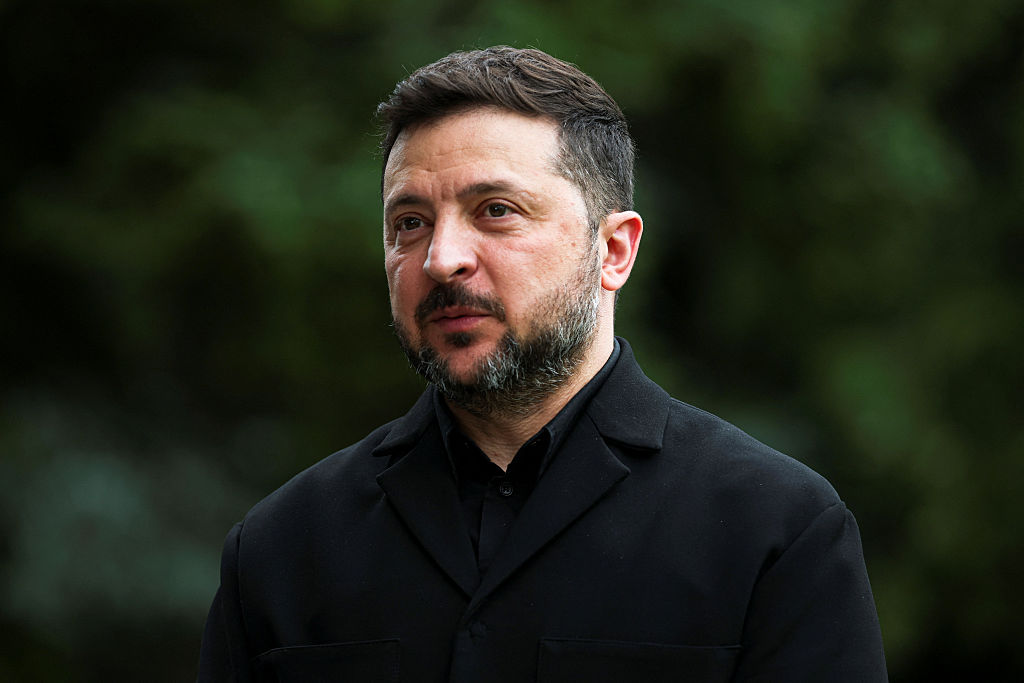
There has long been a worry that Russian escalation or miscalculation might see the Ukraine war widen into a broader European one. But what if it’s Kyiv, not Moscow, that starts this process?
The flashpoint is Belarus. Minsk’s dictatorial leader, Alexander Lukashenko, is beholden to Vladimir Putin, but not a helpless vassal. On the one hand, he has refused to join Putin’s war directly, saying that he won’t allow Belarusians to become “mincemeat.” On the other, he has been willing to let Russian troops use facilities in his country, and fly drones and missiles through his airspace.
There is growing concern, not only in Minsk and Moscow but also in many European capitals, that Zelensky, fired up by his recent successes, may overreach
Flush with recent success after striking deep into Russia, Volodymyr Zelensky has begun escalating his rhetoric against Belarus.
Back in February, he urged NATO to treat Oreshnik missiles based in Belarus as legitimate targets, regardless of whether they had been or were going to be used. Last month, following (implausible) claims that Minsk was considering joining a new Russian offensive against Chernihiv in northern Ukraine, he warned Lukashenko to “understand there will be consequences if there is aggression against Ukraine.” The head of Kyiv’s drone forces warned that he had a list of 500 Belarusian targets he would strike.
Just to make things personal, one of Zelensky’s advisors even threatened Lukashenko directly: “As a cautious person who wants to live to retirement… it would be preferable for him to simply remain silent today.”
Lukashenko was conciliatory, offering a face-to-face meeting with Zelensky “anywhere – in Ukraine, in Belarus” to address his concerns. On Tuesday, he went further, saying that Belarus posed no military threat to Ukraine and even apologizing for his previous harsh remarks.

The next day, though, what seems to have been a Ukrainian drone (though this is denied by Kyiv) hit a bus in the Russian region of Bryansk that was carrying a Belarusian youth football team. One person was killed, six wounded.
Rather than stepping back, on Friday Zelensky escalated, threatening direct military action against Belarus. Highlighting communications relay systems in two border regions, he claimed they were being used to help coordinate Russian drones, and demanded they be disabled.
He set a one-week deadline, threatening that if the Belarusians “don’t do it, we’ll do it.”
Is Zelensky really contemplating direct attacks on Belarus? If so, would he confine himself to those relay stations, given that Belarusian enterprises are connected with the Russian defense-industrial complex, and two of its oil refineries are providing a small but significant supply for its neighbor as Russia’s own refineries are being hit by Ukrainian attacks?
Balazs Jarabik, a former Slovak diplomat who follows Ukraine-Belarus relations closely, warned on X that “the risk of Ukrainian strikes against targets in Belarus is now the highest since 2022,” although this “does not automatically mean a decision to escalate.”
Instead, he thinks this is more likely to be signaling, warning Lukashenko of the costs of his support for Moscow, while ratcheting up the pressure on his regime. It is no coincidence that Zelensky recently hosted émigré opposition leader Sviatlana Tsikhanouskaya, and spoke of “the aspiration of the Belarusian people to free themselves.”
However, there is growing concern, not only in Minsk and Moscow but also in many European capitals, that Zelensky, fired up by his recent successes, may overreach.
He is currently embroiled in a bitter and unnecessary feud with Poland, having decided to honor the UPA – nationalists who collaborated with the Nazis during World War Two and carried out massacres of Poles. He recently slammed Germany for what he called the “unfair” proposal to grant Ukraine interim associate EU membership. He used the latest Davos summit to call Europe – which currently covers some two-thirds of Ukraine’s budget – a “fragmented kaleidoscope of small and middle powers” that talk but don’t act.
It is not that Ukraine has much to fear from the small Belarusian military and Lukashenko is painfully aware that Belarus is highly vulnerable to drone and missile attacks, “laid out like an open palm before the Ukrainian military.” However, while such an escalation on Zelensky’s part would no doubt enthuse his more gung-ho supporters, it would deeply concern many of his allies.
Attacking a third party because they are providing indirect support for the enemy’s war effort is a precedent which goes both ways. Moscow has been carrying out a campaign of low-level attacks and subversion in Europe, just as Kyiv is implicated in the 2022 sabotage of the Nord Stream gas pipeline.
But Putin views with frustration the degree to which so many of the industrial and economic facilities powering Ukraine’s war are within Europe. Although the prospects of any overt military attack against NATO remains extremely unlikely, the Kremlin might step up its covert operations against railroads, factories and other facilities. This, in turn, might generate escalation on Europe’s part. What happens in Minsk doesn’t necessarily stay in Minsk.




Comments