
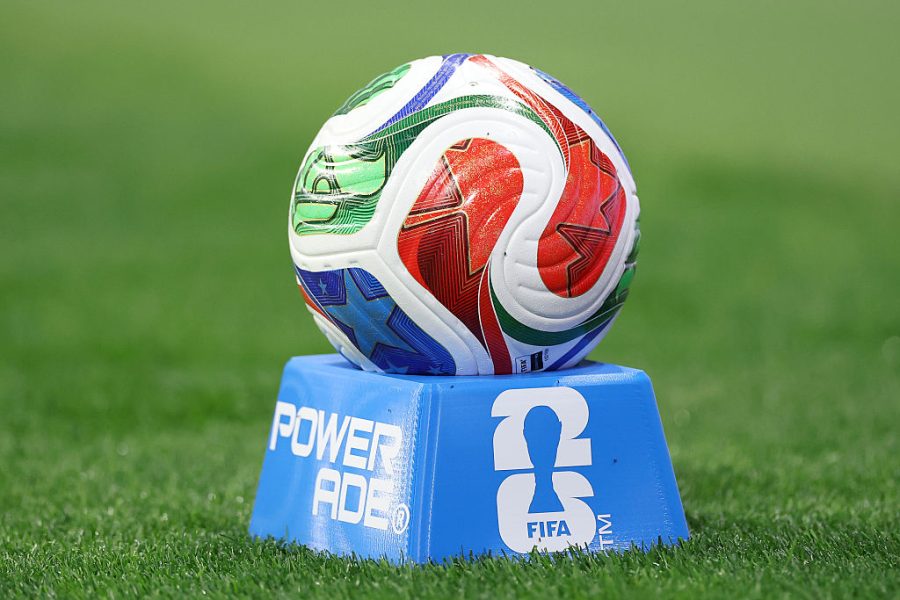
The World Cup’s new ball is the most technologically advanced ever, Fifa tells us. It has a 500Hz motion sensor chip, which lets VAR and analysts figure out precise positioning, speed and even the spin on the ball, for some weird reason. But former England goalkeeper Joe Hart says the Trionda ball is making life harder for goalkeepers trying to save shots. ‘It’s that kind of shoulder height,’ he continued:
As soon as [players] are not using the curling technique, as soon as that ball is not spinning, the goalkeepers are struggling.
Hart obviously has lots of experience in the area and was particularly known for his ability to deal with shots around the head and shoulders, but is he right?
The new Trionda has just four panels but has a very rough surface to counteract this effect
If you average out the saves per game, the current crop of goalkeepers have made more saves than in the previous two tournaments: six per game compared with 5.1 in each one previously. The number of goals has increased slightly, from 2.6 and 2.7 per game to three in this tournament. So it is a small change, but nothing noticeable.
The examples Hart cites are England’s Jordan Pickford and Senegal’s Edouard Mendy, who struggled to get a hand on the ball. He says the same of Iraq’s Ahmed Basil, who got fingertips to a Kylian Mbappe shot but failed to tip it over the bar. Perhaps we could dismiss these examples, as Pickford and Mendy have reputations as flappy goalkeepers – and no disrespect to M. Basil, but he was playing against the world’s best forward, whose shot we know (thanks to those weird sensors) reached 74mph. That’s about 15 per cent faster than the average shot in the Premier League.
Fifa has regularly changed the ball’s design. The 1970 Telstar had black and white hexagons to make it easier to see on black-and-white telly, while the 1986 Azteca was the first to be made from synthetic materials so it wouldn’t get heavier in the rain. The most controversial was the 2010 Jabulani ball, which had just eight panels, making it too smooth and resulting in it flying strangely: swerving or stalling in mid-air if kicked with little spin.
The new Trionda has just four panels but has a very rough surface to counteract this effect. Scientists at the University of Tsukuba in Japan have tested the performance of recent World Cup balls at different speeds. It shows that the new Trionda is slightly different from the 2022, 2018 and 2014 balls, but it actually performs better, maintaining the same drag coefficient at higher speeds. It’s precisely at these higher speeds that the Trionda performs better than previous balls, hence Basil’s misfortune against Mbappe. By comparison, the 2010 Jabulani was far more inconsistent.
Still, these statistics won’t please goalkeepers who are convinced the game is against them. Leicester City legend Kasper Schmeichel blames the ball for some odd goals, saying, ‘There’s no stitching in it, it’s all bonded together.’ He even goes so far as to accuse Fifa of ‘building the balls to score goals’. One thing’s for sure: while the ball may have changed slightly, moaning goalkeepers are still the same.


Comments