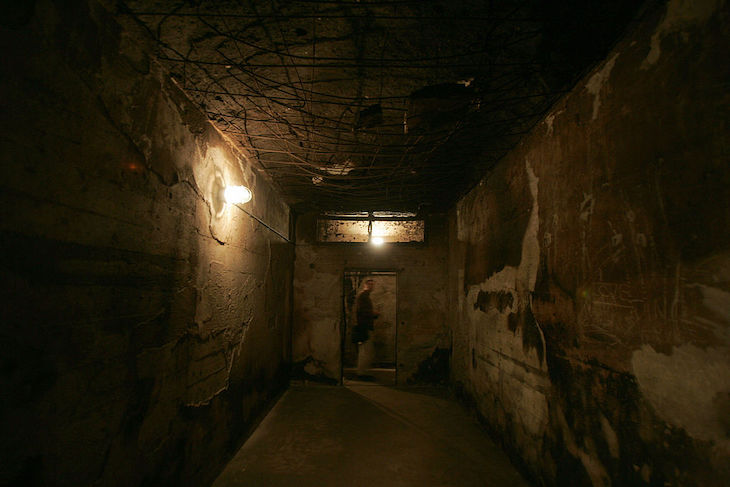
Berlin is currently convulsed by a culture war – and one all too familiar in a country and capital which, nine decades after World War Two ended, can still never seem to escape the long shadow of its Nazi past.
Just a few yards away from that bunker site stands another somber memorial to those evil days
The German capital’s Housing Senator, Christian Gaebler, of the Social Democratic SPD party, has announced plans to demolish the last remnants of a bunker dug beneath Hitler’s long demolished Reich Chancellery building to make way for sorely needed modern apartments.
The plan, however, is being fiercely opposed by a powerful group of amateur historians, the Berlin Unterwelt EV (Berlin Underworld association) who run highly successful tours of other wartime bunkers in the city. Dietmar Arnold, the Chairman of the Underworld Association, describes the demolition plan as “Absolute madness,” contending that Berlin needs to confront its history, however dark the past may be.
As well as the pressing need for housing, the SPD running the city are fearful that the bunker could become a shrine attracting neo-Nazis. Their discomfort is accentuated by the rise of the populist AfD party, which some left-wingers want to ban for alleged right-wing extremism, but which is currently leading the polls in state elections this September in the nearby Saxony-Anhalt province.
The remains in contention are not the same actual bunker where Hitler and his bride Eva Braun committed suicide in 1945 as the Russian Red Army closed in. These were crushed and destroyed by the Russians and their East German comrades after the war. But it is part of the same complex beneath the former Chancellery built by Hitler’s pet architect Albert Speer.

The Underworld Association already runs successful tours of other wartime sites built by, or linked to the Nazis, including a huge air raid shelter beneath an underground tube station, and one of the enormous Flaktowers constructed to shelter Berliners from the punishing Allied air offensive which reduced much of the city to rubble.
Berlin is replete with many other Nazi sites which have become tourist traps attracting thousands of visitors, including the “Topography of Terror” museum on the site of the former SS/Gestapo headquarters; the lakeside Wannsee villa where Reinhard Heydrich planned the Holocaust; and the offices of Hitler’s would-be assassin, Count Claus von Stauffenberg which is now a museum dedicated to the anti-Nazi German resistance.
More grimly, the execution chamber at Plotzensee prison where hundreds of anti-Nazis were hanged from meat hooks is also open to visitors. Even the ground above the bunker where Hitler died – now a car park – has been memorialized with a notice plaque detailing the bunker’s layout and its history.
Just a few yards away from that bunker site stands another somber memorial to those evil days: this is the large square which is Berlin’s Holocaust Memorial: a controversial collection of standing stones symbolizing the deaths of some six million European Jews at the Nazis’ hands.
Nor is the Third Reich the only chapter of Germany’s dark totalitarian past that has become a popular venue for visitors: the former HQ of the Stasi, the secret police of the Communist East German Democratic Republic is also a museum, and whole sections of the Berlin Wall which divided the city during the Cold War, have been lovingly preserved.
The execution chamber at Plotzensee prison where hundreds of anti-Nazis were hanged from meat hooks is also open to visitors
As a former historical guide myself to such sites, I can testify that they are presented responsibly and objectively and cannot honestly be characterized as being merely a magnet for Hitler sympathizing neo-Nazis or those Berliners with a lingering nostalgia for socialism East German style.
It is undeniable that Germany’s involvement with political extremism of both right and left and its catastrophic consequences for Europe and the wider world will continue to exert a fascination for many years to come.
Nor can Britain point the finger at Germany and accuse the country of being over-obsessed with the war. After all, we have a “bunker” of our own in London: in the shape of the Cabinet War Rooms off Whitehall, where Winston Churchill held conclaves of his war cabinet and which is today a proudly presented museum to those dark days.
Any attempt to airbrush the past, however horrific, or pretend that it should not be remembered seems both futile and doomed to disappointment for those who try to wish it away.






Comments