
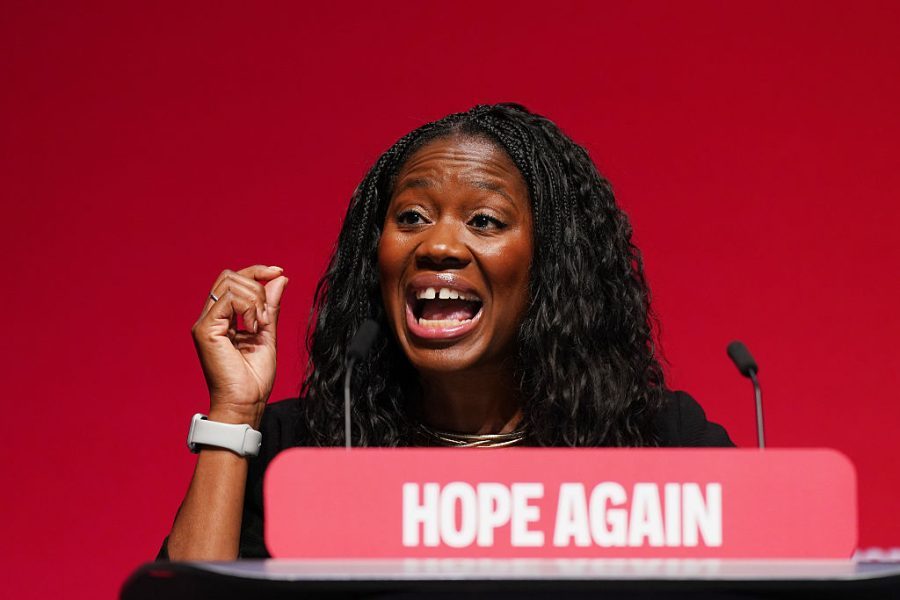
Has Labour’s anti-Rosebank rebellion run out of steam? Today, Labour backbencher Catherine Fookes has claimed that 92 backbenchers have signed her letter pleading the government not to go ahead with developing the Rosebank oil field, claiming that it ‘risks alienating members of the electorate who have put their trust in our message of hope and positivity’. It adds:
We urge you to show that Labour is on the side of people experiencing climate change’s impacts, not those fuelling it.
That is a sizeable rebellion, but it doesn’t seem to have developed very far in the past fortnight. On 15 November it was reported that 75 MPs had already signed the letter and that ‘well over a hundred’ were likely to do so. It was also reported that Energy Security and Climate Change Secretary Miatta Fahnbulleh had been encouraging MPs to sign – something she denies.
One reasoned speech from a government minister and the case against Rosebank could collapse
Labour currently has 404 MPs, so it seems that the anti-Rosebank faction extends to a little under a quarter of the parliamentary party. As for the ‘ministerial resignations’ that have been promised, it is now reported that this extends to three ministerial aides: the political private secretaries who carry ministers’ briefcases. They could resign without anyone noticing.
As for the other three quarters, is it too much to hope that they are on the side of pragmatism? After all, there is little reasoning behind the anti-Rosebank case, which is really little more than an expression of feeling. The 92 MPs opposing the project are against it because they think it sends the wrong message. If they were looking at it logically, on the other hand, they would conclude that approving Rosebank will actually slightly lower global carbon emissions, because it means that Britain would be sourcing more of its oil and gas locally. Gas from Rosebank would feed directly into the UK gas grid, meaning we wouldn’t need to import quite so much liquified natural gas (LNG).

As for oil, which would account for the majority of Rosebank’s output, it is true that around 85 per cent of crude oil from the North Sea is exported. Claims, however, that it ‘will just be sold on international markets at the global price’ obscure the fact that most goes no further than refineries in the Netherlands, from where we re-import some of it in the form of refined fuels.
It is better for the climate as well as the economy that production is kept reasonably local, and in countries where environmental standards are high, so that fugitive emissions of methane are kept to a minimum. Not even Ed Miliband, by the way, believes that Britain can survive without oil and gas for many decades to come: he has specified that Britain should keep a fleet of gas power stations running to tide us over when solar and wind are in tight supply.
If we are using oil and gas, it is illogical to claim the moral high ground by refusing to produce it. Even a virtue-seeking Labour MP can surely see that. Moreover, declining to develop our own resources will merely make us more reliant on what Miliband has called ‘fossil fuel dictators’ in the Middle East: we would be transferring wealth and power to non-democracies.
This is perhaps why this rebellion appears to be running up against the rails. One reasoned speech from a government minister and the case against Rosebank could collapse. Unfortunately, we are unlikely to get one out of Fahnbulleh, who is at least emotionally in alignment with the rebels, even if she hasn’t actively encouraged them. If Burnham is truly the pragmatist he claims to be, hers is one cabinet appointment he may be regretting.






Comments