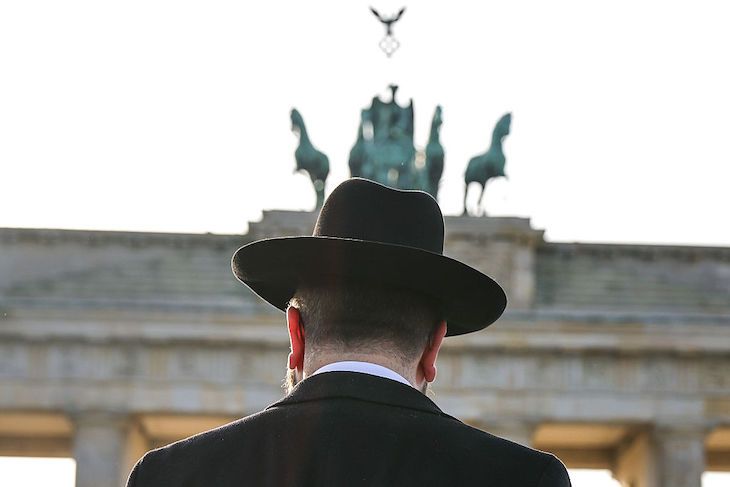
When a leading German-Jewish intellectual warns Jews to leave Berlin for Israel; when there are accusations of ties to organised crime and prophesies of economic hara-kiri, you might think this would be toxic for the political party it’s aimed at. On the contrary: Die Linke, the renamed successor to communist East Germany’s ruling Socialist Unity Party (SED), won a plurality in Berlin’s 20 September city elections.
Remember them? They built the Berlin Wall with its shoot-to-kill order, ran the Stasi secret police goons and ground the economy into rubble. The SED was so virulently anti-Zionist and anti-Semitic that the East Bloc regime not only never had diplomatic relations with Israel. It even ordered its Olympic team to boycott a ceremony mourning the murdered Israel athletes at the 1972 Munich Olympics.
“I would advise young Jews to leave Berlin,” Wolffsohn said in an interview with Cicero magazine
Die Linke (the Left), who call themselves socialist, say they’ve reformed. But their anti-Israel stance harks back to East German supremo Erich Honecker who was photographed embracing Palestine Liberation Organisation leader Yasser Arafat.
So, it shouldn’t be surprising that the party used a shrill anti-Israel campaign to win the votes of Berlin Muslims.
“Death, death to the IDF (Israel Defence Forces)” was part of a rapper’s song at a Die Linke rally in the city’s heavily Muslim Neukölln district. Berlin has about 350,000 Muslims out of a total population of 3.9 million. For those who didn’t get the rapper’s subtlety, Cansin Koetuerk, a Linke member of the Bundestag, Germany’s federal parliament, appeared in an Instagram post in which a voiceover said: “Hey, happy Sunday. Fuck the genocidal, apartheid state of Israel, free the occupied lands of Palestine, fuck the war criminals Bibi Netanyahu and Donald Trump.”
Berlin is a city that has an estimated 30,000 to 50,000 Jews. In 1933, when the Nazis took power, Berlin had 160,000 Jews. By 1945, after the Holocaust, just a few thousand survived and the city was, in the Nazi terminology, Judenrein (cleansed of Jews).
“Left-wing anti-Semitism usually manifests as Israel-related antisemitism. Israel is demonised and delegitimised, and its right to exist is called into question,” says Sandra Kegel, writing in the Frankfurter Allgemeine Zeitung. A leader in the newspaper notes that “anti-Semitism in Germany is judged by a double standard. If the perpetrator has a migration background, it is considered only half as bad.”
Exit polls show 51 per cent of Berlin’s Muslims who voted cast ballots for Die Linke and the party is now leading coalition talks with the Greens and Social Democrats. This produces mind-boggling headlines such as “No agreement yet on anti-Semitism in three-way talks.” This in the city where the Nazis held the Wannsee Conference in 1942 to organise the “Endlösung der Judenfrage,” (the Final Solution to the Jewish Question).
Die Linke are refreshingly blunt on plans to expand their voter base. The party’s election program calls for giving voting rights to non-citizens; making it easier to get a German passport by abolishing language and citizenship tests; and allowing “global freedom of movement,” to bring more migrants to Germany.
Die Linke seem to be following the sarcastic words of Bertolt Brecht after the failed 1953 revolt against communist rule in East Germany: “Wouldn’t it be simpler, then, for the government to dissolve the people and elect another?”
Michael Wolffsohn, born in Tel Aviv in 1947 to Jewish refugees from Germany, and a retired professor of modern history at Munich’s Bundeswehr University (German Armed Forces University), says that with “a bleeding heart” it is time to tell Jews in Germany to go to Israel.
“I would advise young Jews to leave Berlin,” Wolffsohn said in an interview with Cicero magazine.
Hostility to Jews in Berlin is nothing new. Back in November 2024, Berlin’s police president, Barbara Slowik Meisel, casually warned that people who are openly Jewish (or homosexual) should be careful about going to “certain neighbourhoods inhabited predominantly by people of Arab descent who also harbour sympathies for terrorist groups.” One might ask, why is this police president still in office after making such a statement and then failing to fix the problem? But she is. The city’s response might have been quite different if it had been neo-Nazis making life dangerous for Jews and gays.
Berlin’s Arab population grew after Chancellor Angela Merkel opened Germany’s borders to migrants in 2015, many of whom came from Syria and the Middle East. Some 1.2 million people arrived in Germany and applied for asylum in 2015 and 2016.
German media report disturbing ties between Die Linke and organised Arab crime gangs in Berlin, dubbed “clans.” Der Tagesspiegel newspaper says a member of Die Linke in Berlin’s city parliament asked for “detailed information on anti-clan operations of the Berlin police…including timing of operations, units involved and even types of weapons” they were using.
Berlin is a city that has an estimated 30,000 to 50,000 Jews. In 1933, when the Nazis took power, Berlin had 160,000 Jews
As with the far-right Alternative for Germany (AfD), which won elections last month in eastern Saxony-Anhalt state, it is unclear whether German security and intelligence services would be willing to share sensitive information with a Berlin city government that’s led by Die Linke.
What role Berlin’s police will even play in the future – if Die Linke sets up a coalition – is open to question. The party vows to partially defund the police and replace officers with social workers.
“This would be a security risk for Berlin,” warns Dietmar Woidke, the Social Democratic premier of Brandenburg state, which surrounds Berlin, who urged his SPD colleagues not to enter a coalition with Die Linke.
Yet as grotesque as all this is, there’s a deeper threat posed by a possible Die Linke government in the nation’s biggest city: the party’s economic policies threaten to pitch Berlin, that’s already in effect bankrupt, into even deeper crisis.
The tragedy is that this comes as Berlin shakes off its hackneyed “poor but sexy” image and outperforms the national German economy as it becomes the startup hub of Germany, ahead of Munich, Hamburg and Cologne.
The city-state of Berlin’s total debt will hit a staggering 77 billion euros (£65 billion) next year and this year’s budget has a 4.6-billion-euro (£3.9 billion) deficit. Yet Die Linke’s plans can be summarised as a blow-out expansion of state spending and legal reforms to allow and encourage massive new borrowing.
Die Linke’s program is a 325-page compendium of big spending, little of which appears financed beyond classic “soak the rich” policies
The biggest election promise is to expropriate 220,000 privately owned apartments in the city with an estimated value of 40 billion euros (£33 billion). Many of these would come from Vonovia SE, a European residential real estate company. Under German law, real estate that is expropriated must be paid for at fair market value. A draft law to grab the apartments talks about paying just 40-60 per cent of the market value and this only over the next 100 years using income paid by renters. It’s not just real estate companies that would take a hit. Most of these apartment blocks were financed and have big mortgages, meaning that German and international banks would also be sucked into the maelstrom.
Aside from this, Die Linke’s program is a 325-page compendium of big spending, little of which appears financed beyond classic “soak the rich” policies that’ll yield far less than is needed.
The party wants to impose rent control not just on residential apartments but also on commercial real estate. Taxes will be raised on any house worth over 4 million euros (£3.4 million), real estate transfer tax will rise to 8 per cent from the current 6 per cent, business taxes will increase and a new property tax will be aimed at preventing real-estate speculation, says Die Linke.
“We do not want the kind of economic development seen in London, where FinTech bankers and start-up entrepreneurs make billions and buy up the city,” says the election manifesto. Hmm…where is the tax base going to be that Die Linke wants to milk?
The real trouble is that what happens in Berlin does not stay in Berlin. The city is a symbol for Germany around the world. Developments in Berlin – if Die Linke take control – will tarnish the entire German brand as a place to do business.
“Why should I invest in Germany? Why, especially, should I invest in Berlin?” says Michael Moritz, managing partner and co-founder of Carlsquare, a tech investment and corporate finance advisory firm, as cited in Frankfurter Allgemeine Zeitung.
“People will give Germany a wide berth,” Moritz says. “They will certainly give Berlin a wide berth.”





Comments