When Earl Spencer was interviewed by Larry King in 1997, he had nothing but words of praise for the-then Prince Charles, in the aftermath of Diana’s death and funeral. When Larry King asked if the Prince of Wales had had anything to say about Spencer’s fiery eulogy, his guest replied, ‘Not about the speech, no, but he was perfectly polite all day’, and went on to stress that, ‘Nothing nasty has ever been said about it by him to me.’
Spencer attempted to claim that he was drawing a distinction between Charles as king and Charles as unpleasant brother-in-law. Which, I am afraid, will not wash
Given how emotional and pointed his speech was – in which Spencer talked of how Diana ‘needed no royal title to continue to generate her particular brand of magic’ – his nonchalant, even respectful appraisal of his former brother-in-law might have seemed slightly incongruous. But at least it appeared to recognise that through the bond of grief they had transcended any personal disagreements.
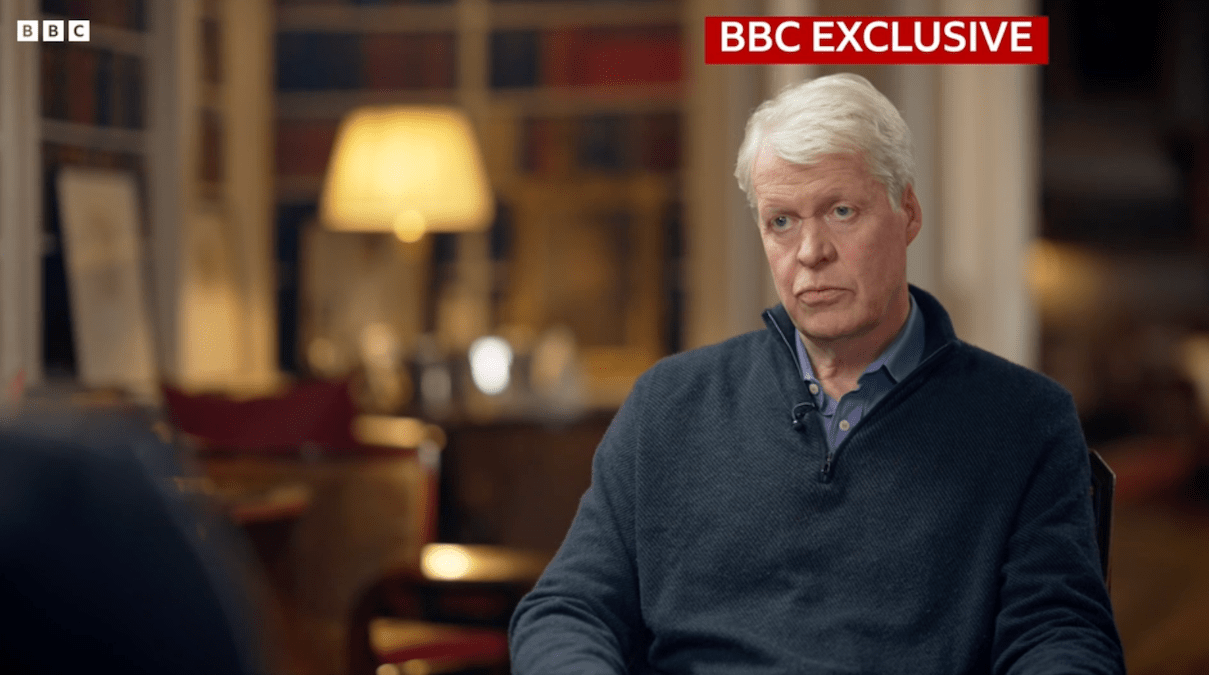
Nearly three decades later, Spencer sat down for a BBC interview with Laura Kuenssberg on Sunday, in which he discussed the extraordinary revelations in his forthcoming memoir Swan Song –most notably, the future king’s alleged dismissal of his former wife, with the words ‘We’ll forget her soon enough.’
It was the most anticipated conversation between the media and a royal-adjacent figure since Harry and Meghan opened up to Oprah in 2021, and the substance of the interview will undoubtedly be just as debated.
If the optics of the encounter superficially owed something to the notorious Emily Maitlis-Prince Andrew sit-down for Newsnight in 2019, less was at stake this time, given that the ‘he said, he said’ dynamic in question could not quite compare to the allegations of sexual abuse being aired then.
Which is not to say that this show, entitled Princess Diana: My Sister’s Story was uneventful or lacking in drama. Spencer was first depicted showing Kuenssberg round the grounds at Althorp, his family seat where Diana is now buried, and there was the usual sort of patronising ‘before we began’ fill-in expository material about her death and the subsequent schism in the Royal Family before the interview proper began.
Spencer was initially allowed an opportunity to present his distinctly partisan account of his memories of Diana and her death before Kuenssberg mentioned the now-notorious call that Spencer had with Prince Charles, in which he once again referred to the ‘giddy tone… a lightness that really jarred with me.’
Kuenssberg suggested that this was ‘incredibly damning’, before quoting the book’s judgement that Charles felt relieved that he would now be free to marry Camilla, all from the tone of his voice. Spencer acknowledged that ‘I cannot be sure’ that this was the case, which was as close as he came to admitting doubt as to his headline-grabbing claim.
There was then discussion about the second phone call Spencer had with Charles, which began as a chat about the logistics for the funeral but then included what Spencer called the ‘monstrous’ idea that the young princes should walk behind the coffin. This led to another call from the Prince of Wales, who supposedly said that he had set the precedent of walking behind Lord Mountbatten’s coffin. Spencer alleged that Charles went ‘ballistic’ and ranted for a significant period of time before saying, fatefully, ‘We’ll forget her soon enough.’ Spencer, in his recollection, allowed ‘a stunned silence’ to elapse, before hanging up on him.
And this is where the central doubts persist. Kuenssberg dutifully cited the Buckingham Palace denial of such a remark ever having been made, only for Spencer to respond that, ‘Is he furious or is he embarrassed?’
When asked whether he had kept a diary or contemporary evidence of this incendiary remark, Spencer could only answer that ‘I told friends and family straight away, because it was so monstrous’, and claimed that evidence of this conversation made it into the eulogy that he delivered at Diana’s funeral, especially the final moment, which he insisted was a direct rebuttal of Charles’s words that she would be wiped away in history before long.
Kuenssberg asked Spencer outright who should be believed. He replied, straight-faced, ‘Well, I’m telling the truth… I can hardly be responsible for what Buckingham Palace is saying.’ And he hinted, for the first time, that he had these discussions with William and Harry before he went public, saying ‘This will not be a surprise to them.’ He justified this decision to break cover by saying ‘I’m aware of mortality and I wanted to put things down, for once and for all, that will be true’. In other words, if he, too, should meet with a car crash, then this will be his last will and testament, and we can judge him by his words.
When Spencer remarked that he had chosen not to include several other disobliging stories about Charles, Kuenssberg observed that this sounded like a threat, especially given that Spencer observed ‘I’m not a salacious writer’ (many others, who have seen the front pages over the past few days, may disagree with this, but there we go). Kuenssberg then pressed the point about how Diana’s reported remark that ‘my husband is in love with his valet’, which has now been brought into the public eye, may be described in his book as ‘an improbable claim’ but has been included in order to further damage Charles’s reputation.
Spencer was never rattled or put out, remaining calm and articulate until giving in to some quiet emotion at the end. He claimed that the book is ‘a brother’s loving tribute to a sister’, rather than a cash-in job. Still, an announcement that he is giving the no doubt huge sums that the book’s sales will earn to charity, especially ones founded or patronised by his sister, has not yet been forthcoming. But his rationale during the half-hour interview was not to admit anything that sounded like weakness or a lack of judgement, nor to say anything that would lead to any unflattering headlines in the papers. He even tried to remain neutral on the vexed topic of Harry, although he observed that he was ‘worried’ about his nephew not having any police protection.
He made it clear that he did not take a side between his nephews, save as a ‘benign figure’, and despite Kuenssberg’s prodding, refused to make a comparison between Diana and Meghan, save to talk about the ‘cancerous influence’ of the tabloid press. Which, of course, has recently paid him a fortune to serialise his tell-all memoir. When asked what Diana would say about the controversy, Spencer remained oblique, saying only ‘as an uncle, I hope one day it’s resolved’, but claiming it would be ‘intrusive’ to go further. Finally, when asked ‘do you believe in the monarchy’, Spencer once again equivocated, praising the Norwegian monarchy before saying ‘it’s absolutely fine… [but] I find some of the flummery quite jarring… I don’t think it’s healthy for a human being to be seen in such archaic, servile terms.’
Finally, when asked whether he supported King Charles, a man who is, as his interviewer observed, still suffering from cancer, Spencer looked concerned, before saying ‘I do’. When Kuenssberg sniped, ‘You have a funny way of showing it’, Spencer attempted to claim that he was drawing a distinction between Charles as king and Charles as unpleasant brother-in-law. Which, I am afraid, will not wash.
Even when the tears finally came, as Spencer reminisced about the loss of his sister, it is hard not to feel that all his talk about this book being his final word on the matter will be sorely tested over the weeks, months and perhaps longer to come. Those who see him as a hero will continue to do so, but those who remain to be convinced of his truthfulness are unlikely to have had their minds changed, either.




Comments