
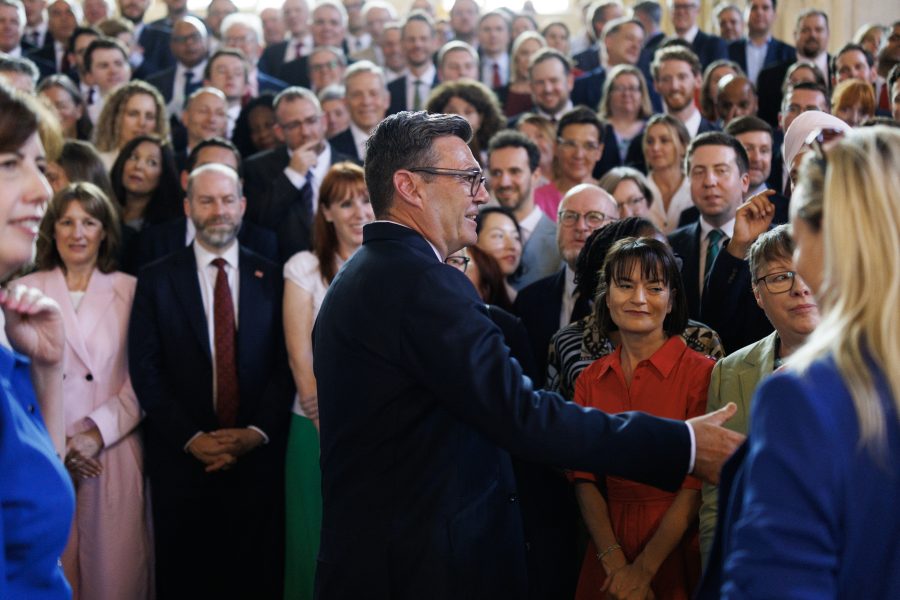
Most of Labour’s 411 MPs arrived in Parliament’s Westminster Hall on Monday afternoon for a photo with their new messiah. The former Starmtroopers (or perhaps now Burnham’s babes?) swarmed the new MP for Makerfield in an attempt to cosy up to the likely future Labour leader and prime minister. Andy Burnham may have felt popular then, with hundreds of new friends, but the honeymoon won’t last.
Much has been made of the machinery of government and how, under Sir Keir Starmer, it has appeared to grind, splutter and stall as the state struggled to deliver. Yet one of the least discussed causes of this paralysis – which Burnham will now have to fix – lies not in Whitehall but in Westminster itself. The trouble is this: Labour is terrible at whipping.
Burnham appears to want to replace the authority of governing with the imperative to be your authentic self. Like a social media influencer
The Whips’ Office is one of Westminster’s more curious institutions, with roots stretching back to the 18th century and a name derived from the ‘whipper-in’ – a huntsman’s assistant whose job was to stop hounds straying from the pack. Without someone cracking the whip, the hounds go where they please.
There has long been much theatre about the whips and its dark arts; the veiled threats and peculiar rituals (which are mainly present in the Conservative school of whipping). Former chief whip Gavin Williamson kept a tarantula named Cronus on his desk. The most junior Tory whip, by tradition, must pour champagne into silver goblets that grow in size with the seniority of their fellow whips. It is silly, of course. It is also effective in reminding their MPs that they are part of something bigger and can be put in their place by others more senior in the party who set the direction. But unlike their Tory counterparts, Labour MPs haven’t taken to the whipping role with the similar gusto.

As for Starmer, he never made his whipping operation a priority, and his government paid the price in rebellions, embarrassments, and the slow haemorrhaging of authority that has defined his tenure.
Starmer’s Whips’ Office was stocked with members of the 2024 intake. They were well-meaning, but weren’t able to command a room, let alone more senior MPs. Even worse, several were connected by marriage or family to Downing Street insiders. There was Imogen Walker, wife of former chief of staff Morgan McSweeney; Gregor Poynton, husband of political director Amy Richards; and Jake Richards, Amy’s brother, whose own wife advises the Welfare Secretary. It had the feel of a family firm rather than an apparatus for government.
The result was predictable. Despite Labour winning a majority of 174 at the last election – the sort of parliamentary cushion most prime ministers can only dream of – Starmer found himself unable to keep his own side in line, ceding to his MPs’ wishes instead of seeing through his own agenda.
One sorry episode for the Labour whips stands out in particular. Around the time Scottish Labour leader Anas Sarwar publicly called for Starmer to resign back in February, a whip and one of her flock (the group of MPs a whip looks after) got into a slinging match in the Parliament hairdressers, of all places, in front of a Conservative MP who, one imagines, watched with glee. The Labour MP had already joined 107 others in a welfare rebellion and barked at the whip that Starmer was useless. The whip lashed back that he owed his seat to Starmer. Neither was entirely wrong, but instead of the usual sensible whipping approach, for example organising a private meeting, or half an hour with a minister that might help the MP keep their seat, the pair almost came to blows. The chief whip during this period, Jonathan Reynolds, is widely known not to have even wanted the job.
What is rather more alarming is that Burnham is considering making things considerably worse. He believes, as he told the Times earlier this month, that government would be ‘better served’ by the ‘collective wisdom’ of the parliamentary Labour party over the Whips’ Office.
Burnham has spoken openly about scrapping the whips system altogether. ‘I think it would raise the esteem of parliamentary politics in the eyes of the public,’ he told the LabourList website last year. His reasoning, such as it is: ‘In the social media age, people want to see people being true to themselves.’ He appears to want to replace the authority of governing with the imperative to be your authentic self. Like a social media influencer.
Burnham made a slightly more coherent argument in 2022, suggesting abolition would allow MPs to be ‘powerful agents for their places’ rather than a ‘rubber stamp for the views of an Establishment.’ It sounds appealing until you remember that Labour MPs are not just local representatives. They are members of a party charged with advancing a national programme. Sometimes they will require persuading. Sometimes they will need something firmer. Without the whip, you’ll end up with political paralysis.
Burnham’s answer to this is characteristically breezy: ‘If any government can’t persuade its own MPs to back a measure voluntarily, that should tell you something: it’s a bad idea and needs to be stopped.’ One can only wish him luck. Governing a country, it turns out, occasionally involves doing things that not everyone – especially some amongst those 400-strong Labour MPs – immediately likes. The whip exists for those moments. Without it, turmoil beckons.




Comments