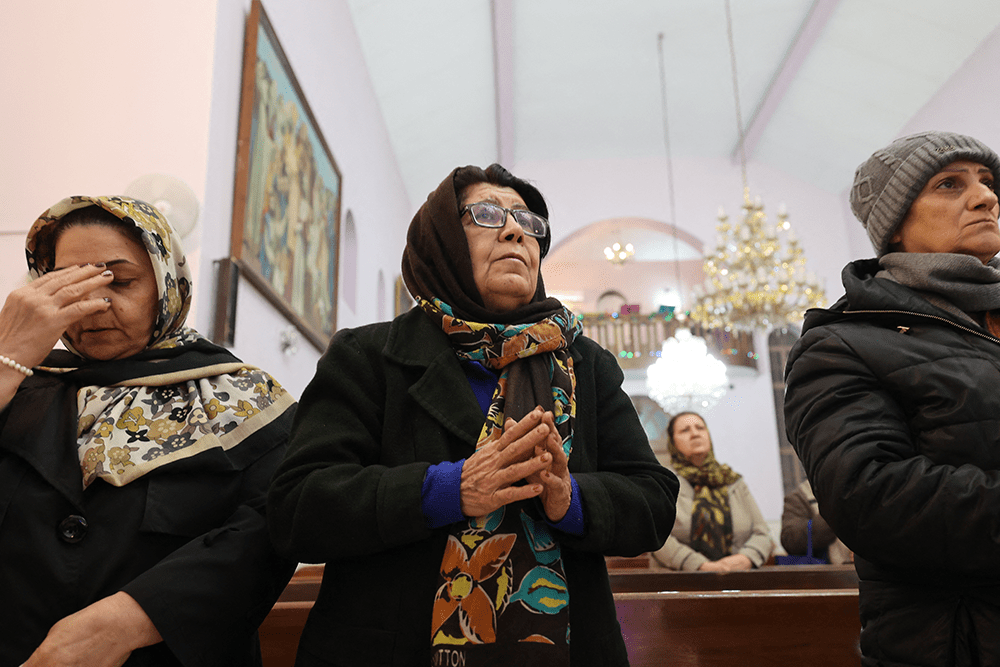
Apostasy – specifically, conversion to Christianity from Islam – is punishable by death in Iran. Suspected Christians are routinely imprisoned and tortured. Despite this, evangelical Christianity is sweeping through Iran. A 2020 survey of 50,000 Iranians conducted by a Dutch NGO, the Group for Analysing and Measuring Attitudes in Iran, suggests that there could be more than 1.2 million Christian converts. In a country with a population of 90 million, that’s a sizeable portion – and it’s growing fast.
‘It’s probably more like two million today,’ says Father Jonathan Samadi, founder of the Persian Anglican Community of London. ‘The numbers increase every year.’ Father Jonathan converted as a young man, having found a Farsi copy of the New Testament in a Tehran library. He fled Iran for Britain in 2009 after he was arrested and questioned by the security services. Now in his forties, he was ordained into the Church of England in 2016.
At Father Jonathan’s church, St Mary and St Peter in Staines, Surrey, the congregation is swelling with Iranian Christians who have recently found refuge in the UK. Two huge karaoke screens flank the altar, broadcasting hymn lyrics in English and Farsi.
After communion, Iranians gather beneath the gargoyles for their post-service coffee morning, keen to let me know what led them to Christ – and, by extension, Staines. ‘My mum became a Christian in Iran,’ says twentysomething Mehdi (not his real name). ‘Then I got interested. There is no force in this religion. Not like Islam. That’s the big difference between Islam and Christianity.’
‘There are lots of Christians like us in Iran,’ insists a group of Iranian ladies, clustering round the pew.
I first came across Iranian Christians 18 months ago, when I started an oral heritage drama and podcast project for refugees and asylum seekers in Hounslow, a few miles from Staines. Based on our normal take-up, we’d budgeted for six months of workshops and about 35 participants. We were expecting Ukrainians, Afghans, Syrians and perhaps a few Saudi girls fleeing domestic abuse. I was amazed when around 100 Iranian Christian converts turned up.
To my shame, I originally assumed these Iranians were political activists who had ‘converted’ once they arrived in the UK to ensure they couldn’t get deported: as apostates, they would be in genuine danger if they were sent back. After working with asylum seekers for more than ten years, I thought – as most are incredibly dynamic, motivated people – this might seem like a wizard wheeze.
‘There is no force in this religion. That’s the big difference between Islam and Christianity’
But, as the Iranian Christians shared their stories, it quickly became clear that they were genuine. They were disgusted by the cruelty of their Islamic Republic, yet they felt the need for some kind of spirituality.
It is the harsh rule of Islamic theocracy that has stoked Christianity in Iran. But, as Father Jonathan explains to me, there were Christians there long before the 1979 revolution. Thomas the Apostle is said to have converted the Persians in the 1st century before he was martyred in India. Iran’s indigenous Christians are ‘mainly ethnic Armenians, Assyrians and so on – from cultures that have always been Christian’. The regime just about tolerates these minorities (recorded in a 2016 state census at around 130,000) – it’s the converts from Islam who must be crushed.

Nadia (not her real name), 60, from Tehran, converted to Christianity ten years ago. She was introduced to the faith by a neighbour who gave her the Bible. She and her fellow Christians would secretly gather to worship and read the Bible in other Christians’ houses, like the early Christian home churches in ancient Rome, albeit with the 21st-century addition of services over Zoom. ‘There are lots of churches in Iran, and they are very old,’ one Iranian Christian explains. ‘But they are locked and no one can go.’
Often, the Gasht-e Ershad (Iran’s morality police, tasked with enforcing Sharia law) then turn up at some hapless suspected Christian’s home, waving the Bible and asking the children if they’ve seen it before. If the children say ‘Yes, Mummy reads it all the time’, then one of two things happens. If Mummy is at home, she is carted off to jail, probably tortured and told to rat on her fellow Christians. But she’s not normally executed – which legally she could be – and that implies there are enough Christians to cause concern to the regime. You can execute dozens, perhaps hundreds, of people, but not 1.2 million without the world – or indeed your population – making a fuss.
If Mummy is out, Daddy rings Mummy and says: ‘Whatever you do don’t come home.’ Then they look for a people trafficker and pay tens of thousands of US dollars to be smuggled, often as a family, in a lorry to Turkey before being flown on false passports to the UK. Here, housed in asylum hotels, they enter our system. Typically, their asylum is granted fairly quickly as they are in genuine danger. Typically, too, some are horrified by the number of Muslims in Britain. ‘The British Muslims try to convert our children at school,’ says one Staines parishioner.
The low-key boom in Iran’s Christianity may even be supported informally by the UK. When I asked a British diplomat who was previously posted to Iran whether he knew anything about the growing numbers of Iranian Christian converts, he turned red and muttered: ‘I might do!’
As for whether mass Christian conversion poses a genuine threat to Iran’s Islamic Republic, it’s certainly another pressure point along with sanctions, a collapsing economy and the rage of Iran’s women and liberal classes. However, given that Iran’s converts seem keener on spirituality than revolution, their effectiveness as a political destabilisation tool is – like so much else – in God’s hands.
I ask Father Jonathan if he thinks the Iranian Christians will start an uprising. ‘No,’ he replies. ‘But there will be a lot of prayer.’



Comments