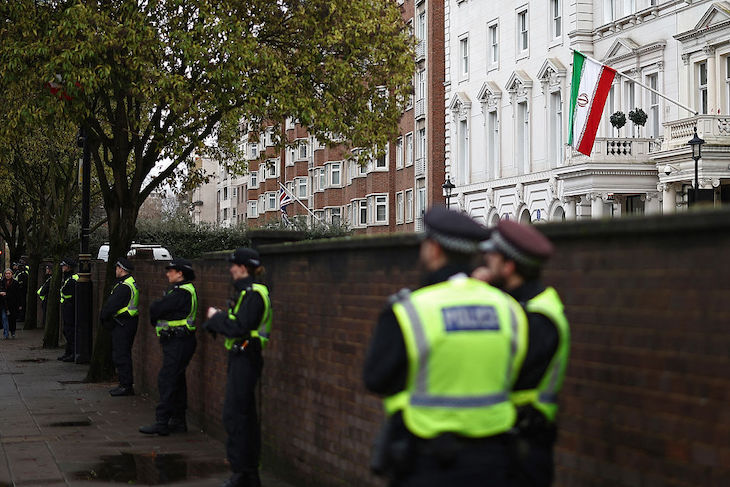
It must be a comforting thought to those who oppose the military action against the Iranian regime that it is, to coin a phrase, a quarrel in a faraway country, between people of whom we know nothing. It’s not our fight and not our war, they argue.
The Iranians have plotted and planned the assassination of British citizens, on British soil, for many years
But the arrests this morning of four people – one Iranian and three dual British-Iranian nationals – on suspicion of assisting a foreign intelligence service show how ludicrous such a view really is. (Six other men were also arrested on suspicion of assisting an offender.) Iran has been our fight – our concern – for decades, and not simply because of its plans for a nuclear weapon and its use of terrorist proxies to create instability across the Middle East. It is our fight for a far more direct reason: the Iranians have plotted and planned the assassination of British citizens, on British soil, for many years. As Deputy Prime Minister David Lammy put it this morning, after the arrests: ‘Iran is the biggest state sponsor of terrorism globally and sadly, that is in effect in our own society as well. Our intelligence services and counter-terrorism police have thwarted lots of action over the last few years.’
What an irony. The government has tried to pretend that none of what is going on at the moment in the skies above Iran is our business, and that our involvement now is purely defensive, a reaction to Iran’s response to an attack that we didn’t support. Lammy and the Prime Minister may not have supported action, but all that shows is how misguided they are. As Keir Starmer put it in his first remarks after Iran’s retaliation: ‘Even in the United Kingdom, the Iranian regime poses a direct threat to dissidents and to the Jewish community. Over the last year alone, they have backed more than 20 potentially lethal attacks on UK soil.’

Ken McCallum, the director general of MI5, has reported that Iran’s ‘aggressive intelligence services’ actively plan terrorist attacks on British soil. In 2023, the then security minister Tom Tugendhat told MPs how the police and security services had detected at least 15 ‘credible threats’ to kill or kidnap UK citizens and residents in 2022. Iran had been gathering information about Jews as ‘preparation for lethal operations’. Tugendhat cited IRGC (Islamic Revolutionary Guard Corps) member Mohammad Mehdi Mozayyani, who ‘worked to conduct a lethal operation against Iranian dissidents here in the United Kingdom’.
This has gone on for years. And yet no government – not the government of which Tugendhat was a member, nor the current Labour government – has done anything about it (Tugendhat should be exempted from criticism as one of the few ministers committed to real action, albeit that he was stymied at every turn). The IRGC remains a legal organisation, free to go about its business until the police and security services manage to interrupt its terror plots as, it seems, they have done today.
To describe this repeated refusal by governments of all stripes to proscribe the IRGC as an abrogation of the duty of protecting British citizens barely comes close to the scale of the failure.
But the IRGC is far from being the only issue. Tehran also operates a network of mosques, student bodies and other organisations. The fact the IRGC remains legal allows the likes of the Islamic Centre of England (ICE) to operate as a charity, despite being described in 2024 by the then chair of the Commons Foreign Affairs Select Committee, Alicia Kearns, as the IRGC’s ‘London office’.
ICE was warned by the Charity Commission after a vigil to honour the IRGC leader Qasem Soleimani following his assassination in 2020. It was also ordered to remove a rule in its constitution ensuring that at least one trustee was a representative of Iran’s Supreme Leader – which the regulator said created a conflict of interest and demonstrated an ‘apparent lack of independence’. (The ICE says it is a ‘purely religious and cultural organisation, which provides various services to the local communities…It is an independent charity regulated by British law, which is totally funded by the local beneficiaries. The majority of the trustees, donors, and attendees are British citizens. Indeed, this charity is nothing to do with politics, while we strongly believe that the politically motivated lobbies are trying to drag the charity into their political disputes.’)
Elsewhere, at an online talk delivered in 2021 during lockdown, Saeed Ghasemi, a senior IRGC commander, told British students that if Soleimani had not been killed, ‘we could have taken over one after another the European countries you are studying in’. All of this is legal.
The idea that the Israeli and US military action against the Iranian regime is not our fight is a wilful rejection of reality. The repeated and large-scale threats to British citizens in Britain show how it is very much our fight, with our security at stake. But as Israel and the US now do our work for us in Iran, our government cannot even bring itself to say that the decision to act was correct, arguing – ridiculously – that it only became valid once Iran decided to retaliate, as if the world’s leading sponsor of terror should not be prevented from carrying out its terror.
It is worrying to consider what might come next here in the UK. This morning’s arrests show the reality of the domestic threat, which the security services have long believed is no less dangerous than that posed by Russian and Chinese agents. But when you combine the depth and reach of Iran’s proxy organisations here, the rise of Muslim sectarian politics and over two years of regular marches in support of Iran’s terror proxies – and, in recent days, demonstrations of explicit support for the Iranian regime – the ingredients are there for something deeply troubling.
The security services do an excellent job in seeking to intercept plots, but in every other respect governments have wilfully refused to act to protect us, allowing explicit support for the Iranian regime across all sorts of institutions – including a strong campus presence – and refusing to tackle this more insidious threat. The fear is we may now reap what we have sowed.






Comments