If you make your way to the Design Museum, which occupies the horned modernist structure that was once home to the Commonwealth Institute in Kensington, you are in for a surprise. And not just because it’s one of those buildings that is far more inspiring on the inside than its rather Stalinist exterior would have you imagine.
No, the biggest surprise is that our national temple to design has decided to dedicate its ground floor to Wes Anderson, the American filmmaker (‘auteur’ is the word film types like to whisper) behind such idiosyncratic gems as The Royal Tenenbaums (2001) or, probably his biggest hit, The Grand Budapest Hotel (2014), which starred Ralph Fiennes, Adrian Brody, Saoirse Ronan and Willem Dafoe, among many others.
Anderson, 56, is one of those rarified creatures – a filmmaker’s filmmaker – whose inventive movies are among the most self-consciously stylised being made today, certainly by a mainstream director. Yet somehow, they’re still highly watchable.
And so it is that until 26 July the Design Museum is giving us Wes Anderson: The Archives, a series of rooms each dedicated to assorted artefacts from his dozen or so films. It begins with 1996’s Bottle Rocket, which he co-wrote with his university pal, Owen Wilson, who also starred in it with his brother, Luke. You can see scripts, notebooks and storyboards, props and Polaroids and professional photography. And from his second film onwards, the cult classic Rushmore (1998) starring David Schwartzman, Bill Murray and Olivia Williams, many of the most distinctive costumes are also on display.
Exhibits include the Fendi mink coat worn by Gwyneth Paltrow in The Royal Tenenbaums and the red Nike tracksuits worn by Ben Stiller and his sons in the film. There are also the costumes from The Grand Budapest Hotel, as well as a three-metre long model of the exterior of the hotel. Then there is the shark and model submersible used in The Life Aquatic with Steve Zissou (2004), and a detailed drawing of the railway carriages as well as a model of the train, the costumes and luggage from 2007’s The Darjeeling Limited. Turn each corner and you are confronted by another space containing the costumes, props or models that define the films.
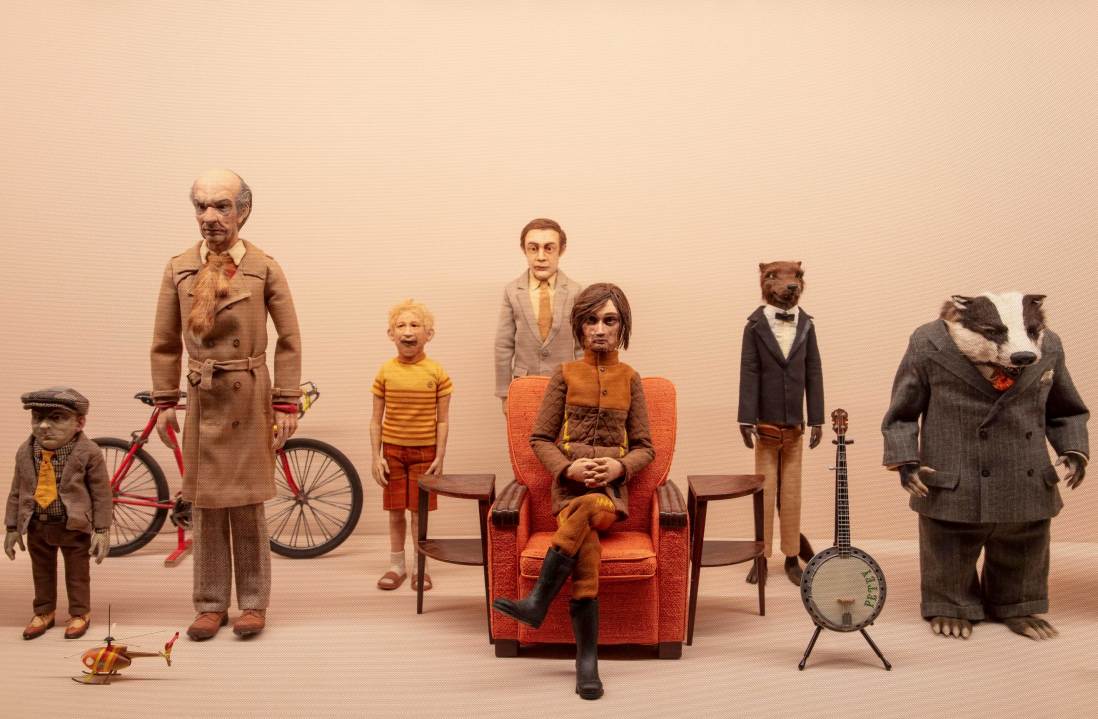
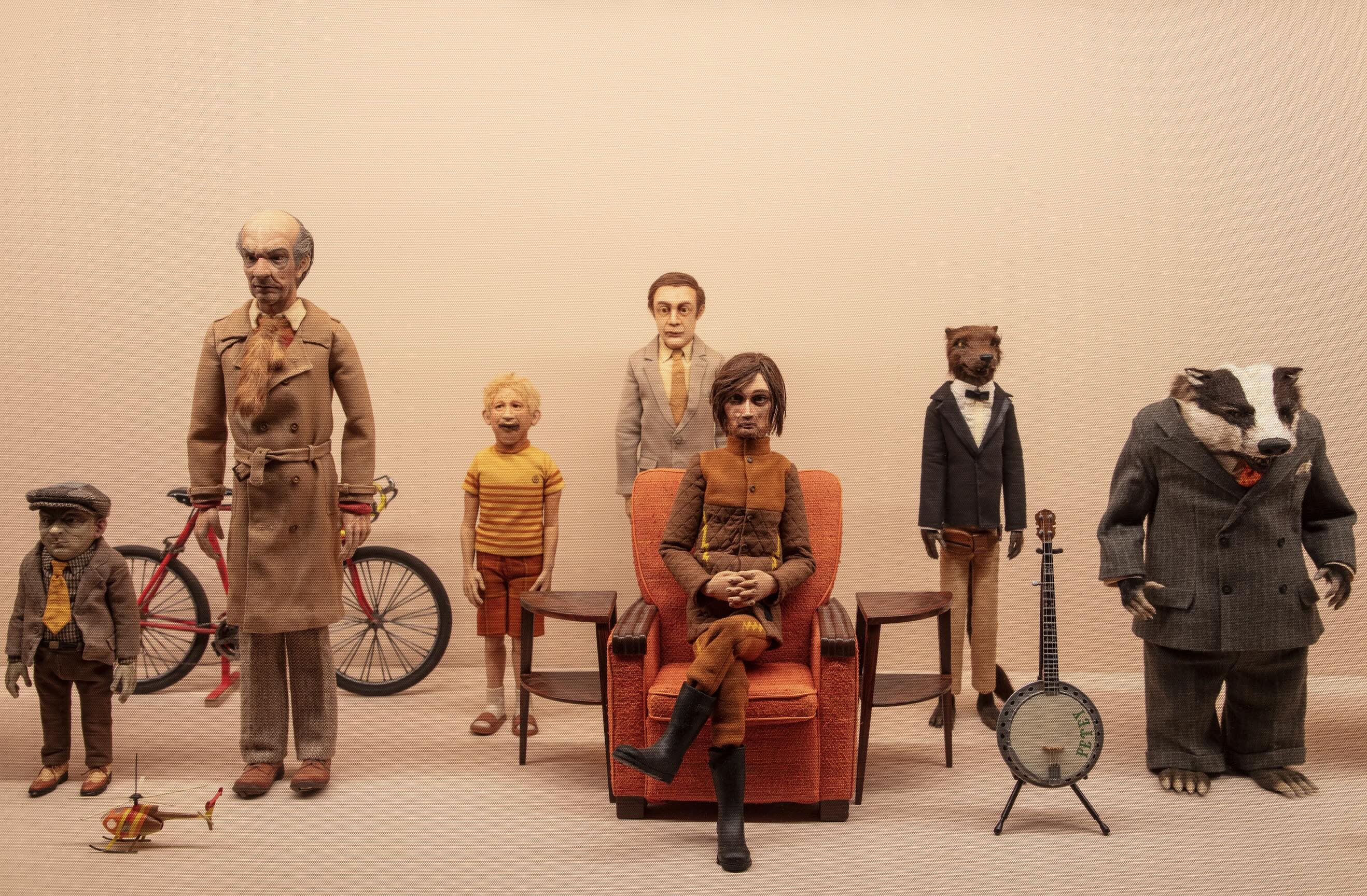
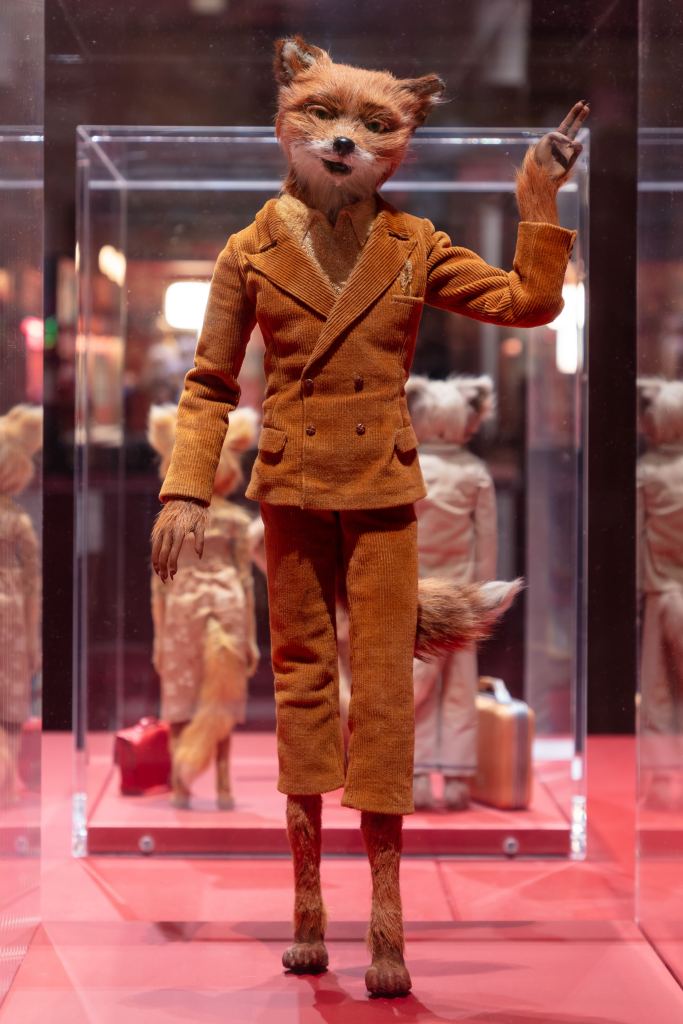
For me, the unexpected stars of the show are the stop-motion puppets, made in Manchester, for Fantastic Mr Fox (2009), based on the Roald Dahl story. They are surprisingly beautiful – more sculptures than puppets, in a way – and astonishingly lifelike: glance at the belligerent-looking badger and you hear Bill Murray; catch sight of Mr Fox and it’s impossible not have a mental voice bubble from George Clooney.
Anderson fans will love all the details, such as the actual letter from Dirk Calloway to Max in Rushmore (if you know the film, you’ll remember it when you see it), or the display of the fictional books written by his films’ many authors (Old Custer by Eli Cash and Dudley’s World by Raleigh St Clair, both in The Royal Tenenbaums). Other highlights include 27 elegantly crafted back-issue covers for the magazine in The French Dispatch (2021), as well as Bill Murray’s Andretti typewriter from that film.
The costumes on the spotlit mannequins are beautifully preserved. Not for nothing was one of Grand Budapest’s four Oscars for costume design. It’s all there: Monsieur Gustave’s brilliant purple concierge tailcoat with the grey waistcoat and trousers that Ralph Fiennes wore; Willem Dafoe’s leather trenchcoat and rings; and Edward Norton’s grey policeman’s uniform, which with its stand-up collar is more Mitteleuropa than a Tintin convention in Prague.
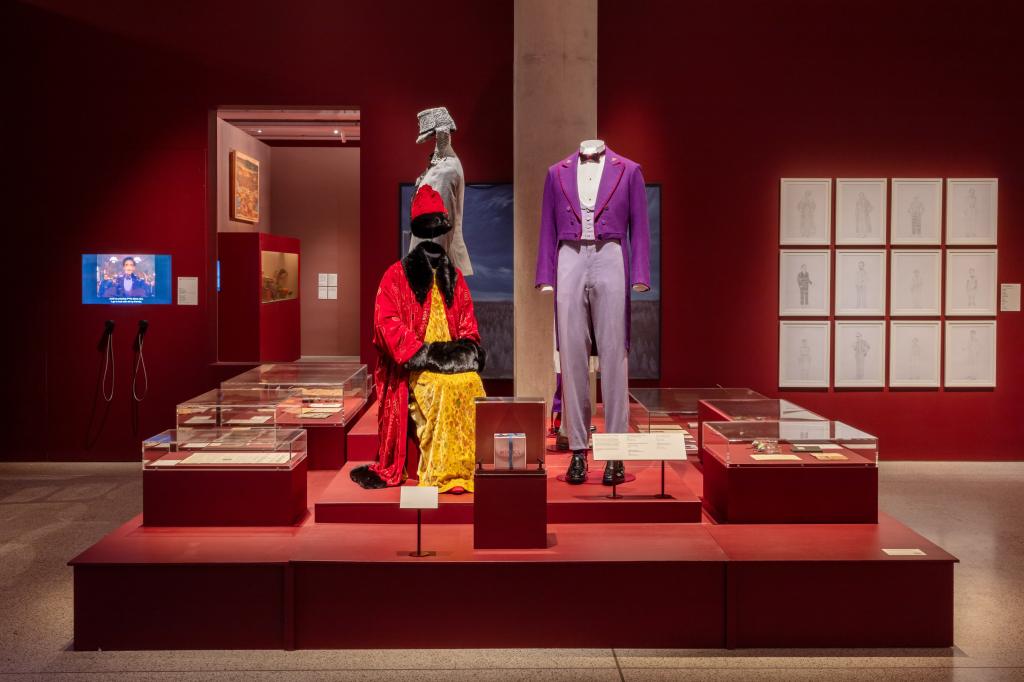
What all this brings home is the unflinching depth and the breadth of creativity underpinning Anderson’s filmmaking, from the smallest detail up. The lengths that have been gone to, and the quality and authenticity of each item, are much greater than you might have imagined and therefore much of the pleasure is in gaining a glimpse of that endeavour, as well as seeing items you recognise in the flesh. You may already have thought that Anderson’s films fetishised design; now you know it’s much more extreme than that. The dense hyper-materialism of the movies is the product of a huge, astonishingly deliberate effort.
With exhibits from his more recent films to bring it all up to date – including items from The Phoenician Scheme, which was out last year, starring Benicio del Toro and Kate Winslet’s daughter Mia Threapleton – the exhibition concludes with four shorts from Anderson’s career, including the original 15-minute 1993 version of Bottle Rocket. There’s also Hotel Chevalier (2007), a two hander between Anderson-regular David Schwartzman and Natalie Portman, which is a prologue, it is said, to The Darjeeling Limited. Set in Paris, where Anglophile Anderson keeps a home, a rather dark story unfolds in the privileged world of monogrammed luggage, hotel gowns and room-service – an elite, very Anderson setting where the world is seen through an ex-patriot, American gaze.
Is it a good exhibition? Absolutely, if you’re a Wes Anderson aficionado. And if you’re not? Well, I could think of no better introduction – aside from watching one of his films, of course. Either way, there are many worse ways to spend £20 in High Street Kensington and, as you can imagine, the exhibition merchandise is on another level.


Comments