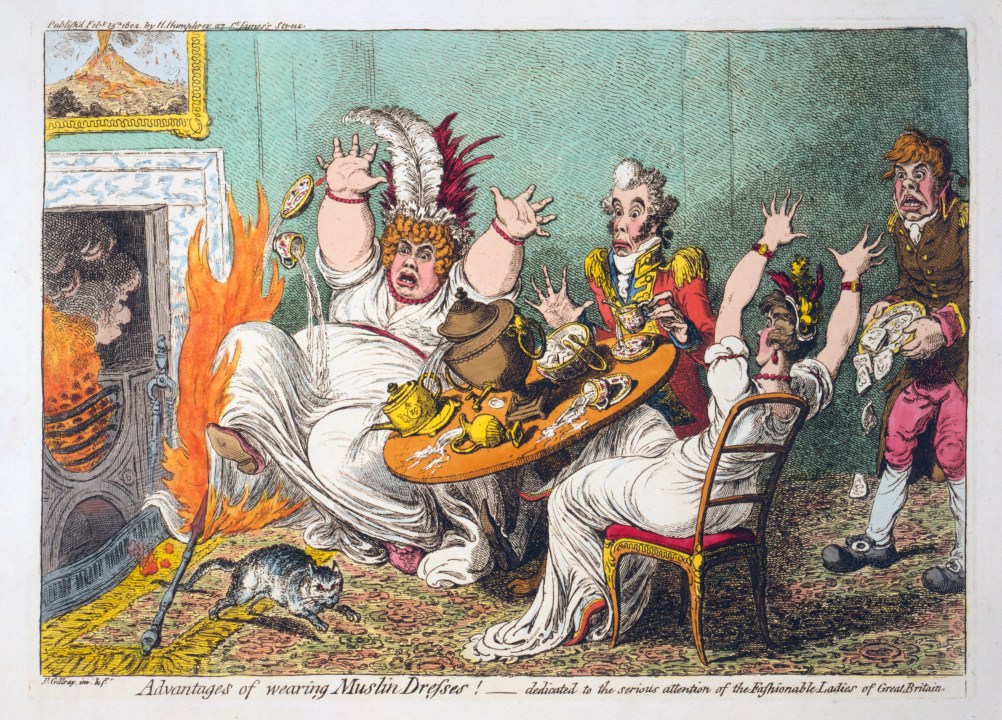
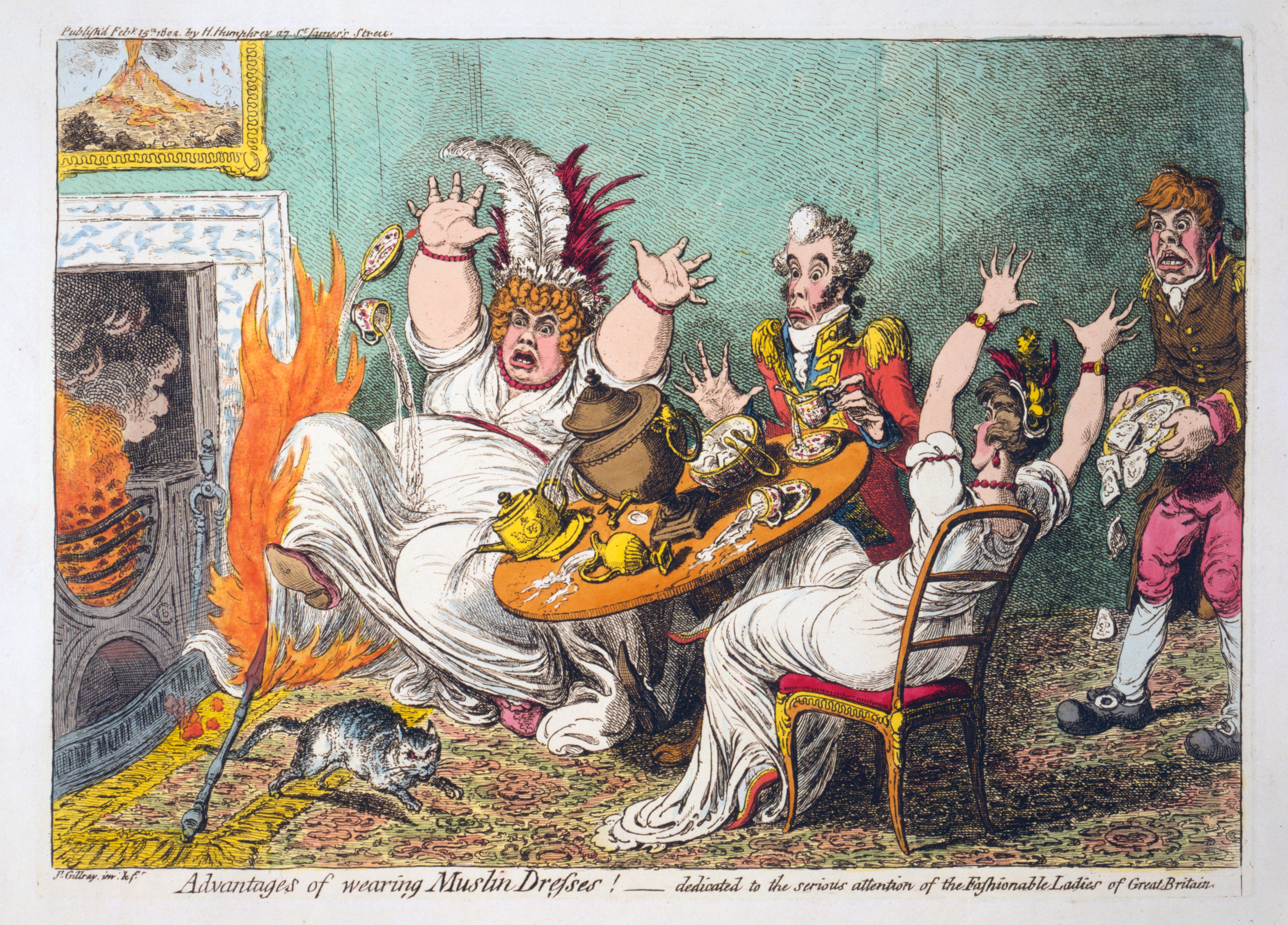
When we think of the Georgians, if we ever do, we think of them in Hogarthian terms: they are squalid, gin-soaked, syphilis-ridden and probably short of a few teeth. They are bewigged zombies without the apocalypse and either dressed in soiled, lice-ridden breeches or lying comatose in some fetid gutter.
Thanks to Bridgerton, we now see them slightly differently: as opulent social climbers who’ll happily strip off their sumptuous corsets and jewels behind the stables before gossiping about their neighbours’ misdemeanours at a ball.
This sort of farcical binary makes one core point: we aren’t nearly grateful enough to the Georgians for what they accomplished. Were it not for the Georgians and their advances in industry, culture and politics, the ‘Great’ Britain of today would be little more than mediocre.
Consider the evidence: first, they gave us the Industrial Revolution. In 1776 James Watt invented a new, more efficient form of steam engine that transformed the technology. Along the way, he gave us the ‘Watt’ and horsepower – and within 20 years his firm, Boulton and Watt in Birmingham, had sold some 500 steam engines to drive the factories of England.
It was thanks to many of these factories – as well as the railways that came hot on their heels, with the first passenger service in 1825 – that we have another reason to be grateful to the Georgians: the defeat of Napoleon in 1815.
Without their industrial heft, we wouldn’t have had the immense wealth to pay for our decades-long military effort – not to mention the £50 million in bungs we gave to the Portuguese, Spanish, Russians, Prussians and Austrians to keep them on their feet. But for the Georgians, Napoleon would certainly have been victorious and – likely as not – Donald Trump would now be speaking French. Or trying to.
As well as seeing off old Boney, the Georgians entrenched the British empire by driving the French out of North America and the Indian subcontinent in the Seven Years War (1756-63). This, of course, is a mixed or contested achievement but – if the French can (and are) still proud of Napoleon – then I don’t see why we can’t be a little bit proud of it. Certainly the empire continues to shape Britain today. The Georgians also found Australia, of course, in 1770 and where would the world be without Bluey, Vegemite or Kylie Minogue?
Rather more fundamentally, the emergence of Britain as world hegemon in the late 1700s allowed us to do something that no other earthly power had done before: abolish slavery. After decades of trying, in 1807 William Wilberforce succeeded in banning the buying and selling of slaves across the global empire. Wilberforce even lived to see the late-Georgians abolish slavery entirely within the empire, dying just a few days after the act was passed in 1833.
This freed hundreds of thousands of enslaved people and changed the world; we were followed by the French in 1848, the Americans in 1865 and the Brazilians in 1888. One can only wonder at how much longer the slave trade and slavery would have persisted if the Georgians hadn’t worked so hard to stamp it all out.
On the domestic front, scores of our beloved institutions – including the British Museum, the Royal Academy of Arts and the National Gallery – were founded by the Georgians. Theirs was the era that spawned the free press of the Times, the Observer and even The Spectator. When it came to literature, their contributions were just as invaluable thanks to Austen, Fielding and Byron; Swift, Shelley and Wordsworth.
But we and the world have still more to thank the Georgians for. It was under their watch that we saw the flowering of Britain’s parliamentary system of government – which, while flawed, remains unrivalled in the world.
First, the Great Reform Act of 1832. You’ll remember, this is the act that abolished 56 rotten boroughs – places where the local landlord or the king could usually command the outcome – and gave seats to the northern towns that had sprung up since Watt and his ilk had given us the industrial revolution. As well as extending the voting franchise (raising it by about 300,000), it showed that parliament was not immutable and that change could happen without chaos following. In this way, 1832 paved the way for the Victorians to continue extending the franchise in 1867 and 1884 before universal manhood suffrage and votes for women were eventually established in 1918.
And then chance played its hand. While George III and Queen Charlotte were highly productive – they had 15 children – their offspring were anything but. And so it was that Victoria, the 18-year-old daughter of their fourth son, became queen in 1837. Because of her age, inexperience and sex and the prevailing prejudices of the day, her accession paved the way for a continued erosion of royal power – one that fitted the rising sense of representative entitlement in the Commons. And with it was birthed our enviable system of constitutional monarchy.
In this sense, as in others, the Victorians were really just the Hanoverians in long trousers: they continued the mission, whether it was extending the electoral franchise or continuing the expansion of the railway network begun under the Georgians, who – for all their periwigs, buckle shoes and lice – were arguably the true modernisers. The Victorians simply institutionalised a lot of their earlier innovations, and where they blazed trails of their own, it was in sanitation – building the Embankment and its sewers, in factory acts and legislation aimed at social improvement.
But the Georgians laid the foundations for much of what the Victorians get the credit for today. Which is wrong. We owe the Georgians a lot: not least the Industrial Revolution, a global hegemony, and the planting of the seeds of democracy. They are our forgotten giants. Their main mistake, of course, was to lose the American colonies but, looking back on it now, perhaps that wasn’t such a bad thing.




Comments