In March, just before Artemis II rounded the far side of the Moon, the Transport Secretary had her own lunar encounter. Heidi Alexander claims that a ‘moon crater’-sized pothole forced her Mini off the road in Oxfordshire. She is far from alone. Pothole casualties in Britain rose from 270 in 2020 to 393 in 2024, including six dead. An RAC Europe survey found that 62 per cent of British drivers thought European roads are better maintained.
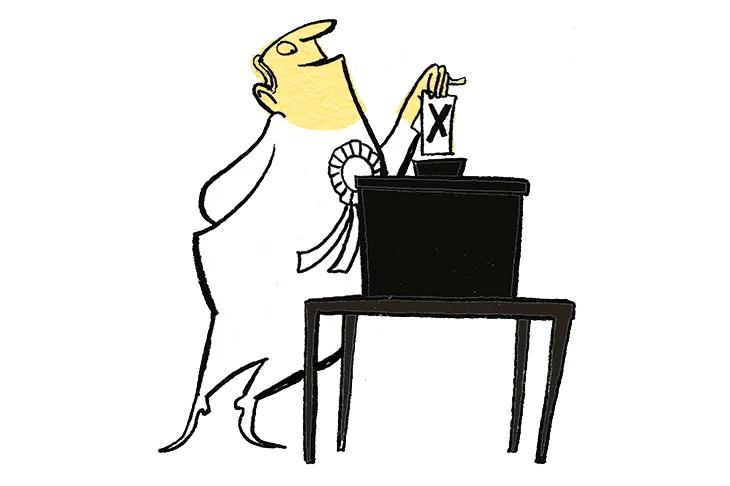
Britain’s pothole problem is a story of government dysfunction. Local authorities seem unable to perform their basic duties; meanwhile, council tax continues to rise, bin collection becomes more infrequent and public spaces continue to deteriorate. Next Thursday’s local and regional elections are supposed to give voters the opportunity to change that story.
Voters have become disillusioned by the fact that no party can meaningfully improve its areas
Reform UK is predicted to be the winner in those elections, yet they have spent much of the campaign focusing on national issues, rather than on the performance of devolved governments and councils. Their slogan this year is decidedly Westminster-focused: ‘Vote Reform. Get Starmer Out’. Why Nigel Farage wishes to assist Angela Rayner, Ed Miliband or any other No. 10 aspirant is unclear. But the fact he has chosen not to run on his party’s record is hardly surprising.
Reform now runs 12 councils and promised to roll out an Elon Musk-style Doge programme: rooting out woke waste, sacking underperforming officials and cutting council tax. Yet in each council, tax is rising, with Worcestershire hiking theirs by 9 per cent. Despite some successes in scrapping climate targets and raising county flags, the promised bonfire of diversity initiatives and removal of useless officers have proved elusive. Meanwhile, Reform councillors have quickly descended into a game of infighting and defections. For those voters hoping to end uni-party incompetence, it is a disappointing spectacle.
Part of the problem for any councillor is the straitjacket of statutory obligations. According to the Taxpayers’ Alliance, adult social care and children’s services accounted for nearly half of local authority spending last year – a 57 per cent increase from 2015-16. That spending will only increase given Britain has an ageing population and a rapidly growing demand for special educational needs provision. Each year, budgets are squeezed so that less is left over for fixing particular local problems. Since 2010, the amount spent on local services excluding those statutory obligations fell by 38 per cent per person.
With councils so constrained, the urge to turn local elections into referendums on Westminster becomes greater. Voters have become disillusioned by the fact that no party can meaningfully improve its areas. Turnout remains low, with roughly half as many votes cast as in a general election. Reform is far from the only party pointing elsewhere; as Andrew Gilligan writes in his article, Green candidates would rather play the sectarian card than bother about bin collections.
If you want to know where this impotent blame-shifting ends, look no further than Scotland and Wales. Should the SNP retain power in Scotland, as polls predict it will, then Scots will soon have endured two decades under nationalist rule. In that time, drug-related deaths have doubled while Scottish schools have tumbled down any rankings ministers choose to look at, all with public spending 18.5 per cent higher per head than in England.
The elections in Wales, meanwhile, may usher in the end of a century of Labour dominance. Labour is predicted to lose its 27-year rule over the Senedd to either Plaid Cymru or Reform. Who-ever wins, what’s clear is that devolution has been an unmitigated disaster for the country. Wales has the worst educational outcomes and NHS waiting times in Britain. Neither Plaid Cymru nor Reform can do much to change that fact. Should the former win, it would mean swapping one set of left-wing nationalists for another, while the latter promises the same tax cuts and waste-trimming that have proved so unsuccessful in England.
But these elections do still matter; control of both councils and our devolved administrations should be decided on merit. In England, Tory-run councils consistently deliver more efficient services with more modest council tax rises. In 2023-24, Conservative councils repaired five times as much road as Labour ones. The Conservative slogan during this campaign – ‘Lower Taxes, Better Services’ – is just as clear as Reform’s, but has the benefit of reflecting what these elections are about.
The Conservatives are not promising the Moon on a stick, but the diligent performance of local duties for the lowest possible cost. These elections are not about filling the vacuum in No. 10 but repairing the fabric of our communities. The Conservatives may still need to prove that they are able to govern nationally once again. But Kemi Badenoch deserves credit for focusing on what is actually achievable in these elections.




Comments