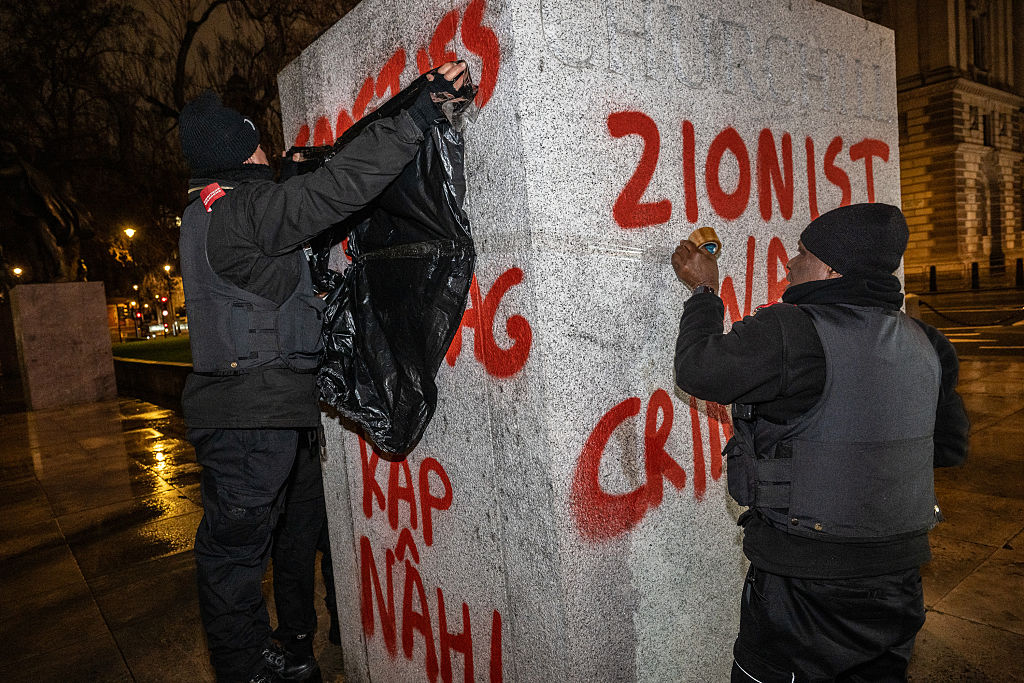
There’s a case for arguing that this has been the worst year for Jews in Britain since Edward I ordered their expulsion in 1290. This sense of growing peril explains why the Prime Minister has summoned police chiefs, civil society organisations and politicians to a ‘Forum on tackling anti-Semitism’ first thing tomorrow at No. 10 Downing Street.
But how far will this summit actually be willing to go in tackling the really difficult questions here – notwithstanding the government’s pride in its new strategy for counter-extremism and strengthening social cohesion that was produced in March? The current government proclaims loudly its opposition to anti-Semitism. But ministers – and key agencies – are now saying surprisingly little about which ideology is actually responsible for the upsurge in one of the oldest forms of hatred.
So which ideology is actually powering this upsurge in violence in the UK today? Hardline Scientology?
Thus, references to Islamism are rare – and, if last week is anything to go by, they appear to be on a downward trajectory.
To address any problem, it must be named. In Golders Green, ministers and senior police officers were explicit that it was British Jews who were under attack and that it was an act of anti-Semitic terrorism which had occurred.
So which ideology is actually powering this upsurge in violence in the UK today? Hardline Scientology? Buddhism? Or Zoroastrianism – of the kind which the late Freddie Mercury grew up in?
Speaking in Golders Green, Metropolitan Police Commissioner Sir Mark Rowley stated: ‘Anti-Semitism is fuelled by hateful and extremist ideologies. It comes from hostile states, the extreme right and the extreme left. These are terrorist and hateful belief systems but they are all rooted in racism. They are given space to operate when civic debate is weak, when hatred is excused and when people are unwilling to challenge it directly’.
Again – which ‘hateful and extremist ideologies’? And how is ‘racism’ the sole driver of the oldest hatred in history, which also has its roots in religion, myth and conspiracy theory?
Standing next to the Commissioner in Golders Green was Sarah Sackman, MP for Finchley and Golders Green, and Minister of State for Courts and Legal Services – and a highly articulate rising star in the Labour party.
But Sackman, too, seems to have an almost maiden-aunt aversion to letting horrid words such as Islamist, Jihadist or Islamism pass her lips. In a Guardian column, Sackman evoked Anne Frank and a united community response to the English Defence League in 2013.
Again, she told us precisely nothing about which ideology is responsible for the current wave of violence against her own constituents. Rightly, she has expressed frustration that wide swathes of the left are failing to speak up against anti-Semitism, while herself saying nothing about Islamist anti-Semitism. Perhaps she should lead by example?
Correctly, Sackman further laments that there is little in the way of a civil society campaign against anti-Semitism. But why is this pushback absent? Because of fear of offending Islamists and their allies. All of which she doesn’t challenge, call out and confront. So there continues to be no civil society campaign. The problem is thus self-reinforcing.
All this points to wider inconsistencies across government. Consider the Commons statement by Security Minister Dan Jarvis MP on anti-Semitic attacks that made six references to Iran – but avoided any reference to the motivating ideology of the Khomeinite strand of Islamism.
Sticking to the general, in one answer Jarvis spoke of the ‘the threats we face from extremists’, once more without telling us what type of extremists.
Sometimes the term Islamism does appear, but is conjoined with other threats as if it were improper for it to stand exposed to public scrutiny all alone.
Thus, when Home Secretary Shabana Mahmood announced the Joint Terrorism Analysis Centre (JTAC) was raising the terrorism threat level to severe, she observed: ‘The terrorist threat level in the UK has been rising for some time, driven by an increase in the broader Islamist and extreme right-wing terrorist threat from individuals and small groups based in the UK.’
Can the Home Office show us its sums here? While it would be wrong to dismiss the far-right threat, it is unclear if it merits reference in the same context as the present wave of Islamist violence. After all, when noting the far-right threat, MI5’s website observed on 1 May ‘Islamist terrorism remains the primary threat to the UK.’
Part of the backdrop to this confusion is the police’s history of engagement with Islamist groups as part of a search for ‘credible’ Muslim community partners. This approach goes back over two decades – to when Bob Lambert headed the Metropolitan Police’s Muslim Contact Unit.
According to advocates of this way of doing business, political Islamists who opposed the likes of al Qaeda in the UK were held to be bulwarks against Jihadist violence – regardless of the type of society such activists sought to create in the longer term and (as is now becoming tragically relevant) their attitudes to Jews.
Such political Islamists were too often regarded as ‘credible’ partners by the police despite their anti-Semitism and support for suicide attacks in Israel; witness the Metropolitan Police’s backing for the visit of the late Yusuf al-Qaradawi’s visit to the UK in 2004.
Such policing strategies are nowadays less visible; they have been recalibrated and remain very much in place in regional counter-terrorism units across the country. So who exactly are the police engaging with as its community partners today? What advice are the police receiving about the state of anti-Semitism in Muslim communities from their own Muslim staff associations inside constabularies across the country?
When was the last time a nationwide audit was conducted of all this, in the context of the present pandemic of anti-Semitism? The Home Secretary should employ her powers for an inspection under section 54(2B) of the Police Act 1996 for this to be one of the first major tasks for the recently appointed interim Chief Inspector of Constabulary.
During the wave of pro-Palestinian protests immediately after 7/10, the authorities initially concluded that Hizb ut-Tahrir’s chant of ‘Jihad’ meant only inner spiritual Jihad, not violent armed struggle. Much later, after it had emerged that the Met had taken the (flawed) advice of the Crown Prosecution Service, did a senior officer publicly concede to Policy Exchange that they had got it wrong.
Indeed, is there any curiosity at the top of the CPS on why so few cases of anti-Semitism get to court, compared to cases of anti-Muslim hatred? Why doesn’t the Attorney General ask the DPP to explain the reasons for this disparity?
Where now? After the Manchester Arena massacre of 2017, Theresa May spoke of the need for ‘difficult conversations’ about radical Islam. They never really occurred then. So before tomorrow’s ‘Forum on tackling anti-Semitism’ is underway, it seems appropriate to ask once again: when are the difficult conversations finally going to start? The early signs aren’t promising.





Comments