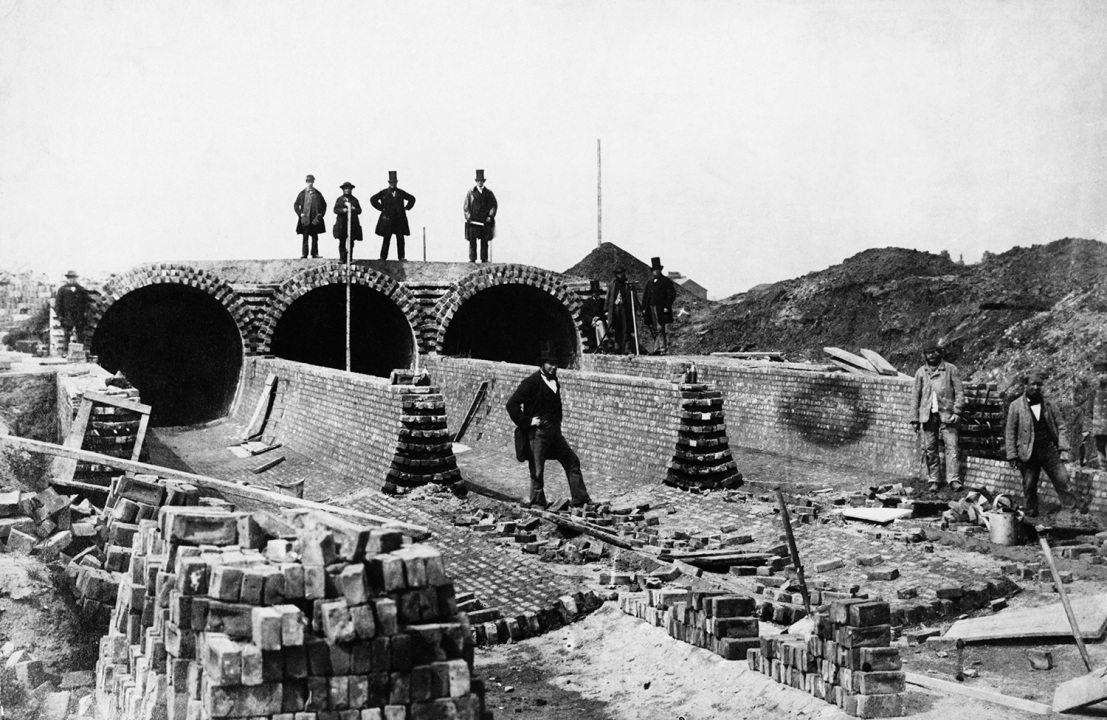
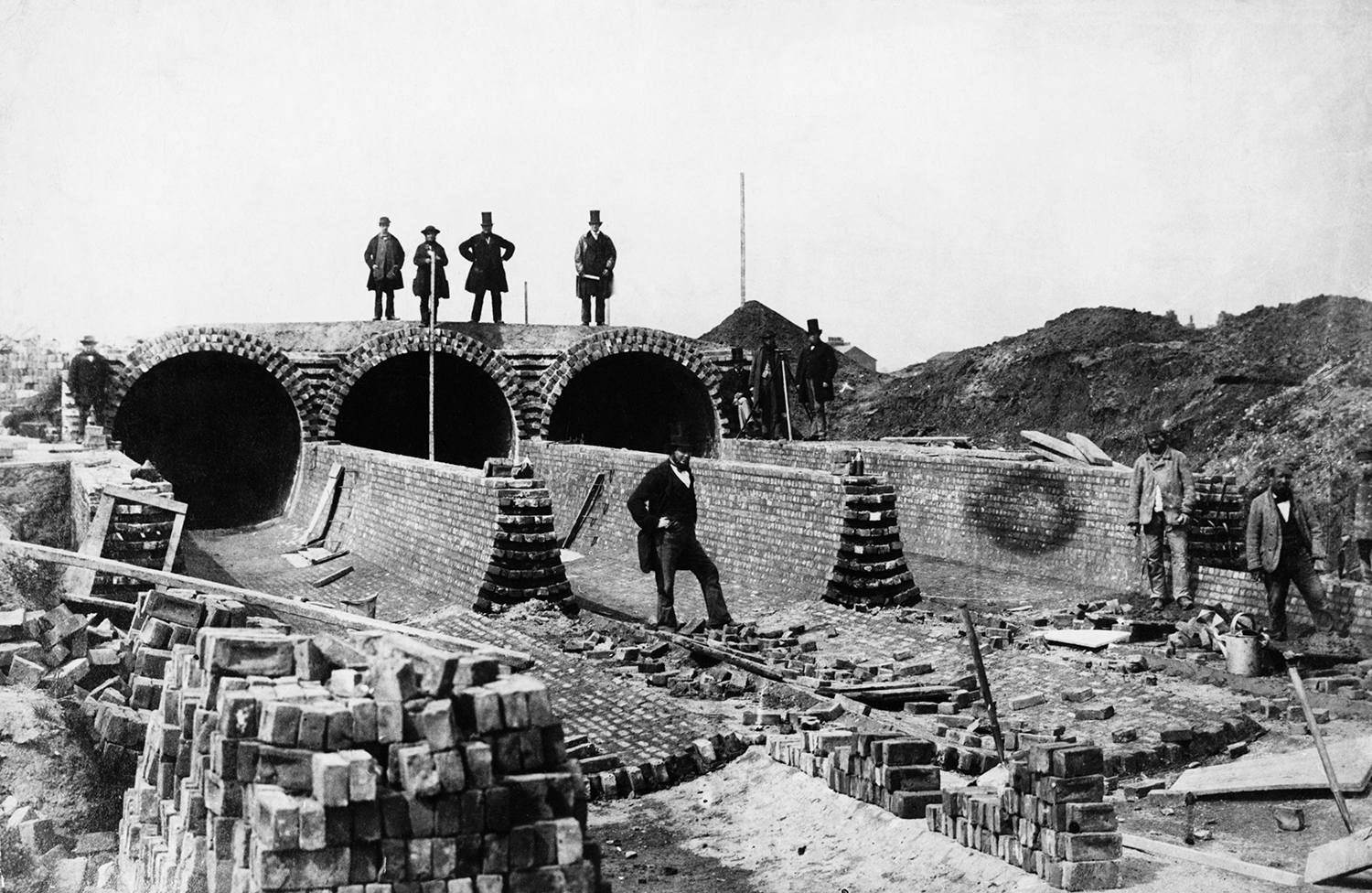
Perhaps the greatest honour ever paid to Queen Victoria was to have a sewage-pumping engine named after her. Both she and Albert – and the future Edward VII, plus Alexandra – had the delight of becoming bywords for the mighty machines constructed by Joseph Bazalgette to lift waste from the depths of his (literally) ground-breaking London sewer system.
Listening to Thames Unfiltered, a new six-part podcast from the Evening Standard, I was amused to learn that the trend now favours the Greek gods. Among the eight barges constructed to serve the Tideway Tunnel sewer, completed last year, are a Zeus, a Poseidon, an Apollo, a Phoebe and, er, a Churchill. What else to give those who have everything?

Bazalgette was only 29 when he was appointed assistant surveyor to the Metropolitan Commission of Sewers. But he wasn’t entrusted with solving London’s sewage problem until the outbreak of the Great Stink a decade later in 1858. An unusually hot summer had exacerbated the already odious smells, which Charles Dickens described as ‘of a most head-and-stomach-distending nature’. Vast quantities of lime were poured into the river and over-curtains hung at the Houses of Parliament in a vain attempt to neutralise the stench.
The podcast’s presenter, business journalist and author Lucy Tobin, asks whether the Thames is returning to the same state. Certainly not, says a seventh-generation waterman: the demolition of riverside factories has made a big difference, and one doesn’t necessarily have to have one’s stomach pumped these days after falling in. But it’s a low bar.
Curiously, the podcast is co-hosted by Thames Water, a fact that raises the eyebrows of more than one contributor. The company is currently facing debts of £20 billion. Is this the best use of its resources? The candour of its spokesmen, at least, is to its credit. Yes, we discharge sewage into the river, says one, but as little as we can at times of heavy rainfall – and we’ll tell you all about it.
At one point in the series, Tobin logs in to Thames Water’s near-real-time map and finds that there’s been a discharge into Winterbourne Stream between 3 a.m. and 5.15 p.m. – that’s a 14-hour dump. The main things I took away from the podcast are that Thames Water isn’t the only company doing this; it’s trying to do it less; the health of the river varies throughout its length; and the Tideway Tunnel has prevented 8,000-Olympic swimming pools’ worth of filth from being emptied into the water. For many, nevertheless, the tunnel is little more than a sticking-plaster.
Tobin says ‘poo’ a lot; one almost admires the relish with which she pronounces it each time. This may prove too much for some, but if you don’t mind the ickiness, the episodes on Bazalgette’s engineering are particularly good. As Tobin visits his Abbey Mills (‘Poo Palace’) and compares it to a church, you may well find yourself wondering, for the first time in your life, whether sewers may be closer to Heaven than Hell.
The Revd Canon Dr Giles Fraser is concerned about real churches in his three-part series for Radio 4. ‘It feels like my life’s work being flushed away,’ laments the Church of England priest,who has been charting diminishing congregations for years on a spreadsheet. Although numbers at his parish of St Anne’s in Kew have been steadily growing, and notwithstanding the much-discussed uptick in attendance among 18- to 24-year-olds, the national trend has been following a downward trajectory for some time.
You may well find yourself wondering whether sewers may be closer to Heaven than Hell
The questions posed by Philip Larkin in ‘Church Going’, the poem that lends its name to this series, are as pertinent now as they were in 1954. ‘When churches fall completely out of use,’ asked Larkin, ‘what shall we turn them into?’ Sir Simon Jenkins suggests that they should be handed back to the community if empty. ‘Give them to the local council?’ asks Fraser, whose heart sinks at the prospect of a church becoming a ‘bijou residence’ – ‘They can’t fix holes in the road!’
It isn’t all doom and gloom. Fraser – an affable host – has conversations with people about the growth of pentecostal churches and the ‘full-fat’ Gospel’, and about ‘church planting’, which roughly translates as starting new churches or finding ways to reach people from existing ones. There are also efforts to understand the historical preconditions of the decline.
The Revd Canon Professor William Whyte, of Oxford, describes the over-building of the 19th century, when representatives of different denominations competed to build more and bigger churches. The result was that many places ended up with four or five places of worship. That many of these churches would have been half-empty even to begin with is certainly food for thought.





Comments